AI Customer Service Software: What It Is + How It Works
What Is an AI Customer Service Software?
AI customer service software is a customer support platform that uses artificial intelligence—including chatbots, AI agents, automation, and analytics—to manage customer interactions across multiple channels and assist human agents at scale. These platforms combine automated responses for routine inquiries, real-time agent assistance, intelligent ticket routing, and data analytics to help businesses handle growing support volumes efficiently while maintaining consistent service quality.
- What Is an AI Customer Service Software?
- Why AI Is Reshaping Customer Service Software
- What Is AI Customer Service Software?
- How AI Is Used in Customer Service Software
- Core Features Found in AI Customer Service Software
- Common Use Cases for AI Customer Service Software
- Types of AI Tools Used in Customer Service Software
- Benefits of AI Customer Service Software for Businesses
- Why Process Design Matters in AI Customer Service
- How AI Customer Service Software and Human Agents Work Together
- How to Choose the Right AI Customer Service Software
- AI Customer Service Software for Different Business Sizes
- Conclusion
Customer service has never been more challenging—or more important. Support teams face mounting pressure from every direction: rising ticket volumes as businesses grow, customers expecting instant responses across multiple channels, agents struggling with burnout from repetitive work, and leadership demanding better service without proportionally larger budgets. Traditional customer service platforms help manage these demands, but they often struggle when volume and complexity exceed what manual processes can handle effectively.
This is where artificial intelligence enters the picture. AI customer service software represents a new category of support platforms that use artificial intelligence to help businesses handle growing volumes more efficiently while maintaining quality. These systems combine automation for routine tasks, AI-powered assistance for agents handling complex issues, and intelligent routing that ensures customers reach the right help at the right time.
The goal isn’t replacing human support teams—it’s making them more effective. AI handles the repetitive work that drains time and energy, allowing people to focus on conversations requiring empathy, judgment, and creative problem-solving. When implemented thoughtfully, AI customer service software transforms support operations from constantly reactive firefighting into proactive, scalable service delivery.
This guide explains what AI customer service software actually is, how it works behind the scenes, the features and capabilities businesses rely on most, common use cases across industries, and what to consider when evaluating different solutions. Whether you’re exploring AI for the first time or looking to improve existing implementations, understanding these fundamentals helps you make informed decisions about modernizing customer service operations.
Why AI Is Reshaping Customer Service Software
The pressure on customer service teams has reached unprecedented levels. As businesses grow and digital channels multiply, support volumes continue rising while customers expect faster, more accurate responses whether they contact you via chat, email, social media, or voice. Expectations have shifted from “respond within 24 hours” to “respond within minutes,” and from “available during business hours” to “available whenever I need help.”
Meanwhile, support organizations face their own internal challenges. Agent burnout increases as people handle back-to-back interactions without breaks, answering the same questions repeatedly while trying to maintain enthusiasm and empathy. Long onboarding cycles mean new agents take months to become productive, during which they’re paid but contributing limited value. The challenge of scaling operations without compromising service quality or consistency seems impossible when every additional agent requires recruiting, training, equipment, and management overhead.
Traditional customer service software helps manage tickets, track interactions, and organize work, but it doesn’t fundamentally change the economics of support. Each additional customer interaction still requires roughly the same amount of human time and attention. When volume doubles, you need to roughly double your team—an unsustainable model for growing businesses.
This is where artificial intelligence begins playing a practical role. Rather than replacing support teams, AI helps organizations manage scale by automating repetitive interactions that don’t require human judgment, assisting agents in real time during complex conversations, and delivering more consistent responses across channels through standardized processes. The technology has matured to where it handles routine work reliably while recognizing when human intervention becomes necessary.
AI customer service software has emerged as platforms designed specifically to address these modern support challenges. These systems combine automation for handling predictable interactions, AI-powered assistance that makes agents more effective, and intelligent escalation that ensures customers reach human help when they need it. Understanding how these capabilities work together reveals why AI is fundamentally reshaping how customer service operations function at scale.
What Is AI Customer Service Software?
AI customer service software is a customer support platform that uses artificial intelligence—including chatbots, AI agents, automation, and analytics—to manage customer interactions across multiple channels and assist human agents at scale. Unlike consulting services that advise on support strategy or individual support roles within teams, this is software specifically designed to streamline and enhance the customer support process through intelligent automation and assistance.
These platforms enable businesses to respond faster to customer inquiries, reduce errors through consistent processes, and maintain service quality even as volumes grow. The “AI” component refers to technologies that can understand natural language, learn from patterns, make decisions based on rules and data, and adapt responses to different situations without requiring explicit programming for every possible scenario.
AI customer service software typically combines several capabilities working together. Chatbots and AI agents interact directly with customers, answering common questions and guiding people through routine processes. Automation handles background tasks like ticket creation, routing, and status updates without human intervention. Analytics examine support data to identify trends, measure performance, and highlight improvement opportunities. Agent assistance tools provide real-time suggestions and information to human support staff during conversations.
The channels supported by these platforms reflect how customers actually communicate with businesses today: live chat interfaces embedded on websites, email responses that maintain conversation context, voice calls through call center systems, and social media messaging across platforms like Facebook, Twitter, and Instagram. Regardless of channel, the software analyzes incoming requests, provides immediate answers for straightforward questions, and escalates more complex issues to human agents with full context when needed.
Essentially, AI customer service software serves dual roles. For routine interactions, it acts as frontline support that resolves issues independently. For complex situations, it functions as an intelligent assistant to human agents, providing information, suggesting responses, and handling administrative work so agents focus on problem-solving. This combination creates faster, more accurate, and more scalable customer interactions than either pure automation or pure human support could achieve alone.

How AI Is Used in Customer Service Software
AI customer service software applies artificial intelligence across multiple aspects of support operations, each addressing specific challenges that traditional approaches struggle to solve at scale.
AI for Automated Customer Interactions
The most visible application of AI involves automating direct customer interactions through chatbots and AI agents. These systems respond instantly to common inquiries—frequently asked questions, routine service requests, basic troubleshooting—without requiring human involvement. When someone asks “What are your business hours?” or “How do I reset my password?” the AI provides immediate, accurate answers drawn from your knowledge base.
This automation reduces response times from minutes or hours to seconds, significantly improving customer satisfaction for straightforward requests. It also lightens workload for human agents by deflecting predictable questions that don’t require expertise or judgment. The consistency matters too—AI provides the same accurate information every time, eliminating variation that occurs when different agents interpret policies differently or when fatigue affects human responses.
Modern AI chatbots go beyond simple keyword matching to understand intent and context. They recognize that “I can’t log in,” “my password doesn’t work,” and “having trouble accessing my account” all describe the same underlying issue requiring password reset assistance. This natural language understanding allows conversational interactions that feel more helpful than rigid, script-based systems.
AI for Agent Assistance
AI also supports human agents by providing real-time guidance during conversations. This takes several forms, all designed to make agents more effective without removing the human element that complex situations require.
Suggested replies appear based on conversation context, offering agents pre-written responses they can send immediately or customize before sending. This accelerates response time while maintaining consistency in how common questions get answered. Knowledge base integration automatically surfaces relevant articles, troubleshooting guides, and policy documents based on what customers are asking about, eliminating the time agents spend searching for information.
Next-best-action recommendations use conversation history and customer data to suggest what agents should do—offer a refund, escalate to technical support, schedule a callback. These AI-powered suggestions help less experienced agents make decisions that align with company policies and best practices without constantly asking supervisors for guidance.
By assisting agents this way, AI helps reduce errors that occur when agents can’t find information quickly or misremember procedures. It accelerates response times since agents don’t pause to search systems or consult documentation. Most importantly, it improves service quality without removing the human judgment, empathy, and creative problem-solving that genuinely complex situations require.
AI for Routing and Escalation
AI plays a critical role in ensuring customer inquiries reach the right destination efficiently. Through intent detection and ticket categorization, the software automatically analyzes incoming requests and directs them appropriately based on what customers need and who’s best positioned to help.
Simple questions route to AI agents for immediate resolution. Technical issues go to support queues with appropriate expertise. Billing questions reach finance specialists. High-priority customers or urgent situations get flagged for immediate attention. This intelligent routing eliminates the manual triage that traditionally consumed significant time while reducing the misrouting that forces customers to explain situations multiple times.
When escalation to human agents becomes necessary, AI ensures smooth handoffs by providing complete context. The human agent sees the entire conversation history, what the AI already attempted, what information was gathered, and why escalation occurred. This context prevents customers from repeating themselves and allows agents to continue from where the AI concluded rather than starting over.
The escalation logic itself represents important AI decision-making. The system recognizes patterns indicating human help is needed—customer frustration evident in language, complexity exceeding the AI’s capabilities, or explicit requests for human assistance. These triggers ensure customers reach people when situations warrant it while still deflecting routine interactions that AI handles effectively.
AI for Analytics and Insights
Beyond direct customer interactions, AI analyzes support data to generate actionable insights that improve operations over time. Sentiment analysis evaluates customer emotions during conversations, identifying satisfaction, frustration, confusion, or anger. This emotional intelligence helps prioritize cases where customers are upset and need immediate attention, while also revealing patterns about which issues consistently frustrate people.
Trend detection highlights recurring problems by analyzing ticket volume, common keywords, and issue categories. When hundreds of customers suddenly report the same problem, AI surfaces this pattern immediately rather than waiting for humans to notice something’s wrong. This early detection enables faster response to bugs, outages, or confusing product changes.
Performance analytics monitor both AI effectiveness and human agent metrics. Which types of questions does the AI resolve successfully versus where does it struggle? Which agents excel at first-call resolution? Where do conversations take longer than expected? These insights inform continuous improvement—refining AI responses, updating knowledge bases, and providing targeted coaching.
Together, these AI capabilities create more scalable, responsive, and data-driven approaches to customer service. Organizations can meet growing customer expectations while maintaining high-quality support, using AI to multiply the effectiveness of existing teams rather than requiring proportional headcount increases.
Core Features Found in AI Customer Service Software
AI customer service software has evolved to include a set of foundational features that modern support operations depend on. Understanding these capabilities helps evaluate different platforms and anticipate how AI can enhance your specific operations.
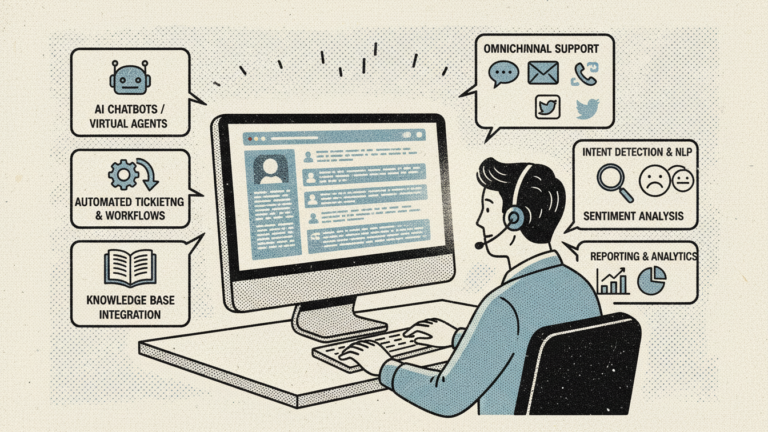
AI Chatbots and AI Agents serve as virtual assistants that interact with customers in real time across channels. They handle routine questions like business hours, account status, and basic troubleshooting while providing consistent responses that align with your brand voice. Modern AI agents go beyond simple scripts to understand natural language, maintain conversation context, and adapt to different customer needs. They’re available 24/7, respond instantly, and never experience the fatigue or frustration that affects human agents during repetitive interactions.
Automated Ticketing and Workflows eliminate manual administrative work by automatically generating support tickets from customer interactions and routing them through predefined processes. When an email arrives, a chat conversation starts, or a social media message appears, the system creates appropriate tickets, assigns them based on rules you define, tracks progress through resolution, and updates status automatically. This automation ensures nothing falls through cracks while freeing agents from data entry and administrative tasks.
Knowledge Base Integration connects AI systems to your documentation repositories, troubleshooting guides, policy documents, and FAQ content. This integration allows AI agents to retrieve accurate, current information when answering questions rather than working from static, potentially outdated responses. It also helps human agents quickly find relevant articles during conversations without interrupting flow to search manually. The knowledge base becomes the single source of truth that both AI and humans reference, ensuring consistency.
Omnichannel Support enables interactions across live chat on websites, email correspondence, voice calls through contact centers, and social media messaging platforms while maintaining consistent context and quality. Customers can start conversations on one channel and continue on another without repeating information. Agents see complete interaction histories regardless of channel, and messaging remains consistent whether customers reach you via chat, email, or Twitter. This unified approach eliminates the silos that plague support operations using disconnected channel-specific tools.
Intent Detection and Natural Language Processing allow AI to understand what customers actually mean rather than just matching keywords. The system recognizes that “can’t access my account,” “login not working,” and “forgot my password” all express the same intent requiring password reset assistance. This understanding enables conversational interactions where customers describe problems naturally rather than following rigid scripts or selecting from predefined options.
Sentiment Analysis evaluates customer tone and emotion during interactions by analyzing word choice, punctuation, capitalization, and other signals of satisfaction or frustration. This emotional intelligence helps identify customers who are upset and need immediate attention, flags conversations that might escalate if not handled carefully, and provides insights into which issues consistently create negative experiences. Agents can adjust their approach when sentiment indicates frustration, and management can prioritize improvements for issues generating the most dissatisfaction.
Human Handoff and Escalation ensures smooth transitions when AI determines human assistance is necessary. The system recognizes situations exceeding its capabilities—complex problems, customer frustration, explicit requests for human help—and escalates appropriately. Critically, it provides complete context to human agents including conversation history, information gathered, troubleshooting already attempted, and why escalation occurred. This context prevents customers from explaining situations repeatedly and allows agents to continue efficiently from where AI left off.
Reporting and Analytics track performance metrics across both AI and human support activities. Standard reports show ticket volumes, resolution times, customer satisfaction scores, and first-contact resolution rates. Advanced analytics reveal trends in issue types, identify knowledge gaps where documentation needs improvement, measure AI effectiveness at handling different question categories, and highlight agent coaching opportunities. These insights drive continuous improvement in both automated and human-delivered support.
These features represent table-stakes capabilities that businesses expect from modern AI customer service software. Together, they allow organizations to scale support operations efficiently, maintain consistent high-quality interactions, and deliver faster responses across all customer touchpoints without relying solely on human agent capacity.
Common Use Cases for AI Customer Service Software
Understanding how businesses actually use AI customer service software reveals the practical benefits and helps identify opportunities within your own operations.
Handling high-volume support queries represents perhaps the most impactful use case. Many support operations receive thousands of routine questions daily—simple inquiries that follow predictable patterns and have straightforward answers. AI manages these volumes efficiently, providing instant responses even during peak periods when human agents would be overwhelmed. This ensures customers receive help immediately rather than waiting in queues, while freeing human agents to focus on cases requiring judgment, empathy, or specialized knowledge.
The economics are compelling: an AI agent can handle dozens of conversations simultaneously, responding to each within seconds. Even with substantial initial investment, the per-interaction cost drops dramatically compared to human agents who handle conversations sequentially and require time to search for information, document interactions, and transition between customers.
Order status and account questions consume significant support resources despite being straightforward to answer. Customers want to know where their orders are, when they’ll arrive, what charges appeared on accounts, or what their subscription status is. AI agents can access order management systems, retrieve current information, and provide accurate updates instantly without human involvement. The customer gets immediate satisfaction, and agents avoid the boring repetition of checking systems and reading status information.
Troubleshooting common issues follows predictable diagnostic paths that AI can guide effectively. When customers report technical problems, connection issues, or product malfunctions, AI asks systematic questions that narrow down causes—”Is this affecting one device or all devices?” “When did you first notice this problem?” “Have you restarted recently?” Based on responses, it provides appropriate troubleshooting steps: resetting passwords, checking settings, updating software, or verifying connections.
For problems the AI resolves through guided troubleshooting, resolution happens in minutes without agent involvement. When issues prove more complex, escalation to human agents includes complete context about troubleshooting already attempted, allowing agents to continue efficiently rather than starting diagnostic processes from the beginning.
After-hours customer support extends service availability beyond traditional business hours without requiring night shift staffing. AI agents provide round-the-clock assistance, resolving routine requests at 2 AM as easily as 2 PM. This 24/7 availability particularly benefits businesses serving global customers across time zones, where “business hours” in one region are middle-of-night in others. Customers appreciate getting help when they need it, and businesses avoid support delays that damage satisfaction and productivity.
Scaling support during peak periods addresses the challenge of volume surges during holidays, product launches, service outages, or seasonal demand fluctuations. Traditional staffing struggles with these peaks—hiring temporary agents requires training investment that barely pays off before the peak ends, while understaffing creates terrible customer experiences with long wait times and rushed service.
AI handles surges efficiently without additional hiring. During normal periods, it manages routine volume while humans handle complex cases. When demand spikes, AI continues handling its workload effectively while humans focus on genuinely difficult situations. The business maintains service quality through the surge without the operational complexity and cost of scaling human teams up and down.
These use cases share common characteristics: they involve predictable, repetitive interactions where consistent responses based on available information create value. They’re situations where speed matters and where automation can genuinely improve customer experience rather than degrading it through rigid, unhelpful responses. Understanding these patterns helps identify where AI customer service software can create the most impact in your specific operations.
Types of AI Tools Used in Customer Service Software
AI customer service software incorporates several distinct categories of tools, each serving specific purposes within the overall support operation.
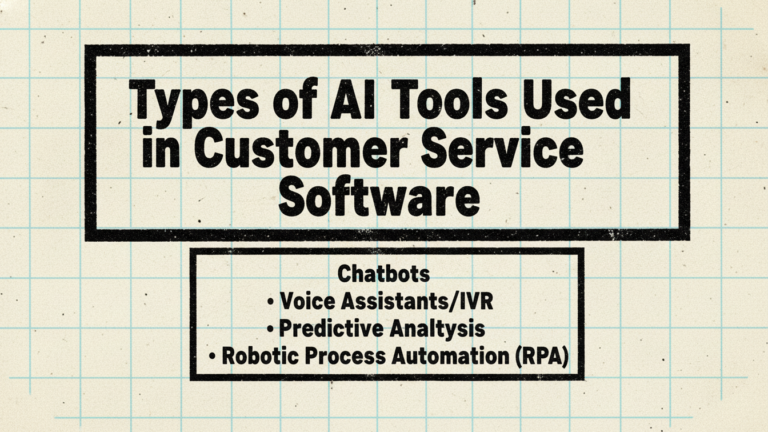
AI Chatbots and Virtual Agents interact directly with customers, serving as the first line of support for routine inquiries. These tools answer common questions, guide users through processes step-by-step, and provide immediate responses across chat interfaces, email, voice systems, and social media channels. They’re optimized for handling predictable interactions where responses can be determined from available information and established procedures. Modern chatbots use natural language processing to understand varied phrasings of similar questions and maintain conversational context rather than treating each message as isolated.
Workflow Automation and Decision Engines handle background processes and execution logic that keeps support operations running smoothly. Automation tools manage ticket routing, send notifications, update systems, and execute repetitive workflows without human intervention. Decision engines guide both AI and human agents through complex processes by presenting decision trees that adapt based on responses—if the customer says X, do Y; if they say Z, do A instead. These systems ensure consistent execution of procedures across all interactions whether handled by automation or people.
AI-Powered Analytics and Sentiment Tools analyze support interactions to extract insights that inform improvements. Analytics platforms process ticket data, conversation transcripts, and performance metrics to identify trends, measure effectiveness, and highlight opportunities. Sentiment analysis examines customer language to detect emotions—satisfaction, frustration, confusion—providing real-time feedback about experiences and flagging conversations that need immediate attention. These tools transform raw support data into actionable intelligence that drives strategic and tactical decisions.
Agent Assist and Knowledge AI support human agents during conversations by providing real-time assistance. These systems suggest relevant responses based on conversation context, automatically retrieve knowledge base articles related to customer questions, recommend next-best actions based on customer history and current situation, and surface relevant case notes from previous interactions. By making information instantly available and suggesting proven approaches, agent assist tools help even less experienced support staff deliver expert-level service.
Collectively, these four categories form the backbone of comprehensive AI customer service software. Each plays distinct roles—direct customer interaction, process execution, insight generation, and agent support—that combine to create scalable, consistent, high-quality support operations. Understanding these tool types helps businesses evaluate whether platforms provide the specific capabilities their operations need most.
Benefits of AI Customer Service Software for Businesses
AI customer service software delivers measurable improvements across multiple dimensions of support operations, creating value that justifies the investment and operational changes required for implementation.
Faster response times represent the most immediately noticeable benefit. By automating responses to routine inquiries and providing instant answers through chatbots, customers receive help within seconds rather than waiting minutes or hours for human agents. This responsiveness directly improves customer satisfaction scores since people value their time and appreciate businesses that respect it. Even when AI escalates to humans, the time saved handling routine volume means shorter queues and faster human response for complex cases.
Reduced support costs occur as AI handles increasing percentages of incoming volume without requiring additional staff. While initial implementation requires investment, the ongoing marginal cost per interaction drops dramatically. An organization handling 10,000 monthly inquiries might need 20 human agents, but with AI resolving 40% of volume automatically, they might need only 12-15 agents for equivalent coverage. These savings compound over time, particularly as volume grows and AI capabilities improve.
Improved agent productivity emerges from eliminating repetitive work that drains time and energy. When agents aren’t spending hours resetting passwords, checking order status, or answering the same basic questions repeatedly, they can focus on complex problems where their expertise creates real value. This shift from task executor to problem solver typically increases both job satisfaction and retention, reducing the costs and disruption of constant agent turnover.
Consistent answers across channels ensure customers receive accurate, uniform information regardless of whether they contact you via chat, email, social media, or phone. AI provides identical responses to identical questions, eliminating the variation that occurs when different human agents interpret policies differently or remember procedures inconsistently. This consistency strengthens trust—customers know they’ll get reliable information rather than gambling on which agent answers their question.
Ability to scale without proportional hiring fundamentally changes support economics. Traditional operations scale linearly: double your customer base and you roughly double your support team. AI customer service software breaks this relationship by absorbing increasing volumes of routine interactions while human teams focus on complex cases. A business growing from 1,000 to 10,000 customers might increase AI infrastructure costs but potentially maintain similar human agent headcount, dramatically improving the unit economics of support operations.
Better customer satisfaction (CSAT) results from faster responses, consistent quality, and 24/7 availability that modern customers expect. While some worry that automation degrades experience, well-implemented AI typically improves satisfaction scores by providing immediate help for routine needs and ensuring human agents are available and attentive when complexity requires their involvement. The key is using AI for what it does well—predictable interactions—while preserving human support for situations requiring judgment and empathy.
Enhanced operational metrics improve across first-call resolution rates, average handle time, ticket backlog, and service level agreement compliance. AI resolves issues completely during initial contact more consistently than humans who might provide incomplete troubleshooting. Handle time decreases as AI manages routine volume and assists human agents with information retrieval. Backlogs shrink when predictable volume gets automated. SLA compliance improves when routine tickets resolve instantly rather than consuming the time budget.
Together, these benefits create more resilient, efficient, and scalable customer service operations. Businesses can maintain high-quality support experiences while growing, meeting modern customer expectations for speed and availability, and controlling costs that would otherwise grow proportionally with customer base.
Why Process Design Matters in AI Customer Service
A critical insight that many organizations learn through painful experience is that AI customer service software doesn’t make independent decisions—it executes processes that humans define. Every action taken by chatbots or AI agents follows underlying workflows, decision trees, escalation rules, and step-by-step logic that someone designed. The quality of those processes directly determines the quality of AI performance.
Without clear, structured processes, AI risks delivering inconsistent answers to similar questions, failing to escalate appropriately when situations exceed its capabilities, providing outdated information because procedures changed but AI configuration didn’t, or handling exceptions incorrectly because edge cases weren’t anticipated in process design. These failures damage customer trust and create additional work when humans must fix problems AI should have prevented or handled correctly.
This reveals the missing layer in most AI stacks: centralized process design. Many organizations implement AI chatbots, automation tools, and analytics platforms but don’t establish centralized systems for defining and maintaining the processes these tools execute. Instead, logic gets scattered across individual tool configurations, informal procedures documented in various places, and tribal knowledge existing only in experienced agents’ heads.
This fragmentation creates several problems. Inconsistency between AI and human agents occurs when chatbots follow different troubleshooting sequences than agents use, leading to confusion and repetition when escalations occur. Difficulty updating processes emerges because changes require modifying multiple systems and documentation, often resulting in some channels reflecting current procedures while others remain outdated. Lack of governance means no clear ownership of process quality, no systematic review ensuring procedures remain optimal, and no audit trail showing what processes were in effect during specific interactions.
To address these challenges, progressive organizations implement process guidance platforms that provide the missing layer. These systems enable teams to design comprehensive workflows defining how every type of customer interaction should be handled, create decision trees that adapt to specific situations rather than forcing all cases through identical paths, establish escalation criteria that trigger human involvement at appropriate points, and maintain version control showing how processes evolve over time.
Critically, these centralized processes apply to both AI agents and human support staff. When chatbots and people follow identical workflows, consistency becomes achievable regardless of who handles interactions. When processes exist as structured, maintainable data rather than scattered configurations, updates propagate everywhere simultaneously. When clear ownership and governance exist, process quality improves continuously based on results and changing business needs.
Process Shepherd exemplifies this process guidance category, providing businesses with frameworks for designing, maintaining, and executing standardized workflows that govern both automated and human-driven support. By centralizing process definition and ensuring both AI and agents follow identical logic, organizations transform AI customer service software from tools that sometimes work inconsistently into reliable, predictable, trustworthy components of support operations.
The fundamental insight is that AI sophistication matters less than process quality. Brilliant AI executing poorly defined workflows delivers unreliable service. Basic AI executing well-structured, carefully maintained processes delivers consistent, effective support. Organizations serious about AI customer service invest equally in the AI tools themselves and the process infrastructure that determines how those tools actually perform.
How AI Customer Service Software and Human Agents Work Together
The most effective AI customer service implementations position AI and humans as complementary rather than competitive, each handling what they do best while supporting the other’s limitations.
AI serves as first-line interaction for predictable, routine inquiries where immediate responses create value. Password resets, order status checks, basic troubleshooting, frequently asked questions—these interactions follow patterns that AI can recognize and handle reliably. By resolving these cases immediately, AI provides excellent customer experience for straightforward needs while preventing routine volume from overwhelming human agents.
Humans handle complexity and judgment for situations requiring empathy, creative problem-solving, policy interpretation, or expertise beyond AI capabilities. Upset customers need human connection and genuine concern. Novel problems need flexible thinking and experience-based intuition. Situations requiring exceptions to standard policies need judgment about when flexibility serves business interests. These human capabilities remain irreplaceable regardless of AI sophistication.
The critical success factor is shared processes. When AI and human agents follow identical standardized workflows and decision trees, responses remain consistent regardless of who handles interactions. A customer troubleshooting connectivity issues gets the same diagnostic questions and resolution steps whether guided by a chatbot or human agent. This consistency eliminates the jarring experience of receiving different answers depending on whether you reach a bot or person.
Shared processes also enable better handoffs when escalation occurs. Because humans see the same workflows AI was executing, they understand immediately what troubleshooting already occurred, what information was gathered, what was attempted unsuccessfully, and why AI concluded human intervention was necessary. This context allows agents to continue efficiently rather than starting over, respecting customer time and building on AI’s preparatory work.
The division of labor creates several advantages. Reduced wait times occur as AI immediately handles routine volume that otherwise would queue for human attention. Better agent utilization emerges when skilled staff focus entirely on complex situations where their expertise creates value rather than spending half their time on basic questions. Improved agent satisfaction results from eliminating the boring, repetitive work that causes burnout while preserving the challenging, interesting cases that require human capability.
Enhanced customer experience comes from getting immediate help for simple needs combined with expert human assistance when situations become complex. Customers appreciate speed when AI resolves issues instantly. They appreciate capability when human agents handle nuanced situations effectively. The combination delivers better overall experience than either purely automated or purely human support.
By positioning AI as supportive infrastructure that multiplies human effectiveness rather than as replacement technology threatening jobs, organizations build support operations that are both more efficient and more capable than either approach alone could achieve. The synergy between artificial and human intelligence creates customer service that scales economically while maintaining the quality that genuine human connection provides.
How to Choose the Right AI Customer Service Software
Selecting appropriate AI customer service software requires evaluating your specific needs and operational context rather than searching for universally “best” tools that may not fit your situation.
Start by assessing volume and complexity of your support requests. High-volume operations where 40-50% of inquiries involve routine, predictable questions benefit enormously from AI that automates these interactions. Organizations where most tickets involve unique, complex problems requiring judgment see less benefit since fewer interactions suit automation. Understanding your ticket composition determines realistic expectations about what AI can accomplish.
Consider your channel mix and ensure platforms support everywhere your customers actually engage. If most support happens via email and chat, robust chatbot capabilities matter more than sophisticated voice AI. If social media generates significant volume, strong social listening and response features become important. Omnichannel platforms that maintain context across channels prevent the fragmentation that forces customers to repeat information when switching between email, chat, and phone.
Evaluate integration requirements with existing systems. AI customer service software must connect smoothly with your CRM to access customer data, your helpdesk or ticketing platform to create and update cases, your knowledge base to retrieve current documentation, and identity systems to verify users securely. Poor integration creates silos where information doesn’t flow properly, forcing agents to toggle between systems and potentially providing customers with outdated or incorrect information.
Examine customization and control over workflows and decision logic. Some platforms provide fixed automation that works well for common scenarios but can’t be adapted to your specific processes. Others offer flexible workflow builders where you design decision trees, escalation rules, and process sequences matching your exact needs. Businesses with unique processes or strict compliance requirements need platforms offering substantial customization rather than one-size-fits-all automation.
Assess process management capabilities that determine whether you can maintain consistent logic across AI and human agents. Platforms that separate AI configuration from agent guidance create the fragmentation problems discussed earlier. Solutions providing centralized process definition—where both automated and human-driven support follow identical workflows—enable the consistency that makes AI reliable rather than inconsistent. This process layer often represents the difference between AI that enhances operations and AI that creates new problems.
Consider governance and compliance especially in regulated industries. Can you audit what processes were in effect during specific interactions? Does version control track how workflows changed over time? Can you enforce required procedures that can’t be bypassed? Are permissions and approvals built into process changes? These governance capabilities matter enormously for healthcare, financial services, telecommunications, and other sectors where process compliance isn’t optional.
Evaluate vendor support and ongoing costs beyond initial licensing. Does the vendor provide implementation assistance, training, and ongoing support? How do costs scale as volume increases? What happens when you need custom development or complex integrations? Understanding total cost of ownership prevents surprises and helps realistic ROI calculations.
By focusing on these criteria rather than chasing rankings or recommendations disconnected from your context, organizations choose AI customer service software aligned with operational realities, customer expectations, and long-term scalability needs. The right solution fits your specific situation rather than being universally “best.”
AI Customer Service Software for Different Business Sizes
The needs and constraints of small versus large businesses differ substantially when implementing AI customer service software, requiring different approaches and priorities.
Small businesses typically prioritize quick setup, ease of use, and limited customization requirements. Teams want AI support running quickly without extensive configuration, technical expertise, or consultant involvement. Simple, intuitive interfaces matter more than sophisticated features that require training to use effectively. Affordable pricing with minimal upfront investment suits budget constraints and reduces risk if AI doesn’t deliver expected benefits.
For small operations handling hundreds rather than thousands of monthly inquiries, AI provides value primarily through extending coverage—offering after-hours support without night shift staffing, handling routine questions so limited staff focus on complex cases, and maintaining consistent service quality despite small team size that makes coverage challenging during vacations or illnesses.
Large businesses face different challenges requiring different capabilities. Governance and process consistency become critical when hundreds of agents across multiple locations must deliver uniform service. Scalability matters enormously—systems must handle thousands or tens of thousands of concurrent interactions without degradation. Integration with complex existing infrastructure can’t disrupt operations or create security vulnerabilities.
Enterprise implementations require centralized process control ensuring all agents—human and AI—follow current procedures across geographies and shifts. Version control and audit trails satisfy compliance requirements and enable continuous improvement based on performance data. Support for multiple languages, time zones, and regional variations accommodates global operations serving diverse customer bases.
The technology investments differ accordingly. Small businesses often choose cloud-based platforms offering simple implementation, pay-as-you-go pricing, and vendor-managed infrastructure. Large enterprises may implement hybrid architectures combining cloud flexibility with on-premise systems for sensitive data, invest in custom development connecting AI to proprietary systems, and dedicate teams to process optimization and governance.
Yet both sizes share one fundamental requirement: regardless of scale, AI customer service software only delivers reliable results when backed by clear, well-maintained processes. Small businesses benefit from structured workflows that compensate for limited staff expertise. Large enterprises require process governance that ensures consistency across massive distributed operations. The difference lies in complexity and scale, not in whether process quality matters—it matters equally for everyone.
Conclusion
AI customer service software has evolved from experimental technology into essential infrastructure for modern support operations. By combining automation that handles routine interactions, intelligent assistance that makes human agents more effective, and analytics that drive continuous improvement, these platforms enable businesses to meet growing customer expectations while controlling operational costs.
The fundamental value proposition is multiplication of human effectiveness rather than replacement. AI handles the predictable, repetitive work that drains time and energy, allowing people to focus on complex situations requiring judgment, empathy, and creative problem-solving. This division of labor creates support operations that are simultaneously more efficient and more capable than purely human or purely automated approaches.
Yet technology alone doesn’t guarantee success. The quality of outcomes depends critically on the processes that AI executes. Organizations investing in both capable AI platforms and structured process frameworks that define how support should work—for both automated and human-driven interactions—create reliable, scalable operations that genuinely transform customer experience. Those implementing AI without this process foundation often discover that automation simply executes inconsistent or outdated procedures faster, creating new problems rather than solving existing ones.
For businesses exploring AI customer service software, the path forward involves parallel investments: selecting platforms with capabilities matching your specific operational needs, and establishing process infrastructure that ensures both AI and human agents follow standardized, well-maintained workflows. Tools like Process Shepherd provide this process layer, enabling organizations to define, govern, and continuously improve the logic that determines how every customer interaction gets handled.
The transformation is already underway. Customer service operations that embrace AI thoughtfully—combining technological capability with process discipline—are delivering faster, more consistent, more scalable support than traditional approaches ever could. Those that delay risk falling behind competitors who’ve made support operations a strategic advantage rather than merely a cost center. The question isn’t whether AI will reshape customer service, but whether your organization will lead or follow this fundamental transformation.