BPO Services: All You Need to Know About Business Process Outsourcing

Business Process Outsourcing (BPO) services involve contracting specific business functions to third-party providers who handle these operations on behalf of client companies. Rather than managing every function internally, organizations outsource processes like customer support, data entry, payroll, or technical assistance to specialized providers who can perform these tasks more efficiently. BPO services help businesses reduce costs, focus resources on core activities, and access specialized expertise without building entire departments from scratch. This business model has become fundamental to modern operations across industries from technology and finance to healthcare and retail.
- What Are BPO Services?
- Common Types of BPO Services
- Front-Office vs Back-Office BPO Services
- Why Businesses Use BPO Services
- Examples of BPO Services in Practice
- Challenges in Delivering Consistent BPO Services
- How Modern BPO Providers Standardize and Scale Service Delivery
- The Role of Process Guidance Platforms in BPO Operations
- Conclusion: BPO Services in a Process-Driven Era
What Are BPO Services?
BPO services represent a business model where companies delegate specific operational functions to external providers who specialize in managing these processes at scale. Unlike hiring individual contractors or consultants for temporary projects, BPO involves ongoing operational partnerships where providers handle entire business functions as extensions of client organizations.
These services cover both customer-facing operations and internal administrative work. Customer support teams answering calls and emails, technical support specialists troubleshooting product issues, sales representatives conducting outreach—these customer-facing functions fall under BPO. Behind the scenes, providers also handle data processing, payroll management, claims processing, document management, and countless other operational tasks that keep businesses running but don’t directly generate revenue.
The distinction between BPO and internal hiring comes down to operational model and expertise. When you hire employees internally, you build departments, develop processes, train staff, and manage operations directly. With BPO, specialized providers already have established infrastructure, trained personnel, proven processes, and management systems. You’re essentially renting access to mature operational capabilities rather than building them yourself.
Companies of all sizes use BPO services, though for different reasons. Large enterprises outsource to reduce operational costs and focus internal resources on strategic priorities. Mid-size companies use BPO to access capabilities they can’t afford to build internally, like 24/7 customer support or specialized technical expertise. Startups leverage BPO to scale operations quickly without the cash flow burden of hiring and training large teams before revenue justifies the investment.
The fundamental value proposition is specialization. BPO providers focus entirely on specific business functions, developing expertise, processes, and economies of scale that client companies couldn’t achieve if those functions were just one department among many competing for attention and resources.
Common Types of BPO Services
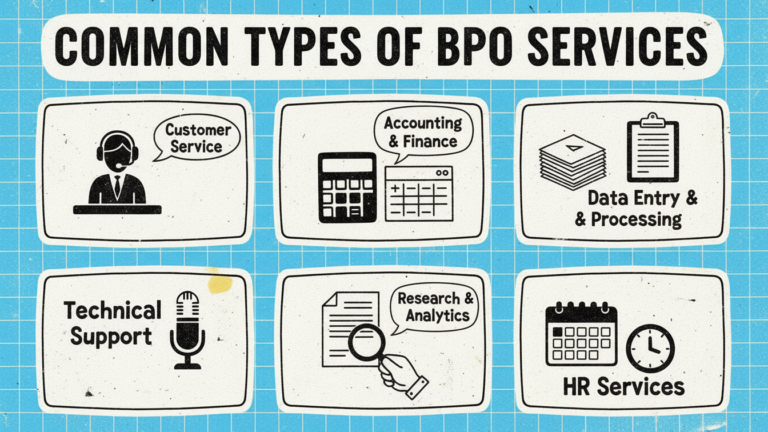
BPO services span virtually every non-core business function. Understanding the major categories helps identify what can be outsourced and what providers typically offer.
Customer Support and Call Center Services
Customer support represents one of the most commonly outsourced functions, with BPO providers managing interactions across multiple channels. Inbound call centers handle customer-initiated contacts like questions about products, billing inquiries, technical problems, or service requests. Outbound call centers make proactive calls for sales, surveys, appointment reminders, or customer follow-ups. Live chat and email support extend customer service across digital channels, providing text-based assistance through websites, apps, and email platforms.
Technical support and sales support require specialized knowledge, making them natural fits for BPO providers who can maintain teams with specific expertise. Technical support helps customers troubleshoot problems, configure products, or resolve service issues. Sales support teams qualify leads, conduct discovery calls, process orders, and handle the interactions that move prospects through buying processes.
This category directly answers the common question: Is a call center a BPO? Yes, call centers operated by third-party providers who handle customer interactions on behalf of client companies are quintessential BPO services. The provider manages agents, infrastructure, processes, and quality while representing the client’s brand during customer conversations.
Back-Office Operations
Back-office BPO covers administrative and operational functions that don’t involve direct customer interaction but are essential for business operations. Data entry teams process information from forms, documents, or systems into databases and applications. Document processing involves digitizing paper records, extracting information from various formats, and organizing documentation.
Claims and order processing handle the administrative workflow for insurance claims, healthcare billing, purchase orders, or service requests. These processes follow defined procedures but require human judgment to handle variations and exceptions that pure automation can’t manage reliably.
Back-office outsourcing typically generates the most direct cost savings since these functions involve repetitive work that can be performed efficiently at scale by providers operating in lower-cost regions.
Finance and Accounting (FAO)
Financial and accounting functions involve sensitive data but follow standardized procedures that make them suitable for outsourcing to qualified providers. Payroll processing ensures employees get paid accurately and on time while handling tax withholdings, benefits deductions, and compliance requirements. Bookkeeping maintains financial records, tracks transactions, and produces reports that inform business decisions.
Accounts payable manages outgoing payments to vendors and suppliers, while accounts receivable handles incoming payments from customers. These functions require accuracy and timeliness but don’t necessarily require in-house staff once appropriate controls and oversight are established.
Many growing companies outsource finance and accounting functions until they reach sufficient scale to justify building internal finance departments, then transition to hybrid models where core financial strategy remains internal while operational execution stays outsourced.
Human Resources (HR) Outsourcing
HR functions involve both strategic activities that typically remain internal and operational tasks that commonly get outsourced. Recruitment process outsourcing (RPO) handles sourcing candidates, screening applications, conducting initial interviews, and managing hiring pipelines. This allows internal HR teams to focus on final interviews, decision-making, and strategic workforce planning.
Onboarding administration manages the paperwork, system access provisioning, and logistical coordination when new employees join. Benefits administration handles enrollment, questions about coverage, claims support, and compliance reporting related to employee benefits programs.
HR outsourcing allows smaller companies to provide professional-grade HR services without building entire departments, while larger organizations use it to handle operational volume so internal HR can focus on culture, development, and strategic people initiatives.
IT and Technical Services
Technology functions increasingly get outsourced as technical complexity grows and specialized skills become harder to find and retain. IT support helpdesks handle employee technology issues, password resets, software problems, and hardware troubleshooting. Software development outsourcing engages teams to build applications, features, or integrations under client direction.
Infrastructure management involves maintaining servers, networks, databases, and cloud environments. Managed service providers handle routine maintenance, monitoring, updates, and issue resolution, allowing internal IT teams to focus on strategic technology initiatives rather than keeping lights on.
Technical services outsourcing works particularly well when specialized expertise is needed intermittently rather than full-time, or when round-the-clock coverage is required but doesn’t justify internal staff across all time zones.
Legal and Marketing Services
Professional services also fall under BPO when operational execution gets delegated to external providers. Legal process outsourcing (LPO) handles document review, contract management, legal research, and administrative legal work. This allows law firms and corporate legal departments to focus on strategy, negotiations, and courtroom work while operational legal tasks get handled cost-effectively.
Digital marketing and content services encompass content creation, social media management, SEO services, and campaign execution. Marketing BPO providers execute strategies and tactics that internal marketing teams design, providing skilled labor without full-time employment overhead.
Front-Office vs Back-Office BPO Services
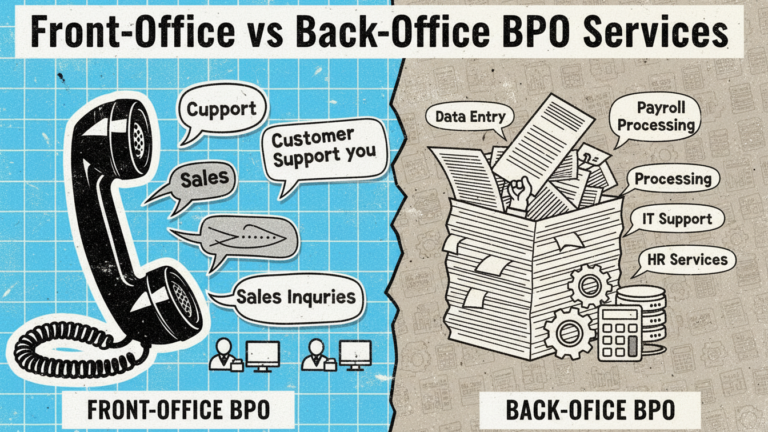
BPO services divide into two fundamental categories based on whether they involve direct customer or external stakeholder interaction.
Front-office BPO handles customer-facing operations where providers represent client brands during external interactions. This includes customer service and support, sales and lead qualification, technical support for customers, and client relationship management. Front-office functions require strong communication skills, brand alignment, and customer experience focus since they directly shape how customers perceive and experience the business.
Examples include call center agents answering customer questions, chat support representatives helping website visitors, technical support specialists troubleshooting product issues, and sales representatives conducting outreach to prospects.
Back-office BPO manages internal operations and administrative functions that don’t involve direct customer contact. This includes data entry and processing, finance and accounting operations, HR administration, claims processing, and document management. Back-office functions emphasize accuracy, efficiency, and compliance since they support business operations without directly impacting customer experience.
Examples include payroll processors ensuring employees get paid correctly, data entry specialists digitizing documents, accounts payable teams processing vendor invoices, and benefits administrators managing employee health insurance.
Businesses outsource front-office functions primarily to extend customer service capacity, provide 24/7 coverage, access multilingual support, or scale rapidly during growth. They outsource back-office functions mainly to reduce operational costs, access specialized expertise, improve efficiency through provider economies of scale, and free internal resources for strategic activities.
Understanding this distinction helps organizations determine which functions to outsource and what capabilities to prioritize when evaluating BPO providers. Front-office providers need strong brand alignment and customer experience focus. Back-office providers need operational excellence, accuracy, and efficient high-volume processing.
Why Businesses Use BPO Services
Organizations turn to BPO services for several compelling reasons that impact both economics and strategic capabilities.
Cost reduction remains the primary driver for many BPO decisions. Providers achieve economies of scale by serving multiple clients, spreading infrastructure costs across larger operations. Labor arbitrage through operations in lower-cost regions produces direct savings on wages and benefits. Reduced overhead from avoiding facility costs, equipment purchases, and management infrastructure creates additional savings. For functions like customer support or data processing, outsourcing can reduce costs 30-50% compared to building equivalent internal capabilities.
Focus on core business activities allows organizations to concentrate resources on what differentiates them competitively. A technology company’s competitive advantage comes from innovative products, not from how efficiently they process payroll. A retailer succeeds through merchandising and customer experience, not through superior data entry processes. Outsourcing non-core functions ensures these necessary-but-not-differentiating activities get handled professionally while leadership attention and investment focus on strategic priorities.
Access to specialized expertise provides capabilities that would be difficult or expensive to develop internally. BPO providers develop deep expertise in their focus areas through concentrated experience across many clients. They understand best practices, common pitfalls, regulatory requirements, and operational nuances that generalist internal teams might take years to learn. This expertise transfer happens immediately when you engage a provider rather than requiring lengthy internal capability building.
Scalability and flexibility enable businesses to adjust operational capacity quickly as needs change. Seasonal businesses scale support up during peak periods and down during slower times without carrying year-round overhead. Growing companies increase capacity rapidly without the lead time required for recruiting, hiring, and training internal teams. Organizations entering new markets access local language and cultural expertise without establishing offices in every region.
Operational efficiency and consistency improve when specialized providers apply focused management and proven processes to specific functions. BPO providers optimize operations they run thousands of times daily across multiple clients, achieving efficiency levels that client companies handling those functions as one department among many rarely match. Standardized processes and quality control systems ensure consistent execution that’s difficult to maintain with internal teams where these functions compete for attention with other priorities.
These benefits compound when done well, creating substantial value beyond simple cost savings. Organizations access capabilities they couldn’t build independently, scale flexibly without operational complexity, and focus finite resources on activities creating competitive advantage.
Examples of BPO Services in Practice
Understanding how BPO services work in practice helps visualize their application and benefits.
A retail company experiencing rapid growth might outsource customer support to handle increasing contact volume during expansion. The BPO provider establishes a dedicated team handling calls, emails, and chat for the retailer’s customers. Agents follow the retailer’s procedures, use their systems, and represent their brand, but employment, training, facilities, and management are the provider’s responsibility. This allows the retailer to maintain quality customer service through growth without building internal call center infrastructure and recruiting, training, and managing hundreds of support agents.
A financial technology startup might outsource payroll and benefits administration to focus resources on product development and customer acquisition. The BPO provider ensures employees get paid accurately and on time, manages tax withholdings and filings, handles benefits enrollment, and maintains compliance with employment regulations. The startup accesses professional-grade financial operations without hiring accountants and HR staff before revenue justifies these full-time positions.
A healthcare provider network might outsource medical claims processing to handle the high-volume, detail-intensive work of reviewing claims, verifying coverage, processing payments, and managing appeals. The BPO provider employs specialists trained in medical coding, insurance regulations, and claims procedures. They process thousands of claims efficiently while the provider’s internal staff focuses on patient care and clinical operations rather than administrative processing.
These examples illustrate common BPO patterns: delegating functions that are necessary but non-core, accessing specialized expertise without building departments, and scaling operational capacity faster than internal hiring permits.
Challenges in Delivering Consistent BPO Services
Despite substantial benefits, BPO operations face inherent challenges that impact service quality and client satisfaction.
Agent inconsistency emerges when different agents handle similar situations differently based on personal interpretation, experience level, or individual judgment. One agent might approve a refund while another denies it for identical circumstances. Troubleshooting approaches vary depending on who handles cases. This inconsistency frustrates customers who get different answers when calling back and creates operational problems when expectations don’t match actual service delivery.
Knowledge gaps across teams occur when information and expertise distribute unevenly through BPO operations. Experienced agents understand nuances and handle complex situations confidently. New agents struggle with scenarios outside their training. Night shift teams might lack the institutional knowledge day shift has accumulated. Multi-client environments create confusion when agents support multiple brands simultaneously and mix up which procedures apply to which client.
Training and onboarding delays extend time-to-productivity for new agents in BPO environments. Agents must learn client products, policies, systems, and procedures before taking interactions independently. High turnover in BPO operations means continuous training of replacements, with significant percentages of teams always relatively new and less capable than fully proficient agents. This training burden impacts both cost and quality.
Quality assurance and compliance issues arise from the difficulty of maintaining standards across distributed teams. QA sampling typically reviews only small percentages of interactions, missing many quality problems. Compliance requirements around data handling, required disclosures, and procedural adherence depend on agent memory and attention under pressure. Monitoring and enforcement mechanisms often can’t catch issues until after problems impact customers.
Process drift over time happens as agents develop shortcuts, informal procedures emerge, and documented processes diverge from actual execution. What’s written in training materials doesn’t match how experienced agents actually work. Updates to procedures don’t propagate uniformly. Different teams or locations evolve different approaches. This drift creates inconsistency and makes it difficult to improve systematically when the gap between documented and actual processes isn’t visible.
These challenges explain why BPO costs are lower than internal operations but results can be inconsistent. The operational model creates economies of scale while simultaneously making consistency and quality harder to maintain than in smaller, more tightly managed internal teams.
How Modern BPO Providers Standardize and Scale Service Delivery
Progressive BPO providers address consistency and quality challenges through systematic approaches to process management and execution.
Process standardization involves documenting detailed procedures for every type of interaction, creating decision trees that guide agents through complex scenarios, establishing clear escalation criteria, and defining quality standards that apply uniformly across teams and shifts. Rather than leaving execution to individual agent judgment, standardized processes create predictable service patterns regardless of who handles interactions.
Guided execution provides real-time support to agents during customer interactions. Instead of expecting agents to remember procedures or search documentation while customers wait, modern approaches present step-by-step guidance that adapts to specific situations. Interactive workflows ask relevant questions, evaluate responses, and automatically provide next steps based on the situation rather than forcing every case through identical procedures.
Embedded decision support ensures agents apply correct logic even in complex situations they encounter infrequently. The system captures institutional knowledge in executable processes rather than leaving it trapped in experienced agents’ heads. New agents can handle sophisticated scenarios with guidance rather than requiring months of experience before contributing fully. Consistency improves because everyone follows identical logic rather than individual interpretation creating variation.
Reducing dependency on memory and manuals transforms how agents work. Traditional models expect agents to memorize procedures, recall policies under pressure, and search documentation when uncertain. Modern approaches recognize these expectations are unrealistic at scale. Providing processes that execute during work rather than documents to study before work dramatically reduces training burden while improving execution quality.
Supporting agents in real time with information, suggestions, and next-best-actions makes everyone more effective. The gap between knowing what’s documented somewhere and correctly applying it during live customer interactions determines service quality. Closing this gap through real-time support rather than hoping training and documentation are sufficient creates the consistency and quality that distinguish excellent from mediocre BPO operations.
These approaches represent evolution from BPO as purely labor arbitrage toward BPO as sophisticated operational execution powered by both skilled people and intelligent process infrastructure.
The Role of Process Guidance Platforms in BPO Operations
The standardization and execution capabilities described above require technological infrastructure beyond traditional training, documentation, and quality monitoring tools.
Process guidance platforms provide this infrastructure by enabling BPO providers to design, maintain, and execute standardized workflows that govern both automated and human-driven interactions. These systems create interactive decision trees that adapt to specific situations, enforce quality standards and compliance requirements systematically, maintain version control showing how processes evolve, and ensure consistency across agents, teams, shifts, and client accounts.
The category addresses a critical gap in traditional BPO operations: the disconnect between documented procedures and actual execution. When processes exist as static documents, inconsistency is inevitable. When processes exist as executable systems that actively guide work, consistency becomes achievable even across large, distributed operations.
Process Shepherd exemplifies this infrastructure category for BPO operations. The platform allows providers to create guided workflows for every client and scenario, ensuring agents follow correct procedures regardless of experience level or how long it’s been since they handled specific situations. For multi-client BPO operations, Process Shepherd organizes workflows by client so agents always apply appropriate procedures for whichever account they’re servicing.
The emphasis is on execution quality rather than just documentation quality. Having perfect procedure manuals helps only if agents reliably follow them during actual work. Process guidance platforms bridge the gap between what should happen and what actually happens by making correct execution easier than incorrect improvisation.
For BPO providers, this infrastructure enables faster agent onboarding since people can contribute productively with guidance rather than requiring complete memorization before taking interactions. It creates consistency that satisfies client quality requirements and supports the operational excellence that distinguishes premium providers from low-cost commodity operators.
Conclusion: BPO Services in a Process-Driven Era
BPO services have evolved from simple cost arbitrage to sophisticated operational partnerships that provide both economic and capability advantages. Modern organizations use BPO not just to reduce expenses but to access specialized expertise, scale flexibly, and focus internal resources on strategic priorities.
Yet the economic benefits of outsourcing only materialize when execution quality meets expectations. The operational challenges inherent in BPO—distributed teams, high turnover, multi-client complexity—make consistency and quality harder to maintain than in traditional internal operations. Success increasingly depends on systematic approaches to process management that ensure every interaction, regardless of which agent handles it, follows established procedures and meets quality standards.
The future of BPO lies in combining specialized human expertise with process infrastructure that makes that expertise consistently accessible. Providers investing in both skilled people and the systems that guide those people toward correct execution create operations that deliver the cost efficiency of outsourcing with the quality and consistency traditionally associated with well-managed internal teams. This combination—capable agents plus structured support—defines the competitive advantage in an industry where process execution quality has become the primary differentiator.