Customer service technology has come a long way from dusty binders of policies and word-for-word scripts agents had to read robotically. Yet many contact centers still rely on tools that feel stuck in the past—static documents, rigid scripts, and systems that make agents hunt for answers while customers wait on hold.
Table of Contents

The most effective customer service technology today doesn’t just store information. It actively guides agents through complex situations in real-time, adapting to each unique customer interaction. This shift from passive resources to intelligent guidance is transforming how call centers, BPO operations, and helpdesks deliver support.
If you’ve ever wondered why some companies consistently deliver great service while others struggle with inconsistency despite extensive training, the answer often comes down to the technology supporting their agents. Let’s explore how modern guided workflows and decision tree systems are changing the game.
The Problem with Traditional Customer Service Technology
Most companies invest heavily in customer service technology—knowledge bases, CRM systems, ticketing platforms, training materials. Yet agents still struggle during live customer interactions.
The issue isn’t lack of information. It’s how that information reaches agents when they need it most.
Static Knowledge Bases Fall Short
Knowledge bases are valuable repositories of information, but they have fundamental limitations during active customer conversations. When agents need an answer, they must stop what they’re doing, search through documentation, scan multiple articles, interpret what they find, and then apply it to the customer’s specific situation.
This process takes time. Customers wait on hold. The conversation loses momentum. And different agents might interpret the same documentation differently, leading to inconsistent service.
Rigid Scripts Create Robotic Experiences
Traditional call center scripts attempt to standardize service by having agents read predetermined text. While this ensures consistency, it creates mechanical interactions that frustrate both customers and agents.
Scripts can’t adapt to unique situations. They don’t account for customer emotion, previous interactions, or the hundred small variations that make each conversation different. Agents following rigid scripts often sound like they’re reading from a teleprompter—because they are.
The Training Gap Never Closes
Even with extensive training, new agents take weeks or months to handle complex issues confidently. Products change. Policies update. Edge cases emerge. No amount of classroom training can prepare agents for every scenario they’ll encounter.
Traditional customer service technology forces agents to rely on memory and training that’s always slightly outdated. The result? Agents who feel uncertain, customers who receive inconsistent service, and supervisors who constantly field questions.
What Makes Modern Customer Service Technology Different
The next generation of customer service technology solves these problems through intelligent, real-time guidance. Instead of expecting agents to know everything or search for everything, these systems actively guide them through each customer interaction.
Guided Workflows That Adapt in Real-Time
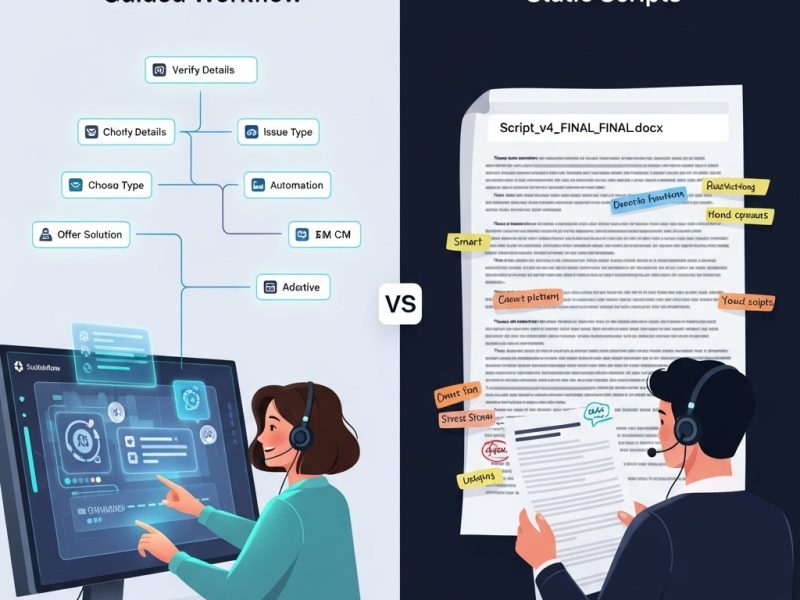
Modern guided workflow platforms present agents with step-by-step instructions that change based on what’s actually happening in the conversation. As customers provide information, the system branches to the appropriate next steps, ensuring agents always know what to ask and what to do.
Think of it like GPS navigation versus a paper map. A map shows you all possible routes, but you need to figure out which one to take. GPS actively tells you “turn here now” based on where you currently are. Guided workflows do the same for customer service interactions.
Decision Trees That Handle Complexity
Behind effective guided workflows are sophisticated decision tree systems. These map out all possible paths a customer interaction might take, with branching logic that accounts for different scenarios, customer types, issue complexities, and business rules.
When an agent asks, “Is this for a personal or business account?” the decision tree automatically shows different options based on the answer. If the customer mentions a problem that requires specific verification steps, those steps appear automatically. The technology handles the logic so agents can focus on helping customers.
Context-Aware Intelligence
The best customer service technology doesn’t operate in a vacuum. It connects to your CRM, helpdesk, and other systems to pull relevant customer information automatically. Agents see account history, previous interactions, current status, and personalized recommendations—all without searching or switching screens.
This contextual awareness means the guidance adapts not just to what customers say, but to who they are and what they’ve experienced with your company.
How Guided Workflows Transform Customer Service Operations
When you replace static resources and rigid scripts with intelligent guided workflows, the impact shows up across every aspect of your operation.
Dramatically Faster Onboarding
New agents traditionally need weeks of training before handling calls independently. With guided workflow technology, that timeline compresses dramatically—often by 70-80%.
Instead of memorizing procedures, new hires follow step-by-step guidance from day one. They learn by doing, with the system ensuring they don’t miss critical steps. When they encounter unfamiliar situations, contextual help appears automatically. Knowledge articles surface at relevant moments. AI assistance answers specific questions instantly.
This accelerated onboarding doesn’t just save training costs. It lets you scale your team quickly, staff seasonal peaks efficiently, and reduce the pain of agent turnover.
Consistent Service Quality
One of the biggest challenges in any call center or BPO operation is consistency. How do you ensure every agent delivers the same quality of service regardless of experience level or how they’re feeling that day?
Guided workflows solve this by ensuring everyone follows the same proven processes. The decision tree logic guarantees agents don’t skip important steps, forget to verify critical information, or improvise workarounds that create problems. Whether a customer reaches your newest hire or most experienced agent, they get the same thorough, accurate support.
This consistency is especially valuable for BPO companies managing multiple clients. Agents can switch between different client processes seamlessly because the guided workflow presents the right procedures for each situation automatically.
Built-In Compliance and Quality Control
Regulated industries face constant pressure to ensure agents follow required procedures. With traditional customer service technology, you’re trusting agents to remember compliance checkpoints during stressful conversations.
Modern guided workflows embed compliance directly into the process. Required disclosures happen automatically at the right moment. Verification steps can’t be skipped.
Documentation is captured in the proper format. The system enforces business rules and regulatory requirements without agents having to consciously think about every compliance detail.
This doesn’t just reduce risk. It removes stress from agents who no longer need to worry about forgetting something important.
Improved Key Performance Metrics
When agents have the right guidance at the right moment, performance metrics improve across the board.
First Contact Resolution increases because agents follow complete troubleshooting processes that identify root causes rather than applying superficial fixes.
Average Handle Time decreases by 20-35% because agents spend zero time searching for information or deciding what to do next.
Customer Satisfaction improves because service becomes faster, more accurate, and more consistent.
Agent confidence rises because they have reliable support for complex situations, reducing the stress that drives turnover.
These improvements compound. Better metrics lead to lower costs, happier customers, and a more capable workforce.
Continuous Improvement Through Data
Traditional customer service technology provides limited insights into what’s actually working. Modern guided workflow platforms track where agents struggle, which processes take longest, what questions come up repeatedly, and which paths lead to the best outcomes.
This data reveals optimization opportunities you’d never spot otherwise. Maybe a particular step causes confusion—you can clarify it. Perhaps certain questions don’t actually help—you can remove them. Specific paths might consistently lead to higher satisfaction—you can promote those approaches.
The technology learns from every interaction, suggesting improvements that make future interactions even better.
How Process Shepherd Exemplifies Modern Customer Service Technology
Process Shepherd represents what’s possible when customer service technology prioritizes intelligent guidance over static resources.
Step-by-Step Guidance That Adapts
At its core, Process Shepherd provides agents with clear, step-by-step workflows that adapt based on customer responses, ticket details pulled from your helpdesk, account information from your CRM, and business rules you’ve defined.
Agents never guess what to do next. The system presents exactly the right question to ask or action to take based on the current context. As the conversation evolves, the guidance evolves with it.
Multiple Layers of Support
When agents need more than just the next step, Process Shepherd provides multiple layers of assistance:
Contextual knowledge articles appear automatically at relevant points in the workflow, giving agents access to detailed information without searching.
AI chatbot assistance answers specific questions instantly, so agents can ask “What’s our policy on this?” and get immediate answers without leaving the conversation.
Integrated system data means customer information, order history, and account details populate automatically—no manual lookups or screen-switching required.
This multi-layered approach ensures agents have everything they need to handle any situation confidently.
No-Code Flexibility
Process Shepherd’s workflow builder empowers operations teams, supervisors, and subject matter experts to create and modify guided workflows without technical expertise. When policies change or new products launch, you update workflows in minutes through simple drag-and-drop building.
This agility means your customer service technology keeps pace with your business instead of becoming outdated documentation that agents don’t trust.
Built for Real Contact Center Operations
The platform integrates directly with leading CRM and helpdesk systems, so guided workflows appear within the tools agents already use. No separate logins, no screen-switching, no trying to remember which system has what information.
For BPO operations managing multiple clients, Process Shepherd handles complex scenarios where processes vary by client, region, or customer type. Agents get the right guidance automatically based on context, making it easy to deliver consistent quality across different client programs.
Measurable Impact
Organizations implementing Process Shepherd’s guided workflow technology consistently see training time reduced by 70-80%, average handle time decreased by 20-35%, first contact resolution increased significantly, customer satisfaction scores improved, and agent turnover reduced.
These aren’t aspirational goals. They’re the natural result of providing agents with intelligent customer service technology that actually supports them during live interactions.

The Future of Customer Service Technology
The evolution from static knowledge bases to intelligent guided workflows represents a fundamental shift in how we think about supporting customer service agents.
Instead of expecting agents to be walking encyclopedias who memorize everything, modern customer service technology recognizes that agents should focus on what humans do best—building rapport, showing empathy, solving problems creatively—while systems handle the procedural complexity.
As artificial intelligence and machine learning continue advancing, guided workflow platforms will become even smarter. They’ll predict likely issues before customers mention them, suggest proactive solutions based on patterns, and personalize guidance based on each agent’s strengths and development areas.
But the core principle remains constant: the best customer service technology empowers agents to deliver their best work by providing intelligent, real-time support exactly when it’s needed.
Conclusion
Customer service technology has moved beyond storing information to actively guiding agents through complex interactions. Modern guided workflows and decision tree systems provide step-by-step, context-aware support that adapts to each unique situation.
This shift transforms operations by dramatically reducing training time, ensuring consistent service quality, embedding compliance and quality control, improving key performance metrics, and enabling continuous optimization through data insights.
For call centers, BPO operations, and helpdesks looking to improve service quality while controlling costs, intelligent guided workflow platforms like Process Shepherd represent the next generation of customer service technology. They don’t just help agents find answers—they guide agents to the right solution every time.
The question isn’t whether your team needs better tools. It’s whether you’ll adopt customer service technology that truly supports your agents, or continue relying on static resources that leave them struggling to deliver great service.
FAQ
Q: What is customer service technology?
A: Customer service technology encompasses all digital tools and platforms that help organizations deliver support to customers. This includes CRM systems for managing customer data, helpdesk software for tracking issues, knowledge bases for storing information, communication platforms for multichannel support, and guided workflow systems that provide real-time agent assistance. Modern customer service technology focuses on making agents more effective through intelligent guidance, automation, and integration rather than just storing information. The most impactful platforms combine multiple capabilities—like decision trees, contextual knowledge delivery, and AI assistance—to support agents throughout customer interactions.
Q: How do guided workflows improve customer service?
A: Guided workflows improve customer service by providing agents with step-by-step instructions that adapt based on customer responses and context. Instead of searching through documentation or memorizing procedures, agents follow clear guidance that ensures they ask the right questions, complete necessary steps, and reach effective solutions consistently. This approach reduces training time by 70-80%, decreases average handle time by 20-35%, improves first contact resolution, ensures compliance with required procedures, and reduces agent stress. Guided workflows are especially valuable in call centers and BPO operations where consistency across many agents is critical, or in complex environments where agents handle diverse issue types requiring different processes.
Q: What’s the difference between decision trees and traditional scripts?
A: Traditional call center scripts are rigid, predetermined text that agents read word-for-word regardless of customer needs or conversation flow. They create robotic interactions and can’t adapt to unique situations. Decision trees, by contrast, are dynamic systems that branch based on customer responses and context. As customers provide information, the decision tree automatically routes agents down appropriate paths, presenting relevant questions and actions for each specific scenario. While scripts force every conversation into the same format, decision trees ensure agents follow logical processes while allowing natural conversation. Modern decision tree technology also integrates with other systems to pull customer data and provide contextual guidance, making interactions both structured and personalized.
Q: How does customer service technology reduce training time?
A: Modern customer service technology reduces training time by replacing memorization with real-time guidance. Instead of spending weeks in classroom training trying to remember hundreds of procedures, new agents learn by doing with guided workflows that walk them through each interaction step-by-step. When they encounter unfamiliar situations, contextual help articles appear automatically, and AI assistance answers specific questions instantly—all without leaving the conversation. This approach allows new hires to handle complex customer issues from day one because the technology provides the expertise they haven’t yet developed. Organizations using guided workflow platforms like Process Shepherd typically reduce onboarding time by 70-80%, dramatically lowering training costs while improving service consistency.
Q: Can customer service technology integrate with existing systems?
A: Yes, modern customer service technology is designed to integrate with existing CRM, helpdesk, and communication platforms. The best guided workflow systems embed directly into tools agents already use—like Salesforce, Zendesk, Microsoft Teams, or Freshdesk—so agents see step-by-step guidance, knowledge articles, and contextual information within their normal interface. This eliminates the need to switch between applications or maintain separate logins. Integration also enables the customer service technology to automatically pull customer data, populate fields, trigger automations, and update records across systems. When evaluating platforms, prioritize solutions with native integrations to your specific systems rather than generic API connections that require custom development and ongoing maintenance.