Call center quality determines whether customer interactions build loyalty or drive churn, whether operations run efficiently or waste resources, and whether brands strengthen or erode with every conversation. Yet despite its importance, quality remains surprisingly difficult to define and even harder to maintain consistently across hundreds of daily interactions, multiple shifts, and teams with varying experience levels. Understanding what call center quality actually means, how it’s measured and managed, and most importantly, how leading operations build it into execution rather than just inspecting for it afterward shapes the difference between contact centers that consistently deliver excellent experiences and those that struggle with unpredictable performance.
- What Is Call Center Quality?
- What Is Call Center Quality Assurance (QA)?
- Why Call Center Quality Matters
- Key Components of Call Center Quality Assurance
- Core Metrics Used to Measure Call Center Quality
- Best Practices for Improving Call Center Quality
- Why Measuring Call Center Quality Isn’t Enough
- How Guided Workflows Improve Call Center Quality
- Final Thoughts: Call Center Quality Is Built Into Execution
What Is Call Center Quality?
Call center quality refers to how consistently customer interactions meet both business standards and customer expectations across accuracy, efficiency, empathy, and consistency. Rather than representing a single characteristic or outcome, quality emerges from balance across multiple dimensions that work together to create positive customer experiences and successful business results.
The four pillars of call center quality provide a framework for understanding this balance. Accuracy ensures agents provide correct information, apply policies properly, and resolve issues completely rather than creating additional problems through mistakes or incomplete solutions. Customers trust call centers that consistently give them accurate answers and effective resolutions.
Efficiency manages interaction duration appropriately, resolving issues in reasonable time without unnecessary delays while never rushing conversations to the point where quality suffers. Efficient interactions respect customer time without sacrificing thoroughness or creating the need for repeat contacts.
Empathy maintains professional, human connection during interactions. Agents demonstrate understanding of customer situations, respond with appropriate concern to problems, and communicate in ways that make customers feel heard and valued rather than processed. Even when delivering unwelcome news or enforcing policies customers don’t like, empathetic communication preserves relationship quality.
Consistency delivers the same standard of service regardless of which agent handles interactions, what time customers contact support, or which channel they use. Customers should receive similarly accurate, efficient, and empathetic service whether they call during morning or evening, reach a veteran agent or recent hire, or contact support via phone, chat, or email.
These four pillars interact rather than existing independently. An interaction can be efficient but lack empathy, accurate but inefficient, or empathetic but inaccurate. True quality requires balance where all four dimensions meet acceptable standards simultaneously and consistently across the operation.
What Is Call Center Quality Assurance (QA)?
Call center quality is operationalized through quality assurance—the structured process that ensures service standards don’t vary by agent, shift, or situation. While quality describes the desired outcome, QA represents the systematic approach for monitoring, evaluating, and improving performance to achieve that outcome consistently.
Quality assurance encompasses several interconnected activities. Monitoring interactions involves reviewing calls, chats, emails, and other customer conversations to understand how agents actually perform in real-world work situations. This monitoring can occur live with supervisors listening to conversations as they happen or retrospectively through recorded interaction review.
Evaluating performance assesses whether monitored interactions meet defined standards across the quality pillars. QA teams score conversations against established criteria, identifying both strengths to reinforce and gaps requiring improvement. This evaluation transforms subjective impressions of quality into objective measurements that support fair, consistent assessment.
Identifying gaps reveals patterns in performance issues that indicate where training needs improvement, where processes create confusion, or where additional support would help agents perform better. Gaps might be individual—specific agents struggling with certain scenarios—or systemic—entire teams misunderstanding policies or procedures.
Improving future interactions closes the loop by translating insights from monitoring and evaluation into coaching, training updates, process refinements, and other interventions that address identified gaps. QA becomes actionable when findings drive actual improvement rather than just documenting current performance.
The relationship between call center quality and quality assurance is foundational. Quality represents the target outcome organizations pursue. QA provides the systematic process for ensuring that target is consistently achieved across all interactions, agents, and situations.

Why Call Center Quality Matters
Organizations invest in call center quality because it drives measurable business outcomes beyond just creating positive customer experiences, though that alone justifies attention.
Higher customer satisfaction and loyalty result from quality interactions where customers get accurate information, efficient service, and empathetic treatment. Satisfied customers continue doing business with companies, recommend them to others, and demonstrate higher lifetime value. Quality contact center experiences strengthen customer relationships while poor quality erodes them, often irreparably.
Reduced repeat contacts and escalations occur when agents resolve issues completely and accurately during initial interactions. Quality interactions solve problems right the first time, eliminating the additional cost and customer frustration of repeat contacts attempting to fix what should have been handled initially. Similarly, fewer escalations mean senior staff spend less time on issues that front-line agents should resolve.
Protection of brand reputation comes from consistently quality service that reinforces brand promises rather than undermining them. Every customer interaction shapes perception of the entire organization. Inconsistent or poor quality service damages brands even when other aspects of business are excellent. Quality contact centers protect brand value by ensuring customer-facing interactions consistently meet expectations.
More predictable and scalable operations emerge from standardized quality where performance doesn’t depend entirely on which agents handle interactions. When quality is consistent rather than highly variable, operations can scale confidently because adding capacity doesn’t create quality lottery where some customers get excellent service and others get poor experiences.
Lower costs from rework and errors reduce expenses when quality interactions eliminate mistakes that create additional work. Inaccurate information requires correction calls. Incomplete resolutions require follow-up interactions. Policy violations create compliance issues requiring remediation. Quality interactions get things right initially, avoiding these downstream costs.
Key Components of Call Center Quality Assurance
Effective quality assurance programs combine several core components that work together to monitor, evaluate, and improve performance systematically.
Monitoring and Evaluation
Call and interaction monitoring provides the observational foundation for QA by examining how agents actually perform during customer conversations. Monitoring can happen live with supervisors or QA specialists listening to calls in real-time, providing immediate coaching opportunities when they observe issues. Retrospective monitoring reviews recorded interactions after completion, allowing deeper analysis without the time pressure of live oversight.
The emphasis on consistency and objectivity ensures monitoring serves improvement rather than creating anxiety. When agents know monitoring occurs randomly or according to clear schedules, when evaluation criteria are transparent, and when the goal is identifying opportunities for growth rather than catching mistakes for punishment, monitoring becomes accepted as normal quality management rather than feared as surveillance.
Quality Scorecards and Criteria
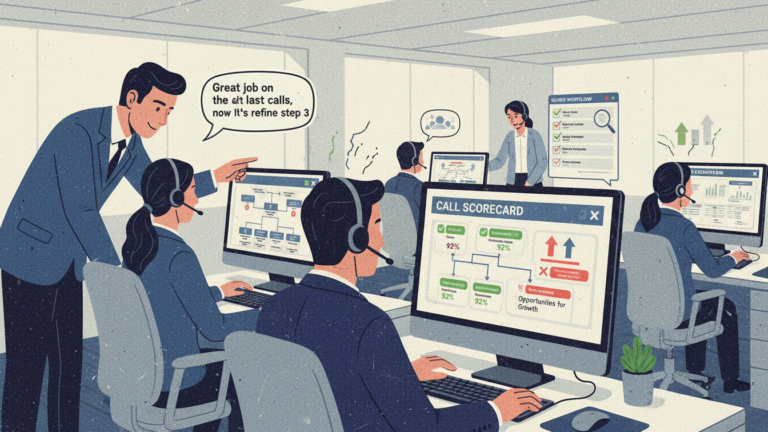
Scorecards define what “good” and “poor” interactions look like by establishing specific criteria against which performance is evaluated. These criteria might include greeting quality, verification completion, information accuracy, resolution effectiveness, empathy demonstration, and closing quality. Each criterion typically has defined scoring rubrics that guide consistent evaluation.
Standardized evaluation criteria matter enormously for fairness and effectiveness. When different evaluators use different standards or interpret criteria differently, scores become inconsistent and unhelpful. Clear, detailed scoring guides with examples of excellent, adequate, and poor performance create consistency that makes scores meaningful and actionable.
Coaching and Feedback
Quality assurance insights translate into agent development through structured coaching and feedback. Rather than just delivering scores, effective coaching discusses specific interactions, explains why certain approaches work better than others, provides clear guidance for improvement, and recognizes strengths to reinforce.
The focus on improvement rather than punishment distinguishes developmental coaching from punitive approaches. When agents understand that QA exists to help them succeed rather than catch them failing, they engage with feedback constructively instead of defensively. This coaching mindset creates cultures of continuous improvement rather than compliance and fear.
Training and Continuous Improvement
QA findings inform training program updates and process refinements through feedback loops that connect front-line performance to organizational learning. When QA reveals that many agents misunderstand specific policies, training gets updated to address that confusion. When certain procedures consistently cause problems, processes get refined to eliminate the friction.
This continuous improvement approach treats quality as evolving rather than static. Initial training and processes are starting points that improve based on what actual performance reveals about what works and what needs adjustment.
Core Metrics Used to Measure Call Center Quality
Several key metrics provide quantitative measurement of call center quality, though each captures only part of the complete picture.
Customer Satisfaction Score (CSAT) measures customer perception through post-interaction surveys asking customers to rate their experience. CSAT provides direct customer voice about whether interactions met their needs and expectations. However, it captures perception rather than objective quality—customers might be satisfied with inaccurate information they don’t realize is wrong, or dissatisfied with correct information they don’t want to hear.
First Call Resolution (FCR) tracks the percentage of issues resolved during initial contact without requiring follow-up calls or escalations. FCR indicates effectiveness—whether agents actually solve problems rather than just handling calls. High FCR suggests quality troubleshooting and solution application. Low FCR indicates incomplete issue resolution that forces customers to contact support multiple times.
Average Handle Time (AHT) measures interaction duration from start to finish including talk time and after-call work. AHT indicates efficiency but requires careful interpretation. Very high AHT might indicate inefficiency, but very low AHT often indicates rushed interactions that sacrifice quality for speed. Optimal AHT balances efficiency with thoroughness.
QA Scores and Compliance Scores reflect adherence to defined standards based on scorecard evaluations. These scores measure whether agents follow procedures, demonstrate required behaviors, and meet quality criteria that the organization defines as important. Unlike customer perception metrics, QA scores measure execution against internal standards.
The critical nuance is that no single metric defines quality comprehensively. CSAT without FCR might indicate pleasant but ineffective interactions. FCR without CSAT might indicate fast resolutions that feel impersonal. AHT without quality context might reward speed over completeness. Effective quality measurement interprets metrics together, understanding that excellent quality typically shows strong performance across multiple dimensions simultaneously.
Over-optimizing any single metric, particularly speed, often degrades overall quality. When operations pressure agents to minimize AHT without equally emphasizing resolution completeness and customer satisfaction, quality suffers as agents rush conversations and provide incomplete solutions.
Best Practices for Improving Call Center Quality
Proven practices for enhancing call center quality focus on creating systematic approaches to quality management rather than depending on individual agent capability alone.
Define clear quality standards that articulate exactly what excellent interactions look like across different scenarios. Vague aspirations like “provide great service” don’t guide behavior. Specific standards like “verify customer identity using three authentication factors,” “acknowledge customer frustration before providing solutions,” and “confirm issue resolution before ending interactions” create clarity about expectations.
Use consistent evaluation criteria so all agents are measured against identical standards and all evaluators interpret those standards similarly. Inconsistent evaluation creates perception of unfairness and makes scores meaningless for identifying actual performance patterns. Calibration sessions where evaluators score the same interactions and discuss their assessments ensure consistency.
Review a meaningful sample of interactions that provides representative insight into performance without requiring impossible 100% monitoring. Statistical sampling determines appropriate review volumes for confidence in findings. Random sampling prevents agents from knowing which interactions will be evaluated, encouraging consistent quality rather than performing well only when they suspect monitoring.
Provide regular, structured coaching based on QA findings through scheduled sessions that discuss specific interactions and performance patterns. Coaching should be timely—occurring soon after observed interactions while they’re fresh—and balanced, recognizing strengths alongside addressing development needs. Quarterly coaching isn’t sufficient; monthly or even weekly sessions create ongoing development.
Involve agents in quality discussions by soliciting their input on quality standards, evaluation criteria, and improvement opportunities. Agents who help define what quality means and how it’s measured take greater ownership of achieving it. They also provide valuable insight into practical barriers to quality that managers might not recognize.
Review and refine processes continuously based on what QA reveals about where processes support quality and where they create obstacles. When the same issues appear repeatedly across many agents, the problem is usually process design rather than individual performance. Fixing processes creates more improvement than coaching individuals to work around flawed procedures.
Why Measuring Call Center Quality Isn’t Enough
Traditional quality assurance approaches, while necessary, have inherent limitations that prevent them from fully ensuring consistent quality across all interactions.
Post-call scoring identifies issues only after interactions complete and affect customers. When QA discovers that an agent provided incorrect information or forgot required verification steps, the customer has already experienced that quality failure. The QA finding helps improve future interactions but doesn’t prevent the initial problem.
Agent performance varies widely even with regular monitoring and coaching because agents must remember and execute procedures correctly under the pressure of live customer conversations. Training teaches what to do. QA checks whether they did it. But neither directly supports agents during the moment when they need to make decisions and take actions correctly.
Quality standards exist in documentation and scorecards, but execution during actual work depends on agent memory, judgment, and ability to apply general procedures to specific situations. The gap between knowing what good quality looks like and consistently delivering it across varied scenarios and high-pressure situations creates the performance variation QA reveals.
The traditional QA cycle is reactive: interactions happen, some get reviewed, gaps are identified, coaching occurs, and hopefully future interactions improve. This approach addresses quality retrospectively rather than proactively ensuring it during execution.
How Guided Workflows Improve Call Center Quality
Guided workflows represent a natural evolution of quality assurance from retrospective inspection to proactive execution support that builds quality into interactions as they occur.
Standardized call flows reduce inconsistency by providing all agents with structured paths through common scenarios. Rather than each agent developing personal approaches that might or might not align with quality standards, workflows present the questions to ask, information to gather, and actions to take in sequences that ensure completeness and accuracy. This standardization means quality doesn’t depend on individual agent experience or memory.
Real-time guidance helps agents follow QA standards naturally by presenting quality criteria at exactly the moments they apply during interactions. If verification is required, the workflow prompts it before allowing progress. If specific information must be captured, the workflow requests it at the appropriate point. If disclosures are mandatory, they appear when needed. This embedded guidance transforms quality requirements from things agents should remember into steps workflows ensure happen.
Fewer quality issues occur when agents don’t have to guess about next steps, recall rarely-used procedures, or interpret ambiguous guidelines under time pressure. Workflows eliminate the guesswork that causes quality failures by providing clear direction adapted to specific customer situations. Agents spend mental energy on customer communication and relationship rather than figuring out what to do next.
Quality assurance expectations become part of the interaction rather than just review criteria by embedding scorecard requirements into workflows that guide execution. The verification steps QA checks for become prompts workflows present. The information QA expects captured becomes fields workflows require completion. QA standards and actual work align because workflows operationalize those standards.
Process Shepherd exemplifies systems that turn quality assurance standards into live workflows agents follow during customer interactions. Rather than quality existing only in scorecards used for retrospective evaluation, Process Shepherd makes quality requirements actionable guidance that shapes how work gets done. The platform ensures agents execute procedures meeting quality standards not through hope that they remember training but through structured workflows that guide correct execution.
Final Thoughts: Call Center Quality Is Built Into Execution
Call center quality ultimately depends on aligning what organizations define as quality standards with what actually happens during customer interactions. The traditional approach of defining standards, training agents, reviewing samples, and coaching based on findings creates improvement but leaves substantial gaps between aspiration and execution.
Strong call center quality comes from designing it into processes rather than inspecting for it afterward. When quality requirements are embedded in workflows agents follow, when guidance appears exactly when needed during work, when procedures prevent rather than just detect quality failures, consistency improves dramatically. Agents perform according to standards not because monitoring might catch mistakes but because workflows make correct execution easier than improvisation.
The future of call center quality lies in helping agents do the right thing in the moment through real-time support that ensures quality standards shape actual behavior. This proactive approach complements traditional QA rather than replacing it. Monitoring and coaching remain important for continuous improvement, but guided workflows ensure the quality those activities promote consistently translates into execution.
Organizations serious about call center quality invest in both defining clear standards and creating systematic approaches for ensuring those standards guide real work. When quality expectations exist not just in scorecards but in the workflows agents follow daily, when processes enforce quality requirements rather than depending entirely on agent memory and discipline, consistency becomes achievable even across large, distributed operations. That alignment of standards, measurement, and execution defines the path toward sustainably excellent call center quality.

Nola Neven
Nola Neven is a content strategist in the CX space, focused on turning complex operational problems into clear, credible content that people actually read, reference, and share.
Her work sits where content and operations meet. She spends her time understanding how contact centers and help desks really function day to day, where workflows break down, where teams rely on workarounds, and where systems quietly slow everything down.