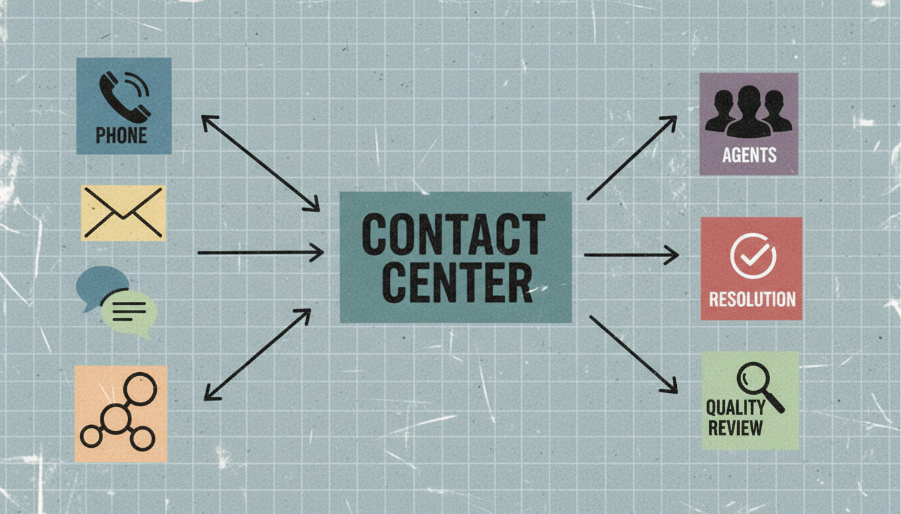
If you’re searching for information about contact center processes, you’re probably looking for a clear explanation of how contact centers actually work—from the moment a customer reaches out to the final resolution and follow-up.
This article covers exactly that. We’ll walk through the standard process flow that most contact centers use. But we’ll also go deeper into what usually breaks in real operations and why even well-designed processes often fail during execution.
Beyond systems and diagrams, contact center processes only succeed when agents can execute them consistently in real time. That’s the gap most operations struggle to close.
For teams struggling to turn documented processes into consistent execution, we’ll also explore where execution support fits in and how modern contact centers are solving this challenge.
What Are Contact Center Processes?
Contact center processes are the structured workflows that guide how customer interactions are received, routed, handled, and resolved across multiple channels. These processes define everything from how calls are distributed to agents, to how issues are escalated, documented, and followed up on. They also include quality assurance procedures and continuous improvement mechanisms.
Here’s the key differentiator: contact center processes define not just how interactions are routed, but how decisions are executed consistently by agents during live customer interactions.
Why do these processes matter so much?
Customer experience: Consistent processes lead to predictable, reliable service that customers can count on.
Efficiency: Well-designed workflows reduce handle time, minimize transfers, and eliminate wasted effort.
Compliance: In regulated industries, process adherence isn’t optional—it’s mandatory.
Agent confidence: When agents know exactly what to do, they perform better and experience less stress.
The Core Contact Center Process Flow (Step by Step)
Let’s walk through the standard model used across most contact centers. This is the foundational framework that governs contact center operations, whether you’re running a small support team or a large-scale operation.
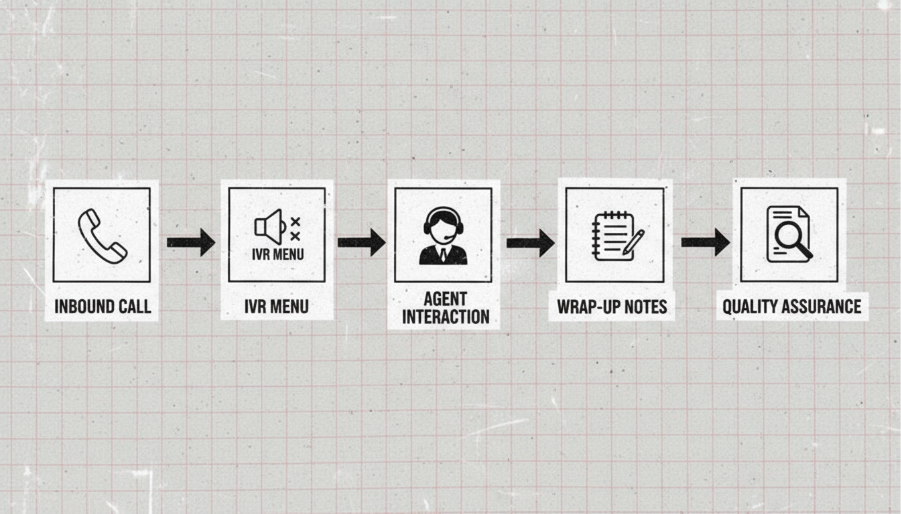
Inbound Interaction Reception and Routing (ACD)
When a customer reaches out—by phone, chat, email, or social media—the first step is reception and routing. This is typically handled by an Automatic Call Distributor (ACD) system that uses skill-based routing to match customers with the right agents.
The technical side works like this: The system identifies the interaction type, checks agent availability and skills, and routes the customer based on predetermined rules. Priority customers might jump the queue. Complex technical issues go to specialized teams.
What usually goes wrong:
Customers get routed to the wrong department because the routing rules don’t account for edge cases. Queues become overloaded when volume spikes or agents are unavailable. Agents receive interactions without proper context about what the customer already tried or what the IVR captured.
Most issues here aren’t purely technical—they’re execution and decision problems. The routing logic might be perfect, but if agents don’t know what to do when they receive a misrouted call, the process breaks down.
IVR and Self-Service Handling
Many customers interact with an Interactive Voice Response (IVR) system or self-service portal before reaching a live agent. The IVR captures intent, authenticates the customer, and either resolves simple requests or gathers information for the eventual handoff.
In theory, IVR reduces agent workload by handling routine inquiries. In practice, poor menu logic frustrates customers who end up pressing zero repeatedly to reach a human.
What breaks:
Customers get routed incorrectly because they selected the wrong menu option—not because they wanted to, but because the right option wasn’t clear. The IVR collects information that never makes it to the agent’s screen. Agents are unsure how to recover when the IVR fails or when customers opt out early.
This is where execution guidance becomes critical. Agents need to know how to pick up where the IVR left off, especially when the handoff is messy.
Live Agent Interaction and Resolution
This is the heart of contact center operations. The agent opens the customer’s record in the CRM, reviews available information, conducts the conversation, diagnoses the problem, and works toward resolution.
Sounds straightforward, right?
Here’s the execution friction:
Agents are juggling multiple tools—CRM, knowledge base, ticketing system, script guides—while trying to maintain a natural conversation. They’re trying to remember the correct process steps for dozens of different scenarios. They’re handling exceptions that weren’t covered in training. They’re making judgment calls about escalation while a customer waits on the line.
The cognitive load during live interactions is enormous. Even well-trained agents struggle with consistency when they’re relying purely on memory during high-pressure moments.
This is where most contact center processes succeed or fail. Not in the design, but in the execution.
Wrap-Up, Documentation, and Recording
After the interaction ends, agents complete wrap-up tasks: logging notes, selecting disposition codes, updating the CRM, and ensuring compliance records are complete.
This step is critical for continuity. If the customer calls back, the next agent needs to understand what happened. If there’s a dispute, documentation provides the record. If you’re in a regulated industry, incomplete records create compliance risk.
What goes wrong:
Agents write incomplete notes because they’re rushing to meet AHT targets. Documentation is inconsistent because different agents follow different formats. Over time, process drift sets in—agents develop their own shortcuts that don’t align with the official procedure.
The result? Your contact center workflow degrades slowly until someone notices the pattern in QA reviews.
Quality Assurance and Follow-Up
The final component of the contact center process flow involves quality assurance reviews, coaching sessions based on those reviews, and customer follow-ups when needed.
QA teams sample interactions, score them against established criteria, and provide feedback to agents and team leads. High-performing centers use this data to refine training and identify process gaps.
Here’s the challenge:
QA happens after the mistake—not during the decision. An agent might handle an interaction incorrectly, and it takes days or weeks before a QA reviewer catches it. By then, the customer is already frustrated, and the agent has repeated the same mistake dozens of times.
What if agents had real-time guidance during the interaction instead of feedback after the fact?
If your contact center processes look perfect on paper but break during live interactions, execution—not documentation—is usually the missing layer.
Why Contact Center Processes Break Down in Real-World Operations
Even the best-designed contact center processes fail in real-world execution. Let’s talk about why.
Cognitive overload: Agents are expected to remember hundreds of procedures while simultaneously listening actively, navigating systems, and maintaining empathy. The human brain isn’t built for that level of multitasking.
Training decay: New agents receive comprehensive training, but retention drops sharply over time. Within weeks, they’re working from partial memories and developing their own interpretations of the process.
Process drift: Without real-time enforcement, processes gradually change. Agents find shortcuts, skip steps they think are unnecessary, or develop workarounds that become unofficial standard practice.
Edge cases and exceptions: Training covers the common scenarios, but customers don’t always fit neatly into categories. When an unusual situation arises, agents improvise—sometimes successfully, sometimes not.
Here’s what’s critical to understand: this is not an agent problem. It’s a process execution problem.
Your agents want to do good work. They’re not intentionally skipping steps or making mistakes. They’re doing their best within a system that relies too heavily on human memory during high-stress, real-time interactions.
Systems vs Processes vs Execution (The Missing Layer)
Most contact centers invest heavily in two areas but overlook a third. Let’s break this down clearly:
Systems: These are your technology tools—ACD for routing, IVR for self-service, CRM for customer data, workforce management for scheduling, analytics for reporting. Systems are essential infrastructure.
Processes: These are your documented workflows—the steps agents should follow, the rules for escalation, the compliance requirements, the scripts and guidelines. Processes provide the blueprint.
Execution: This is what the agent actually does in the moment—the decisions they make during live interactions, how they navigate exceptions, whether they remember to complete critical steps. Execution is where theory meets reality.
Here’s the gap: most contact centers invest heavily in systems and documentation, but very little in execution support.
They buy excellent CRM platforms and routing tools. They create detailed process documentation and SOPs. They train agents thoroughly. Then they hope agents will execute correctly every single time.
Hope is not a strategy.
This is where Process Shepherd enters the picture. Process Shepherd is an execution-layer platform that sits between your processes and your agents. Instead of expecting agents to remember everything, Process Shepherd guides them through processes step by step, supporting their decisions during live interactions.
It’s not a replacement for your systems or your processes. It’s the missing layer that helps agents execute those processes consistently, even when things get complicated.
Process Shepherd helps teams bridge the gap between process design and real-world execution.
Modern Contact Center Processes in 2025 and Beyond
Contact center operations are evolving rapidly. Let’s look at what’s changing and what it means for process execution.
Omnichannel complexity: Customers now interact across phone, email, chat, SMS, social media, and messaging apps. They expect seamless continuity when they switch channels. Your processes need to work consistently across all of them—which means agents need guidance that travels with the interaction, not just channel-specific scripts.
AI-driven insights: Modern contact centers use AI to predict customer intent, suggest next-best actions, and identify at-risk accounts. But those insights only matter if agents can act on them correctly during the interaction.
Real-time personalization: Customers expect agents to know their history, preferences, and context. This requires agents to synthesize information from multiple systems while conducting a natural conversation.
Here’s the challenge: as complexity increases, relying on agent memory becomes risky.
The solution isn’t more training or longer onboarding. The solution is execution support that scales with complexity.
Modern contact center management processes increasingly include:
Guided workflows that walk agents through multi-step procedures in real time
Decision trees that help agents navigate complex scenarios without memorization
Real-time prompts that remind agents of critical steps or compliance requirements
Built-in compliance checks that prevent errors before they happen, not after
These aren’t nice-to-have features. They’re becoming essential components of high-performing contact center workflows.
Practical Examples of Contact Center Process Execution
This is where theory becomes reality. Let’s walk through specific scenarios that show how execution support changes outcomes.
Escalation Handling Without Missed Steps
A customer calls in frustrated because their issue wasn’t resolved in three previous interactions. They’re demanding to speak with a supervisor.
Without execution support:
The agent knows there’s an escalation process but can’t remember all the steps. They transfer the call immediately to avoid conflict. The supervisor receives the call without context. The customer has to explain everything again. The supervisor doesn’t have the documentation from previous interactions because it wasn’t logged correctly.
Result: Customer frustration increases. Handle time doubles. The supervisor’s time is wasted.
With guided execution:
Process Shepherd walks the agent through the escalation protocol step by step:
- Verify that standard troubleshooting was attempted
- Document all previous resolution attempts
- Check if the issue qualifies for immediate escalation or if additional steps should be tried
- If escalation is warranted, collect specific information the supervisor will need
- Brief the supervisor with context before transferring
Result: The escalation happens smoothly. The supervisor has all the context. The customer feels heard. The process is executed correctly.
This isn’t about restricting agent autonomy. It’s about supporting them so they can handle complex situations confidently.
Compliance-Sensitive Customer Interactions
In banking, healthcare, or insurance, compliance isn’t optional. Every interaction must follow specific procedures, and mistakes can lead to regulatory penalties.
Consider a customer calling their bank to dispute a transaction.
The compliance requirements include:
Verifying identity using specific authentication questions Reading required disclosures Following exact steps for different dispute types Documenting specific information Setting correct expectations about timelines
An agent who handles five disputes per day might remember the process. An agent who handles one per month probably won’t—especially under pressure.
With real-time guidance:
Process Shepherd ensures every compliance step is completed, every disclosure is read, every documentation field is filled in correctly. The agent doesn’t have to remember—the system guides them through it.
Here’s the critical difference: this is real-time guidance during the interaction, not after-the-fact QA review. Prevention, not correction.
Supporting New Agents Without Increasing AHT
One of the biggest challenges in contact center operations is the new agent performance gap. New hires take months to reach the productivity and quality levels of experienced agents.
Traditional approach: Extensive training, side-by-side coaching, frequent QA reviews, and accepting that new agents will be slower and make more mistakes for their first 6-12 months.
Execution support approach:
New agents receive the same step-by-step guidance that experienced agents use. They can handle complex interactions from day one because they’re not working from memory—they’re being guided through the correct process in real time.
The results are measurable: training time reduced by 80%, new agents handling complex cases within days instead of months, and consistent quality from day one.
Teams use Process Shepherd to guide agents through complex workflows without slowing down handle time. The guidance is fast, contextual, and integrated directly into the agent’s workflow.
Frequently Asked Questions About Contact Center Processes
What are contact center processes?
Contact center processes are structured workflows that define how customer interactions are received, routed, handled, resolved, and documented. They include everything from call routing and IVR design to agent scripts, escalation procedures, quality assurance, and continuous improvement mechanisms.
What are the three main processes in a call centre?
The three main processes are: (1) Inbound handling – receiving and routing customer contacts to the appropriate agents; (2) Interaction management – the live conversation, problem diagnosis, and resolution activities performed by agents; and (3) Follow-up and quality assurance – post-interaction documentation, QA reviews, coaching, and customer follow-ups.
What is contact center management?
Contact center management involves overseeing all aspects of contact center operations, including workforce planning, performance monitoring, quality assurance, technology management, and process optimization. Effective management focuses not just on reporting and metrics, but on ensuring consistent execution of processes across the entire team.
Final Thoughts: Designing Processes Is Not Enough
Here’s what we’ve learned:
Systems matter. You need the right technology infrastructure to route interactions, manage customer data, and track performance.
Documentation matters. You need clearly defined processes that establish the right way to handle different scenarios.
But execution matters most. The best-designed contact center processes fail if agents can’t execute them consistently during real-time interactions.
The traditional approach—invest in systems, document processes, train agents, and hope for consistency—has a fundamental flaw. It places the entire burden of execution on human memory during high-stress, cognitively demanding interactions.
Modern contact centers are solving this by adding an execution layer that guides agents through processes in real time, supports decision-making during complex scenarios, and ensures consistency without micromanagement.
Process Shepherd was built specifically for this purpose. It turns your documented contact center workflows into guided, interactive processes that agents can follow confidently—whether they’ve been with your company for five years or five days.
If your contact center processes are well-designed but inconsistently executed, Process Shepherd helps turn documented workflows into real-time action.
Learn more about how Process Shepherd supports contact center operations at processshepherd.com.