In the modern contact center, organizations continuously seek methods to enhance execution accuracy, reduce operational errors, and maintain consistency across agent teams. For decades, the go-to answer has been process documentation — written guides, printed manuals, and internal wikis that tell agents what they need to do.
Process documentation is the foundation most call center processes are built on. It communicates procedures, captures institutional knowledge, and sets the standard for how interactions should be handled. But in live call center environments, it consistently falls short. Agents are expected to read, memorize, and recall instructions mid-call — all while managing a customer on the other end of the line. That gap between knowing the process and executing it correctly, every time, is where things break down. According to HiringBranch’s contact center statistics, 60% of failed first call resolution attempts are caused by agents lacking access to the right data and resources at the moment they need them — not a training problem, but a delivery problem.
The evolution of call center process management has led to the emergence of guided workflows — a transformative approach that moves beyond static documentation into dynamic, intelligent systems. This shift isn’t just a digitization of existing procedures. It’s a fundamental reimagining of how operational knowledge is delivered at the exact moment agents need it.
Understanding Process Documentation and Guided Workflows
Before examining the differences, it’s worth establishing what each one actually does — because despite sharing the same goal, they operate in fundamentally different ways.
Process Documentation: The Traditional Foundation
Process documentation refers to any written resource that outlines how tasks should be carried out — SOPs, call scripts, knowledge base articles, training manuals, or internal wikis. In a call center context, these exist to give agents a reference point for handling interactions correctly.
Core functions of process documentation:
- Training and onboarding new agents
- Capturing institutional knowledge and best practices
- Maintaining process consistency across teams and shifts
- Supporting compliance and audit requirements
The core limitation is in the delivery. Process documentation is static. It sits in a separate tab, a printed binder, or a knowledge base that agents have to search while a customer waits. The burden of finding, interpreting, and applying the right information in real time falls entirely on the agent. Even the most carefully written documentation can’t account for the pressure of a live call, an impatient customer, or an agent who is three weeks out of onboarding and handling an unfamiliar issue for the first time.
Guided Workflows: The Dynamic Evolution
A guided workflow is the live, interactive version of process documentation. Rather than requiring agents to reference separate materials mid-call, guided workflows deliver real-time, step-by-step instructions directly within the agent’s interface as the interaction unfolds.
Core capabilities of guided workflows:
- Sequential task navigation with contextual instructions
- Conditional logic and dynamic branching based on customer inputs
- Quality checkpoints and validation at critical stages
- Real-time adaptation to exceptions and variations
This isn’t simply digitized documentation. Guided workflows create adaptive systems that act as an in-the-moment guide for every agent on every call. The system interprets the call center process for the agent — eliminating guesswork, preventing missed steps, and keeping the interaction moving forward correctly. Where documentation asks agents to recall, guided workflows simply tell them what to do next.
Shared Objectives: The Common Ground
Despite their differences, both process documentation and guided workflows share the same operational goals:
- Standardization: ensuring tasks are executed consistently across teams
- Error Reduction: minimizing mistakes through clear process definition
- Quality Protection: maintaining consistent output regardless of who handles the call
- Process Adherence: keeping agents aligned with approved procedures
- Knowledge Preservation: capturing and retaining institutional expertise
The critical difference lies not in intent but in execution — how reliably that knowledge reaches the agent at the right moment, in the right format, during a live interaction. Documentation states the standard. Guided workflows enforce it.
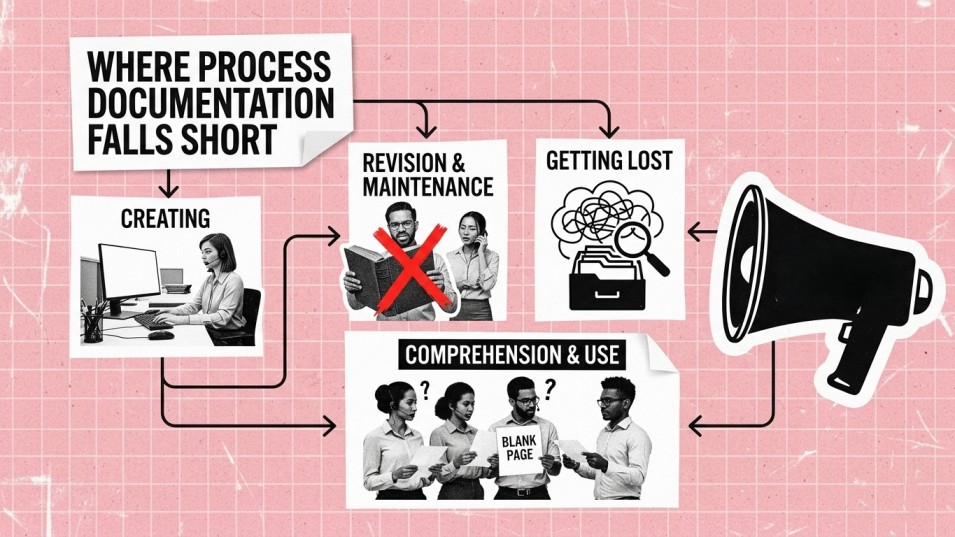
The Critical Distinctions: Where Process Documentation Falls Short
Real-Time Guidance vs. Static Instructions
Process documentation tells agents what should be done. Guided workflows show them exactly how to handle each step while it’s happening. With documentation, agents bear full responsibility for interpreting written instructions and translating them into action during a live call. Guided workflows remove that interpretation burden entirely by delivering contextual, explicit direction at each stage of the interaction.
The interpretation gap: static documentation assumes the agent will correctly understand and apply instructions under pressure. Guided workflows eliminate that assumption by surfacing the next required action automatically — no searching, no second-guessing. The agent stays focused on the customer, not the knowledge base.
Adaptive Flexibility vs. Fixed Linear Processes
Process documentation is written for ideal conditions. It assumes a linear call flow where everything goes according to plan. Real call center interactions rarely work that way. Customers escalate, situations change, exceptions come up constantly, and the call that was supposed to take five minutes turns into fifteen.
Guided workflows adapt to real-world complexity. When conditions shift, the workflow branches automatically, escalates where needed, and adjusts based on what the agent enters. The agent always follows the correct path for their specific scenario — without having to manually interpret exceptions or hunt through multiple documents mid-call.
The complexity challenge: a well-documented call center process is only useful if agents can navigate it correctly under pressure. Most can’t — not consistently. Guided workflows handle that navigation automatically, removing the cognitive load that documentation places on the agent at the worst possible moment.
Operational Intelligence vs. Limited Visibility
Process documentation provides no insight into how calls are actually being handled. It can’t show where agents struggle, which steps get skipped, or why certain issues keep recurring. Managers are left relying on call monitoring, QA sampling, and anecdotal feedback to identify problems — all of which are reactive and resource-intensive.
Guided workflows generate data on every step of every interaction — every decision, delay, and deviation becomes measurable. This delivers real visibility into call center process performance and enables continuous improvement based on actual execution data rather than assumptions or gut feel.
The data advantage: without measurement, improvement is guesswork. According to Xima Software’s call center research, contact centers using data-driven tools see a 14% increase in issues resolved per hour and a 9% reduction in average handle time. Guided workflows generate precisely the kind of data that makes those improvements possible — turning every interaction into a data point that reveals bottlenecks, training gaps, and optimization opportunities across the entire team.
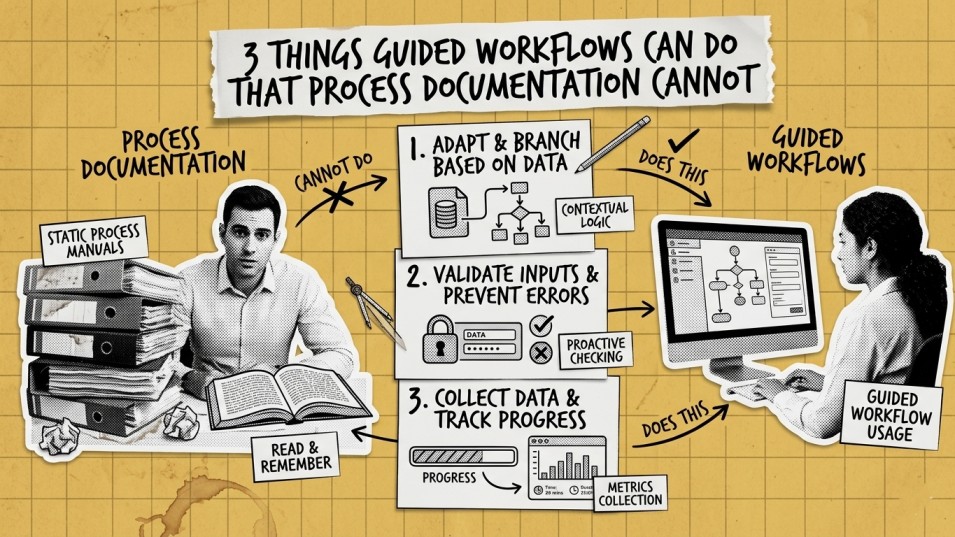
Three Things Only Guided Workflows Can Do
Eliminate Human Error Through Mandatory Step Progression
Rather than relying on agent memory or interpretation of written materials, guided workflows surface the exact next required action and prevent progression until each step is properly completed. This is especially valuable for new agents, high-turnover teams, or anyone handling an unfamiliar call type for the first time.
Process documentation relies on the agent noticing what they’ve missed. Guided workflows make missing a step structurally impossible.
Practical example: in a call center handling billing disputes, relying on process documentation means agents manually follow a multi-step verification checklist — and under pressure, steps get missed. An agent might skip confirming the account holder’s identity, forget to log the dispute reason before issuing a credit, or move to resolution without collecting the documentation needed for a follow-up audit. Each skipped step creates downstream problems: failed compliance checks, unresolved disputes, and customers calling back.
A guided workflow makes those checkpoints unavoidable. The agent cannot move to resolution until verification is confirmed, dispute details are captured, and the correct approval is obtained. The call center process becomes error-resistant by design — not because agents are better trained, but because the system no longer relies on them to remember every step while simultaneously managing a live customer interaction.
Generate Actionable Operational Intelligence
Every interaction within a guided workflow produces quantifiable data. Contact center managers can identify specific bottlenecks, pinpoint training gaps by agent or team, and address process failures before they compound. Process documentation offers none of this — it has no visibility into whether it’s being followed, misunderstood, or skipped entirely. There’s no way to know if the problem is the process or the people.
This data layer is what separates reactive call center management from proactive call center process improvement. Managers stop finding out about problems through escalations and customer complaints, and start identifying them through workflow data before they become patterns.
Practical example: in a telecoms call center handling technical support, static documentation can’t explain why first call resolution rates are consistently low for a specific fault type. Managers can listen to calls, run QA sessions, and retrain agents — but without knowing exactly where the process breaks down, those interventions are educated guesses.
A guided workflow generates data showing that agents are skipping the line diagnostics step and jumping straight to ticket escalation — not because they’re cutting corners, but because the documentation buries that step in a long checklist that’s easy to miss under time pressure. That insight enables a targeted fix: restructuring the workflow so diagnostics appears earlier and is mandatory before escalation becomes available. The result is measurable improvement in FCR without a full retraining cycle, because the problem was always process design, not agent performance.
The shift from reactive problem-solving to proactive call center process improvement is one of the most significant operational advantages guided workflows deliver — and it’s only possible when you can actually see what’s happening on every call.
Automate Navigation of Real-World Complexity
Call center interactions rarely follow a straight line. Customer classifications, account types, issue categories, and compliance requirements create a level of complexity that process documentation handles poorly. Agents are expected to know which document applies, find the right section, identify the relevant exception, and execute the correct procedure — all in real time, while a customer is waiting.
Guided workflows branch automatically, adjust dynamically, and escalate appropriately based on what the agent inputs. The correct path is always presented without requiring the agent to manually interpret which version of the process applies to the situation in front of them.
Practical example: in a financial services call center, a standard documentation approach might instruct agents to “follow the high-risk account procedure if applicable.” That single instruction contains multiple points of failure: the agent needs to know what makes an account high-risk, where to find the relevant procedure, which steps differ from the standard process, and what approvals are required. Under time pressure, with a customer waiting, that’s a lot to get right every time.
A guided workflow handles this automatically. When the agent pulls up the account and the system flags a high-risk classification, the workflow immediately shifts to the appropriate call center process: different verification steps, additional compliance checkpoints, and a mandatory supervisor review before any changes are made. The agent doesn’t need to recognize the exception, locate the right document, or remember the alternate procedure. The complexity is managed by the system, ensuring the correct process is followed every time regardless of agent experience level.
Why This Matters for Call Center Operations
The most thorough process documentation is only as good as the agent’s ability to find it, understand it, and apply it correctly under pressure. In a contact center environment — where calls are timed, customers are impatient, agents handle dozens of interaction types, and turnover keeps bringing new people onto the floor — that’s an unreliable foundation to build consistent service on.
Guided workflows close the gap between knowing the process and executing it correctly. They transform operational knowledge from a static reference into an active guidance system that works inside every call, for every agent, every time. The improvement isn’t dependent on hiring better agents or running longer training programs. It comes from building a call center process that works regardless of who is on the phones.
The Execution Gap
Contact centers that rely heavily on process documentation often find that agents who pass training still execute inconsistently on the floor. Different agents interpret the same instructions differently. Steps get skipped under time pressure. Exceptions get handled incorrectly because the agent couldn’t quickly find the right section of the knowledge base. And managers only find out after something goes wrong — a compliance failure, a customer complaint, or a spike in repeat calls on a particular issue.
This is the execution gap: the distance between what the documentation says should happen and what actually happens on a live call. No amount of documentation refinement closes it, because the problem isn’t the content — it’s the delivery mechanism. Static documentation will always require agents to bridge that gap themselves, and they’ll do it inconsistently.
The Measurable Impact
Contact centers that move from documentation-dependent operations to guided workflows typically see immediate, measurable results across key metrics. For a full picture of how these improvements connect to broader contact center processes, the patterns are consistent:
- Reduced ambiguity: agents always know the exact next step without searching
- Decreased error rates: mandatory progression prevents skipped actions
- Faster onboarding: new agents handle real calls sooner with in-system guidance rather than relying on memory
- Data-driven improvement: actual execution data replaces assumptions and anecdotal feedback
- Consistent quality: standardized call center process execution regardless of agent experience level or shift
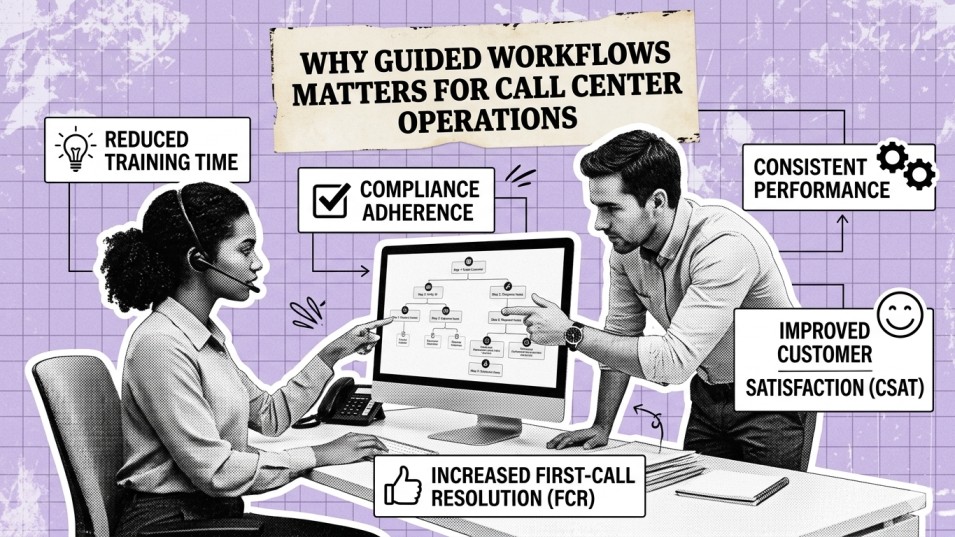
These aren’t incremental gains. For teams dealing with high turnover, complex multi-step interactions, or strict compliance requirements, the difference between documentation-dependent and workflow-guided operations can be significant enough to show up clearly in CSAT, FCR, and AHT within the first few weeks of rollout.
The Broader Shift in Call Center Process Management
The contact center industry has evolved significantly — from basic call handling to omnichannel service delivery, from script-reading to consultative support. That evolution has exposed the limits of static process documentation at every stage. Agents are now expected to manage more complexity, across more channels, with less tolerance for error and higher customer expectations than ever before.
Guided workflows reflect where call center process management is heading: away from documentation that agents are expected to memorize, and toward intelligent systems that guide execution in real time. This connects directly to broader improvements in call center efficiency, contact center automation, and overall customer experience improvement.
Technology as an Enabler
Modern guided workflow platforms provide capabilities that process documentation simply cannot match:
- Universal access: available within the agent’s existing interface, no separate tab or system required
- Real-time updates: process changes deploy instantly across the entire team without redistributing documents
- Integration: direct connection to CRM, ticketing, and telephony systems so context is always available
- Analytics: built-in visibility into execution performance at every step of every interaction
From Documentation Compliance to Execution Outcomes
The measure of a call center process should never be whether a document exists or whether agents completed training on it. It should be whether the process is executed correctly, consistently, and efficiently — on every call, by every agent, regardless of experience level or how busy the floor is. That’s the standard guided workflows are built to meet.
For contact centers focused on quality assurance and effective agent training, guided workflows provide the execution layer that makes those investments actually stick. Training tells agents what to do. Guided workflows make sure they do it correctly every time.
Conclusion: Guided Workflows as the Active Layer of Call Center Process Management
Process documentation will always have a role — for compliance records, audit trails, high-level reference, and regulatory requirements. That role isn’t going away. But documentation alone cannot ensure that the right call center process is followed correctly on every interaction, by every agent, under the real-world conditions that contact centers operate in every day.
Guided workflows fill that gap. They support agents at the precise moment of execution, adapt automatically to the complexity of live interactions, and generate the performance data necessary for continuous improvement. They don’t replace the knowledge that documentation contains — they deliver it in a format that actually works when it matters most.
For contact centers dealing with inconsistent execution, elevated error rates, long agent ramp times, or limited visibility into what’s actually happening on the floor, guided workflows are the missing layer. They transform call center process knowledge from something agents are expected to remember into something the system actively delivers — ensuring precision, consistency, and quality on every single call, from the most experienced agent on the team to the one who just completed their first week.
The question isn’t whether your processes are documented. It’s whether those processes are actually being followed. Guided workflows are how you ensure they are.