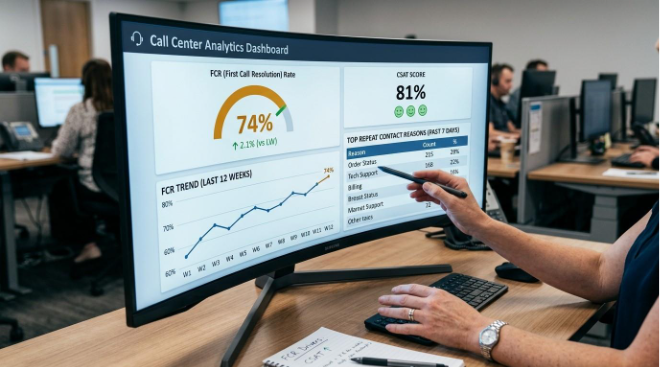
First call resolution (FCR) is the metric that measures whether a customer’s issue was fully resolved the first time they contacted your call center — with no follow-up call, no repeat contact, and no transfer to another agent required.
It sounds simple. But for most call centers, the gap between understanding FCR and consistently achieving it is where millions of dollars in operational cost quietly disappears.
This guide covers everything you need: the definition, the formula, what a good FCR rate looks like, why rates stay frustratingly low — and, critically, how to fix the root cause rather than just track the symptom.
What Is First Call Resolution?
First call resolution means a customer contacts your call center once, their issue is fully handled during that interaction, and they have no reason to call back about the same problem.
FCR is one of the most important KPIs in call center management because it sits at the intersection of two things every contact center cares about: customer satisfaction and operational efficiency. When FCR is high, customers are happy and your cost to serve is low. When it’s low, customers are frustrated and agents are fielding the same issues over and over.
It’s worth noting that FCR and first contact resolution are often used interchangeably. Technically, first call resolution refers specifically to phone interactions, while first contact resolution (also called first touch resolution) extends the same principle across all channels — chat, email, social, and messaging. As contact centers become more omnichannel, first contact resolution is the broader, more modern term. Both measure the same underlying thing: did we solve it the first time?
Another name for first call resolution you’ll encounter is one-call resolution or single-contact resolution — same concept, different terminology depending on the organization.
Why First Call Resolution Matters

FCR is not just another metric to add to a dashboard. It is one of the clearest leading indicators of call center health across every dimension that matters.
Customer satisfaction. Research from SQM Group shows that for every 1% improvement in FCR rate, customer satisfaction improves by 1% in parallel. The inverse is also true: customer satisfaction drops by an average of 15% every time a customer has to call back about the same unresolved issue. Customers who trust that their issue will be handled on the first call are significantly more likely to stay loyal and recommend the business to others.
Operational cost. Every repeat call is a direct cost. Agents spend time re-handling issues that should have been closed. Supervisors deal with escalations that stem from failed first attempts. When you calculate the true cost of a low FCR rate — repeat contacts multiplied by average handle time, multiplied by agent cost — the numbers are significant. A 1% improvement in FCR reduces operating costs by approximately 1%, according to industry research.
Agent experience. Agents who consistently resolve issues feel competent and effective. Agents who repeatedly handle the same unresolved complaints from frustrated customers experience significantly higher stress and burnout. FCR is a retention metric as much as it is a customer satisfaction metric.
Revenue. Customers who experience high-quality, resolved-first-time service are more than twice as likely to make repeat purchases. High FCR also reduces the cost of acquiring new customers by increasing referrals and positive word-of-mouth.
The First Call Resolution Formula
The FCR formula is straightforward:
FCR Rate (%) = (Number of issues resolved on the first call ÷ Total number of calls) × 100
For example: if your contact center handled 1,500 calls last week and resolved 1,125 without any follow-up, your FCR rate is 75% — (1,125 ÷ 1,500) × 100.
In practice, there are two ways to calculate FCR:
Gross FCR counts all interactions in the denominator — including repeat contacts, abandoned calls, and escalations. This gives you a broad view of overall call center workload.
Net FCR excludes contacts that were never resolvable in the first place — escalations requiring specialist knowledge, for instance, or calls that came in outside agent capability. This gives a more accurate view of agent and process performance specifically.
Most mature contact centers track both: gross FCR for capacity planning, net FCR for coaching and process improvement.
The harder question is not the math — it’s defining what “resolved” actually means in your operation. Does the customer need to confirm resolution? Is it defined by no repeat contact within 7 days? 14 days? 30 days? There is no universal standard. What matters is that your definition is clear, agreed upon internally, and applied consistently — otherwise your FCR data is unreliable and your improvement efforts are built on shaky ground.
What Is a Good First Call Resolution Rate?
The widely accepted industry benchmark for a good FCR rate is 70–79%. Top-performing contact centers consistently achieve rates above 80%, with best-in-class operations reaching 85–90%.
Benchmarks vary meaningfully by industry. Retail contact centers average around 77%. Health insurance averages around 68%. Financial services and telecoms typically sit in the 70–75% range. Complex technical support environments may see lower rates by nature of the queries involved.
Rather than fixating on an industry number, the more actionable goal is consistent internal improvement. A contact center moving from 65% to 72% over six months is performing exceptionally well regardless of where the industry average sits.
Why FCR Rates Stay Low — The Root Cause Most Teams Miss
Most attempts to improve FCR focus on measurement: better surveys, more granular data, clearer definitions. These matter. But they are not the root cause of a low rate.
FCR fails at the moment of the call itself — when an agent cannot find the right information quickly enough, makes the wrong decision at a decision point, skips a step in the resolution process, or doesn’t have a clear framework for handling the specific issue in front of them.
These are not training failures in the traditional sense. An agent who learned the correct process six weeks ago and is now handling their 80th call of the week under pressure will make mistakes. Memory degrades. Cognitive load builds. Edge cases arise that weren’t covered in onboarding.
The real question is not “did the agent know what to do?” but “did the system make it easy for them to do the right thing in real time?”

How to Improve First Call Resolution: 8 Proven Strategies
1. Define “Resolved” Before You Measure Anything
Your FCR rate is only as reliable as your definition of resolution. Establish a clear, organization-wide standard — ideally combining two data points: internal confirmation (no repeat contact within a defined window) and external confirmation (post-call survey asking whether the issue was resolved). Neither alone tells the full story. Together, they give you a picture you can act on.
2. Give Agents the Right Information at the Right Moment
A significant share of FCR failures happen because agents can’t locate the right information fast enough during a live call. They put customers on hold. They transfer unnecessarily. They give incomplete answers. The fix is not more training on product knowledge — it’s surfacing the right information in the agent’s interface during the call itself.
Tools like Process Shepherd address this directly. A guided workflow can surface relevant customer history, the correct resolution steps, and any required compliance actions in real time — so agents aren’t hunting across multiple systems while a customer waits.
3. Replace Linear Scripts with Decision Trees
Scripts are one of the most common causes of low FCR. A linear script assumes every customer interaction follows the same path. Real conversations don’t. When the script doesn’t fit the situation, agents improvise — and improvisation produces inconsistency.
A call center decision tree solves this. Rather than a rigid script, agents navigate a dynamic flow that adapts to what the customer actually says. Each decision point presents the correct next step based on the customer’s specific situation. The result: agents handle complex, branching interactions correctly every time without needing to recall every edge case from memory.
4. Embed Resolution Steps in a Guided Workflow

Training tells agents how to handle an issue. A guided workflow shows them — right now, on this call — what to do next.
Process Shepherd allows operations teams to build step-by-step guided workflows for every interaction type: complaints, billing queries, technical issues, escalations. These workflows run in the agent’s interface during live calls, walking them through the correct resolution process in real time. Agents spend less mental energy on recall and more on the customer. Errors that cause repeat calls are caught before they happen.
5. Identify and Fix Your Most Common Repeat Contact Reasons
Pull your repeat contact data and identify the top five or ten issues that most frequently fail FCR. These are almost always caused by one of three things: a gap in agent knowledge, a gap in the process, or a product or service issue that generates inherently complex queries.
For knowledge and process gaps, the fix is targeted workflow improvement — update the guided workflow for that interaction type and retrain specifically on it. For product or service issues, the data becomes a direct input to product and service improvement. Either way, your FCR data is telling you exactly where to focus.
6. Use QA Data to Coach on Specific Missed Steps
Generic coaching — “you need to resolve more calls first time” — does not improve FCR. Specific coaching does. When your quality assurance process can identify precisely which step in the resolution workflow was skipped, which decision was made incorrectly, or which piece of information was missing, coaching becomes targeted and actionable.
Process Shepherd’s built-in reporting tracks compliance at the individual workflow step level. Supervisors can see not just whether FCR was achieved but exactly where in the process it broke down — giving them the precise data needed to coach effectively.

7. Track FCR Alongside AHT and CSAT Together
FCR, AHT (average handle time), and CSAT (customer satisfaction score) need to be read together. A contact center with high FCR but low CSAT may be technically resolving issues but rushing calls in a way that leaves customers feeling dismissed. High FCR with high AHT may indicate agents are resolving well but inefficiently. The three metrics form a triangle: optimize all three together, not one at the expense of the others.
8. Create a Feedback Loop Between Agents and Process Owners
Agents on the front line know exactly why first call resolution fails. They know which queries they lack confidence on, which process steps feel wrong, and which system limitations force them to give incomplete answers. The problem is this knowledge rarely reaches the people who can fix it.
Process Shepherd includes a built-in agent feedback mechanism that allows agents to flag workflow steps that feel outdated or unclear. That feedback goes directly to the process owner, who can update the workflow immediately — and the fix rolls out to every agent’s interface without a retraining session. FCR improvement becomes continuous rather than periodic.
FCR and AHT: What’s the Difference?
AHT (average handle time) measures how long an interaction takes. FCR (first call resolution) measures whether that interaction fully solved the customer’s problem. They are related but distinct. An agent can have a very low AHT by closing calls quickly — but if those calls aren’t actually resolved, FCR suffers and repeat contacts inflate overall volume. Always optimize for FCR first. Efficient resolution follows naturally from a well-structured process.
FCR and CSAT: How They Connect
CSAT (customer satisfaction score) measures how the customer felt about the interaction. FCR is one of the strongest drivers of CSAT because customers who don’t have to call back are, by definition, customers whose problems were solved. However, a high FCR rate doesn’t automatically mean high CSAT — resolution achieved rudely or dismissively still produces a poor satisfaction score. Both metrics matter, and improving one without the other is a half-measure.
Frequently Asked Questions
What is another name for first call resolution? First contact resolution, first touch resolution, one-call resolution, and single-contact resolution are all used interchangeably. First contact resolution is the most common modern term, as it applies across all channels rather than specifically to phone calls.
What is a good first call resolution rate? The industry benchmark is 70–79%. Top performers exceed 80%. Best-in-class contact centers consistently achieve 85%+. What matters more than the benchmark is a consistent upward trend in your own rate over time.
What is AHT and FCR? AHT (average handle time) measures the average duration of a customer interaction. FCR (first call resolution) measures the percentage of those interactions that fully resolved the customer’s issue without a follow-up. Both are key call center KPIs, and both should be tracked and optimized together.
What are first call resolution phrases? These are script phrases agents use to confirm resolution before closing a call — for example: “Is there anything else I can help you with today?” or “I want to make sure your issue is fully resolved before we end the call.” Embedding these phrases into a guided workflow ensures they’re used consistently on every interaction.
Conclusion: Measure It, Then Fix the Process That Drives It
First call resolution is the most honest single measure of whether your call center is actually doing its job. High FCR means customers are getting real answers on the first attempt. Low FCR means something in the process — the information agents have access to, the decision-making framework they’re using, or the steps they’re following — is breaking down.
Tracking the rate is necessary. But tracking alone doesn’t move it. What moves FCR is fixing the moment of the call itself: giving agents the right process, the right information, and the right decision support in real time.
That’s exactly what Process Shepherd is built for. By converting your resolution processes into live guided workflows and dynamic decision trees, Process Shepherd ensures every agent takes the right steps on every call — reducing repeat contacts, improving satisfaction scores, and driving your FCR rate in the right direction, consistently.
See how it works at processshepherd.com — free trial, no credit card required.