Contact centers plan their staffing carefully. Workforce managers run forecasts, build schedules, and calculate exactly how many agents are needed to meet service level targets. Then reality intervenes. Agents are in training. Others are on breaks. Someone called in sick. A system outage has knocked three workstations offline. The agents on the schedule and the agents available to take calls are two very different numbers — and the gap between them is call center shrinkage.
Most organizations treat shrinkage as a workforce scheduling problem: forecast it, build it into the headcount model, and manage it through better planning. That approach addresses part of the problem. But there is a second category of shrinkage that workforce schedules cannot touch — the productive time lost when agents are technically available but operationally inefficient. Unclear processes, fragmented knowledge, excessive escalations, and time spent searching for answers all reduce the effective output of agents who are present, logged in, and counted as available.
This guide covers both dimensions: the definition, formula, and benchmarks of call center shrinkage, and the operational strategies — including guided workflows and decision-tree processes — that reduce it where workforce planning alone cannot reach.
What Is Call Center Shrinkage?
Call center shrinkage is the percentage of paid agent time when employees are unavailable to handle customer interactions. It represents the gap between the hours agents are scheduled to work and the hours they are genuinely productive — actively handling contacts or ready to do so.
Unavailable time encompasses a wide range of activities. Scheduled breaks and lunches, formal training sessions, team meetings, one-to-one coaching conversations, and approved leave all contribute to planned shrinkage. Unscheduled absences, late arrivals, early departures, personal time, system outages, and technology failures contribute to unplanned shrinkage. Together, these categories account for the total contact center shrinkage rate — the share of scheduled hours that is not available for customer-facing work.
It is worth being precise about what shrinkage measures and what it does not. It measures unavailability — time when agents cannot take contacts. It does not, in its traditional definition, measure inefficiency — time when agents are available but not performing productively due to process friction or operational obstacles. That second category is real, significant, and underaddressed in most shrinkage management frameworks. Understanding both is what separates contact centers that manage shrinkage strategically from those that manage it reactively.
Call Center Shrinkage Formula
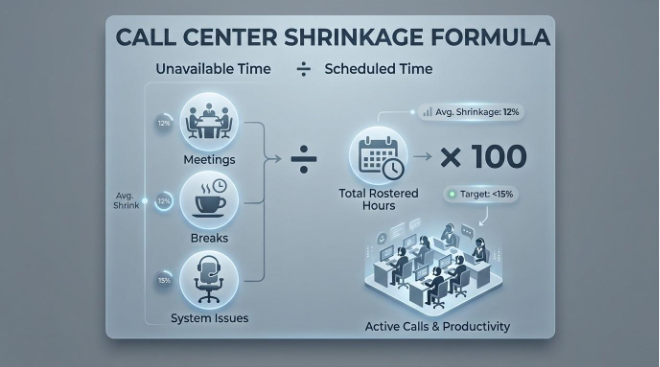
The shrinkage formula is straightforward and should be a standard calculation in every workforce management cycle:
Shrinkage % = (Total unavailable time ÷ Total scheduled time) × 100
Applied at the individual agent level: an agent scheduled for an 8-hour shift who spends 2 hours in training, on breaks, and in a team meeting has a personal shrinkage rate of 2 ÷ 8 × 100 = 25%.
Applied at the team level: a contact center with 60 agents scheduled for 8-hour shifts has 480 total scheduled hours. If 156 of those hours are lost to unavailability across the team, the shrinkage rate is 156 ÷ 480 × 100 = 32.5%.
The call center shrinkage percentage becomes most useful when it is broken down by category rather than reported as a single blended number. A total shrinkage rate of 32% tells you that a problem exists. A breakdown showing 18% planned shrinkage and 14% unplanned shrinkage tells you where the problem is and which operational lever to pull. Planned shrinkage above benchmark points toward scheduling and training management. Unplanned shrinkage above benchmark points toward agent engagement, workforce culture, and — as we will examine — operational efficiency.
Most workforce management platforms automate the shrinkage formula calculation across teams and time periods, generating the category-level visibility that makes the number actionable. The calculation itself is simple. The interpretation and operational response is where the real work lies.
Types of Call Center Shrinkage
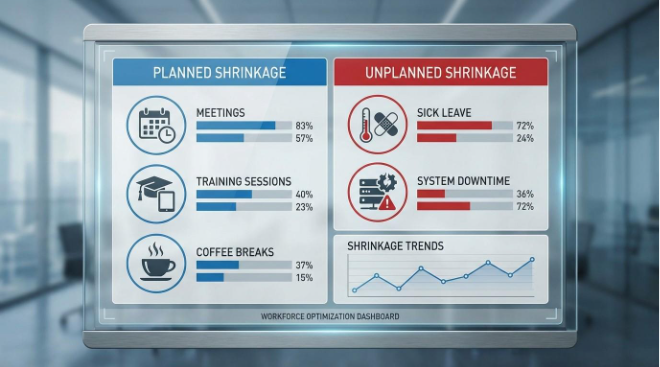
Understanding shrinkage as a single uniform category leads to uniform — and often ineffective — responses. The two primary types require fundamentally different management approaches.
Planned shrinkage covers all predictable, scheduled unavailability. Training sessions, team briefings, one-to-one coaching conversations, scheduled breaks, lunches, and approved annual leave all fall into this category. Planned shrinkage is manageable because it is foreseeable — it can be built into staffing models, timed to coincide with lower-volume periods, and optimized through intelligent scheduling. The primary lever is not reducing planned activities — training and coaching are operationally necessary — but scheduling them at times that minimize their impact on service level. A training session during a peak demand window converts planned shrinkage into a service level crisis. The same session during a historically quiet period is absorbed without impact.
Unplanned shrinkage covers all unpredictable unavailability: unscheduled absences, lateness, personal emergencies, and technology failures. Unplanned shrinkage cannot be eliminated, but it can be reduced and better absorbed. High unplanned absenteeism is frequently a signal of agent disengagement or burnout — both of which are connected to the operational environment agents work in daily. Agents who spend their shifts navigating unclear processes, searching for answers under time pressure, and managing customer frustration driven by their own tool limitations experience higher cognitive load and occupational stress. That stress manifests, over time, as the unplanned absences that inflate shrinkage rates. Addressing the operational root causes of agent stress is a shrinkage management strategy as much as it is a wellbeing one.
The Impact of Shrinkage on Contact Center Performance
Call center shrinkage does not stay contained within the workforce management function. Its effects propagate across every operational metric that contact center leaders track and report against.
The most immediate impact is on agent availability. If a contact center staffing forecast is built on the assumption of 25% shrinkage but actual shrinkage runs at 35%, the operation is chronically understaffed against its service level targets. The agents who are present absorb a higher contact volume per hour, queue times grow, abandonment rates rise, and customers experience longer waits before their calls are answered. The service level agreement targets set at the planning stage become progressively harder to meet as the gap between scheduled and available agents widens.
The downstream effects on customer satisfaction are direct and measurable. Customers who wait longer in queues arrive at the agent interaction already frustrated. Agents handling elevated contact volumes under time pressure are more likely to miss steps in the resolution process, make errors, or close calls without complete resolution — driving repeat contacts that consume further agent capacity. The cycle compounds: shrinkage reduces capacity, reduced capacity reduces quality, reduced quality drives repeat contacts, repeat contacts reduce capacity further.
The cost implications are equally significant. Unplanned shrinkage in particular carries a hidden cost that extends beyond the lost productive hours of the absent agent. Supervisor time is consumed managing short-notice absences. Remaining agents may work overtime to absorb the gap. Escalated contacts generated by understaffed teams require more senior agent time to resolve. When the full cost of high shrinkage is calculated — including these second and third-order effects — the business case for proactive shrinkage management is substantial.
Average Call Center Shrinkage Benchmarks
Understanding where your shrinkage rate sits relative to industry benchmarks is the starting point for assessing whether you have a problem worth prioritizing and how significant it is.
The widely accepted industry average for call center shrinkage sits between 30% and 35%. Contact centers operating above 35% are carrying shrinkage that is meaningfully impacting their operational performance and almost certainly their service level and customer satisfaction metrics. Operations consistently below 25% are either managing shrinkage exceptionally well or may be under-measuring certain unavailability categories — both possibilities worth investigating.
High-performing contact centers typically maintain shrinkage rates in the 25–30% range. These operations tend to combine robust workforce management processes with strong scheduling discipline and — critically — low unplanned absenteeism driven by high agent engagement. The best-performing operations in the industry, typically large in-house contact centers with stable workforces and mature operational processes, sustain rates at or below 20%.
Benchmarks vary by operating model and industry. Outsourced BPO environments typically carry higher shrinkage due to larger team sizes, higher training frequency, and more complex workforce logistics. In-house operations with experienced, long-tenured workforces run lower. Multichannel contact centers handling voice, chat, and email simultaneously may see different shrinkage dynamics than single-channel operations. The benchmark is most useful as a directional reference — the real goal is sustained internal improvement tracked against a consistent measurement methodology.
The Hidden Causes

Here is the category of shrinkage that most workforce management frameworks miss entirely — and where some of the most significant productivity gains are available to contact centers willing to look beyond the scheduling model.
Even when agents are technically available — present at their workstations, logged into their systems, and counted as productive in the workforce management platform — operational inefficiencies can dramatically reduce their effective output. This is operational shrinkage: time that exists within the available hours but produces no customer value because the agent is navigating process friction rather than serving customers.
Agents spending time searching for answers during live calls is one of the most prevalent forms of operational shrinkage. When the correct resolution process is not embedded in the agent’s interface, they search across knowledge bases, internal wikis, team chat channels, and supervisor escalations while the customer waits. That search time — invisible in traditional shrinkage measurement because the agent is technically available — is real productive time being consumed by a process infrastructure failure.
Unclear troubleshooting procedures extend handle time on every affected interaction. When agents lack a structured decision framework for complex query types, they improvise. Improvisation takes longer than a defined process, produces more errors, and generates more repeat contacts — all of which consume agent capacity that shrinkage calculations do not capture.
Excessive escalations driven by inadequate process guidance represent another significant source of operational shrinkage. When agents escalate contacts they could resolve with the right structured support, both the escalating agent’s time and the receiving supervisor’s time are consumed beyond what the interaction required. A decision tree that makes the correct escalation threshold explicit — and provides the resolution steps for interactions that do not meet that threshold — directly reduces this consumption.
The practical implication is significant: improving agent productivity during available hours is a shrinkage reduction strategy that complements workforce scheduling rather than competing with it. Reducing the time each agent spends on each contact creates capacity — effective capacity — without adding headcount or changing the scheduling model.
How Guided Workflows Reduce Call Center Shrinkage
The operational shrinkage described above has a structural solution: guided workflows that embed the correct process into the agent’s interface during live customer interactions, eliminating the searching, the improvisation, and the escalation that consume productive time.
A guided workflow presents agents with the correct next step at each stage of a customer interaction based on what the customer has said and what the situation requires. Rather than recalling a complex procedure from a training session, searching a knowledge base under time pressure, or escalating to a supervisor because the correct path is unclear, the agent navigates a structured decision-tree workflow that surfaces the right action at the right moment — without friction, without delay, and without cognitive overload.
The impact on effective agent productivity is direct. Average handle time decreases because time spent searching is eliminated. Escalation rates fall because the decision tree makes the correct resolution path explicit for interactions that agents previously felt uncertain about. First call resolution improves because the guided workflow ensures every step in the resolution process is completed before the call closes. And the cognitive load on agents is reduced — which, over time, contributes to lower unplanned absenteeism by reducing the occupational stress that drives it.
Process Shepherd transforms complex support procedures into interactive decision-tree workflows that guide agents through troubleshooting and resolution in real time. Operations teams build these workflows using a no-code, drag-and-drop editor — covering every contact type, including edge cases and compliance requirements, without engineering involvement. The workflows run live in the agent’s interface during customer interactions and integrate natively with Zendesk, surfacing the correct guided workflow automatically alongside each incoming ticket. When a process changes, the update is published once and immediately available to every agent across the operation — no retraining cycle, no risk of agents following an outdated procedure that extends handle time or generates repeat contacts.
For contact centers carrying elevated shrinkage rates driven partly by operational inefficiency, guided workflow technology is one of the highest-leverage investments available — because it improves the productivity of every available hour rather than simply trying to increase the number of available hours.
Best Practices
Effective shrinkage management requires parallel attention to workforce planning and operational efficiency. The following practices address both dimensions.
Improve demand forecasting accuracy. Shrinkage management begins with an accurate picture of contact volume demand. Forecasting models that systematically over or underestimate demand produce scheduling decisions that amplify the impact of shrinkage rather than absorbing it. Regular forecast accuracy reviews — comparing predicted against actual volumes by time period and contact type — are the foundation of effective workforce management.
Schedule planned activities against demand patterns. Training, coaching, and team meetings should be scheduled during historically low-volume periods wherever possible. Workforce management platforms that overlay training schedules against demand forecasts make this straightforward to implement — and the service level impact of planned shrinkage reduces significantly as a result.
Track schedule adherence in real time. Schedule adherence — the percentage of time agents are doing what their schedule requires at the time it requires it — is the most direct behavioural driver of unplanned shrinkage. Real-time adherence monitoring gives supervisors the visibility to identify and respond to deviations before they accumulate into a meaningful service level impact.
Monitor and address agent engagement as a shrinkage driver. High unplanned absenteeism is rarely random. It clusters in teams with high cognitive load, poor tooling, and inadequate operational support. Identifying the correlation between absenteeism patterns and operational conditions — including the process environment agents work in — is what allows targeted interventions rather than generic policy responses.
Implement guided workflows to reduce operational shrinkage. Decision-tree workflow platforms like Process Shepherd standardize the processes agents follow during live interactions — reducing handle time, escalation rates, and the searching behaviour that consumes productive agent time without appearing in traditional shrinkage metrics. The result is more effective output from every hour of available agent time: a direct improvement in operational capacity without an increase in scheduled headcount.
Conclusion
Call center shrinkage is unavoidable. Some portion of every agent’s scheduled time will always be consumed by training, breaks, meetings, and the unpredictable events that generate unplanned absence. The goal is not to eliminate shrinkage — it is to measure it accurately, manage its planned components intelligently, reduce its unplanned components systematically, and address the operational inefficiencies that consume productive time even within the hours that shrinkage calculations count as available.
The most effective shrinkage management strategies combine robust workforce planning with operational process improvement — treating agent productivity during available hours as seriously as agent availability itself. As contact centers grow more complex and the interactions they handle become more demanding, platforms like Process Shepherd play an increasingly important role in reducing operational shrinkage: guiding agents through faster, more consistent support workflows that make every available hour more productive than the one before it.
Start your free trial at processshepherd.com — no credit card required.