Most businesses assume a strong customer service relationship comes down to hiring friendly agents. The truth is far more structural, and fixing it requires looking at the systems behind every single interaction.
Think about the last time you had a genuinely great customer service experience. Chances are, what made it stand out wasn’t that the agent was unusually warm or funny. It was that they knew what they were doing. They didn’t put you on hold four times. They didn’t give you a different answer than the last person you spoke to. They handled your issue cleanly, confidently, and completely, and you walked away feeling like the company actually had its act together.
That feeling, that sense of being handled by a team that knows its processes, is the real foundation of a strong customer service relationship. And it’s far rarer than most businesses realize.
What a Customer Service Relationship Actually Means
The phrase “customer service relationship” gets used loosely. Marketing teams talk about it in terms of brand loyalty. Customer success teams talk about it in terms of check-in calls and health scores. But for the vast majority of customers, the relationship isn’t built in a campaign or a quarterly review. It’s built (or broken) in the moments when something goes wrong and they pick up the phone.
A customer service relationship is the ongoing connection a business builds with its customers through every touchpoint and interaction. At its core, it is trust built through repeated interactions. Every time a customer contacts your support team, they’re placing a small bet: will this be resolved, or will I be frustrated again? Win that bet consistently, and loyalty follows naturally. Lose it enough times, through slow responses, conflicting information, or agents who clearly don’t know the process, and no amount of goodwill messaging will save the relationship.
The defining word here is consistency. Not perfection. Customers are remarkably forgiving of honest mistakes. What they don’t forgive is feeling like a different company picked up the phone each time they called.

The Hidden Enemy of Customer Relationships: Inconsistency
Here’s a scenario that plays out in contact centers every day. A customer calls about a billing dispute. The first agent they speak to offers a partial credit and explains a specific resolution process. The customer calls back the next day to follow up. A different agent answers, offers a different interpretation of the same policy, and suggests a different outcome. The customer is now more frustrated than when they started, not because either agent was rude, but because the company can’t get its own story straight.
This is the inconsistency problem, and it silently destroys customer service relationships at scale. It has several root causes.
Agent knowledge gaps. Most teams have a small group of seasoned agents who genuinely know the processes inside out. The rest, especially newer hires, are operating from memory, hoping their training from three weeks ago still applies. In fast-changing businesses, it often doesn’t.
Over-reliance on top performers. When complex cases come in, they get escalated to the same three people. This creates bottlenecks, burnout among your best agents, and a two-tier service experience that customers eventually notice.
High turnover cycles. Contact centers typically see some of the highest staff turnover across any industry. Every time an experienced agent leaves, institutional knowledge walks out with them, and the inconsistency gap widens again.
Customers don’t leave because an agent was unhelpful. They leave because the third agent gave them a third different answer.
The damage this does to the customer service relationship is compounding. Every inconsistent interaction erodes a little more trust. Eventually, customers stop believing the problem will actually get solved, and they start looking elsewhere. This is why tracking the right customer service KPIs matters: they reveal where inconsistency is quietly doing the most damage.
Why Training Alone Can’t Fix It
The instinctive response to inconsistency is more training. Longer onboarding. More detailed manuals. Refresher sessions every quarter. And while training has its place, it has a fundamental limitation: human memory is unreliable under pressure.
An agent handling 60 interactions a day, across a dozen different issue types, cannot be expected to recall the precise steps for every edge case on demand. They’ll handle the common scenarios reasonably well. But the moment a customer comes in with something outside the usual pattern, a complex billing dispute, a compliance-sensitive refund, an unusual account configuration, the agent is on their own, making judgment calls that may or may not align with company policy.
Add to this the reality that most contact centers are training new agents on a rolling basis. A typical onboarding process takes weeks or months before an agent is truly confident on the floor. During that ramp-up period, every interaction carries higher risk, for the customer’s experience and for the company’s compliance record.
Training gets agents to a baseline. But it can’t sustain consistency across an entire team, across every interaction, in real time. That requires something different: guidance that travels with the agent, right into the moment it’s needed.
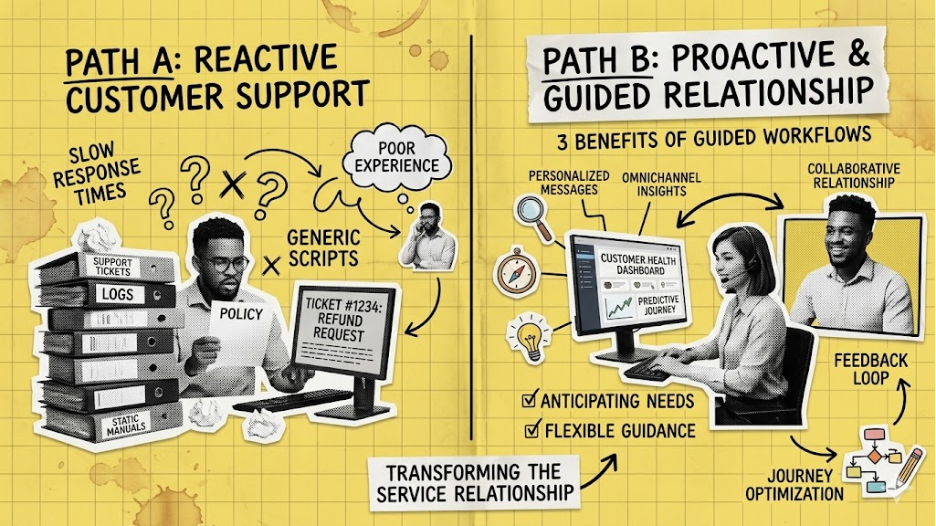
How Guided Workflows Transform the Customer Service Relationship
This is where the approach shifts from reactive to structural. Instead of trying to load every process into an agent’s memory before they hit the floor, guided workflows embed the process into the interaction itself, presenting the right step, at the right moment, in a format any agent can follow.
Process Shepherd is built around exactly this principle. Rather than leaving agents to rely on recalled training, the platform guides them through each interaction via dynamic decision trees: branching, step-by-step prompts that adapt based on what the customer is actually saying and what the situation requires.
When a billing dispute comes in, the agent doesn’t need to remember the resolution protocol. The workflow surfaces it. When an edge case arises, an unusual account type or a regulation-specific scenario, the decision tree branches to cover it. The agent simply follows the path. Every time. For every customer.
Beyond the decision tree itself, Process Shepherd layers in an AI knowledge system that surfaces relevant information articles exactly when an agent needs them, embedded directly within the workflow step, not buried in a separate documentation tab. No more alt-tabbing. No more “let me put you on hold while I find that.” The knowledge comes to the agent, not the other way around.
According to Zendesk’s guide on customer relations, customers who receive consistent, knowledgeable service are significantly more likely to stay loyal and recommend a brand to others. When every agent follows the same guided process, the customer stops getting different answers depending on who picks up. The interaction feels professional, accurate, and handled. That’s what builds trust. That’s what turns a single transaction into a long-term relationship.
Consistency at Scale: What It Actually Looks Like
Picture a contact center where a brand-new agent, on their second week on the floor, receives a call about a complex refund dispute involving a third-party payment processor. Under a traditional setup, this call gets escalated. The customer waits. The experienced agent is pulled from another interaction. Everyone loses time.
With guided workflows in place, that new agent follows the decision tree specific to third-party refund disputes. Each step is clear. The required compliance checks are built in. The appropriate resolution options are surfaced at the right moment. The agent handles the call correctly, not because they had months of experience, but because the process was structured to carry them through it.
The customer doesn’t know any of this. All they experience is an agent who knew what they were doing, resolved the issue cleanly, and didn’t waste their time. That’s exactly the kind of interaction that quietly builds a strong customer service relationship: not through grand gestures, but through reliable, competent service delivered every single time.
At scale, this consistency compounds. Fewer escalations. Lower average handling times. Reduced error rates. Higher first-call resolution. And customers who gradually stop expecting to be frustrated when they call, because they’ve learned, over time, that this company consistently gets it right.
The Agent Side of the Relationship
It’s worth flipping the lens for a moment. A strong customer service relationship isn’t only shaped by what the customer experiences. It’s also shaped by how agents feel while delivering that experience.
Agents who are constantly guessing, constantly afraid of making mistakes on complex cases, and constantly overwhelmed by the cognitive load of memorizing dozens of process variations are not in a position to be warm, present, or engaged on a call. The stress shows, subtly, but it shows. Tools like interactive decision tree software remove that burden entirely, freeing agents to focus on the human side of each conversation.
When agents have clear guidance, they can focus their mental energy on the human side of the interaction: listening properly, responding with empathy, and actually connecting with the customer rather than frantically trying to recall the right protocol. The result is an agent who feels competent and supported, and that confidence is something customers can feel on the other end of the line. Process Shepherd’s approach to improving agent productivity is built precisely around this idea: that a better-supported agent always delivers a better customer experience.
The Strongest Relationships Are Built on Systems
There’s a temptation to think of customer service relationships as something soft and interpersonal, built on charm, empathy, and individual talent. And those qualities matter. But they can’t scale. They can’t be replicated across a team of 50 agents. They can’t survive high turnover. They can’t protect you when a complex edge case lands on the desk of your newest hire.
What scales is process. What survives turnover is a well-structured guided workflow. What protects your compliance record and your customer relationships simultaneously is a system that gives every agent, regardless of experience level, the exact guidance they need, at the exact moment they need it.
The businesses with the strongest customer service relationships aren’t necessarily the ones with the best agents. They’re the ones who’ve built systems that make every agent capable of delivering a consistently excellent experience: every call, every ticket, every time.