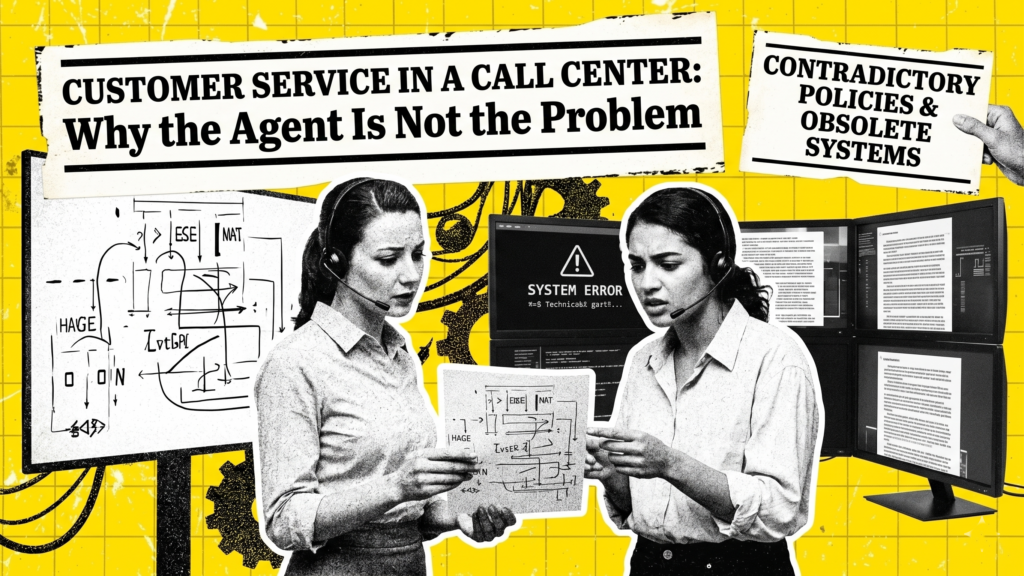
Every article about customer service in a call centre eventually arrives at the same conclusion: hire better agents, train them harder, and monitor them more closely. It is a reasonable instinct. When quality is inconsistent, the natural place to look is the people delivering the service. But this instinct misidentifies the problem. The agents are rarely the issue. The system they are working within usually is.
This article makes the case that improving customer service in a call centre is less a people development challenge and more a process infrastructure challenge, and that the teams consistently delivering excellent service are the ones who have built systems that make quality the default rather than the exception.
What Customer Service in a Call Centre Actually Looks Like Day to Day
It is worth being clear-eyed about the environment call centre agents are actually operating in before diagnosing why quality breaks down.
On any given shift, an agent might handle calls covering billing disputes, technical troubleshooting, account changes, complaints, compliance-sensitive requests, and edge cases they have never encountered before. They are doing this back to back, across a full shift, often without meaningful breaks between interactions. According to research from the International Customer Management Institute, the average call centre agent handles between 40 and 80 calls per day, each requiring them to recall the correct process, apply the right policy, and communicate clearly under time pressure.
The knowledge required to do this well is vast and constantly changing. Products update. Policies change. Regulations evolve. And the training that was supposed to prepare agents for all of this happened weeks or months ago, in a controlled environment that bore little resemblance to the pressure of a live call with an impatient customer on the other end.
This is the baseline reality of customer service in a call centre. It is not a forgiving environment for memory-dependent quality management.
The Real Reason Customer Service Quality Breaks Down in a Call Centre
When quality problems surface in a call centre, the instinct is to look at individual agent performance. The more revealing question is: what does the system those agents are working within actually look like?
In most call centres, knowledge lives in people’s heads. Processes are taught at onboarding and then left to individual recall. The agents who have been in the role longest carry the most institutional knowledge, handle the most complex calls, and informally cover for the gaps in newer agents’ understanding. Quality concentrates at the top of the experience curve. Newer agents, who represent a significant portion of most call centre floors given the industry’s notoriously high turnover rates, are operating with incomplete knowledge in a high-pressure environment and making judgment calls they are not yet equipped to make confidently.
According to a report by Salesforce on contact centre performance, high agent turnover is one of the most persistent drivers of inconsistent customer service, with some call centres experiencing annual turnover rates exceeding 30 to 45 percent. Every time an experienced agent leaves, the institutional knowledge they carried leaves with them, and the quality gap widens.
The result is a service experience that varies significantly depending on who picks up. The same customer calling about the same issue on two different days can receive two entirely different responses. That inconsistency is not a reflection of individual agent failure. It is the predictable output of a system that has not been built to enforce consistency at scale.
What Actually Fixes It: Process Before People
The conventional response to call centre quality problems is more investment in people: more training, more coaching, more performance management. These are not wrong, but they treat a systems problem as though it were a talent problem, and they do not scale.
Training gets agents to a baseline. But it cannot be present in the moment when a complex call comes in six weeks after onboarding, when the agent is on their twelfth call of the shift and is trying to recall a process they have only encountered twice before. What is needed is guidance that does not rely on memory at all, a system that travels with the agent into every interaction and presents the right process at the right moment, regardless of their experience level or how long ago they trained.
That is what a decision tree does. Rather than expecting agents to hold every process in their heads, a decision tree guides them through each interaction step by step in real time, adapting as the conversation develops, surfacing the right information at the right moment, and ensuring the correct process is followed every time.
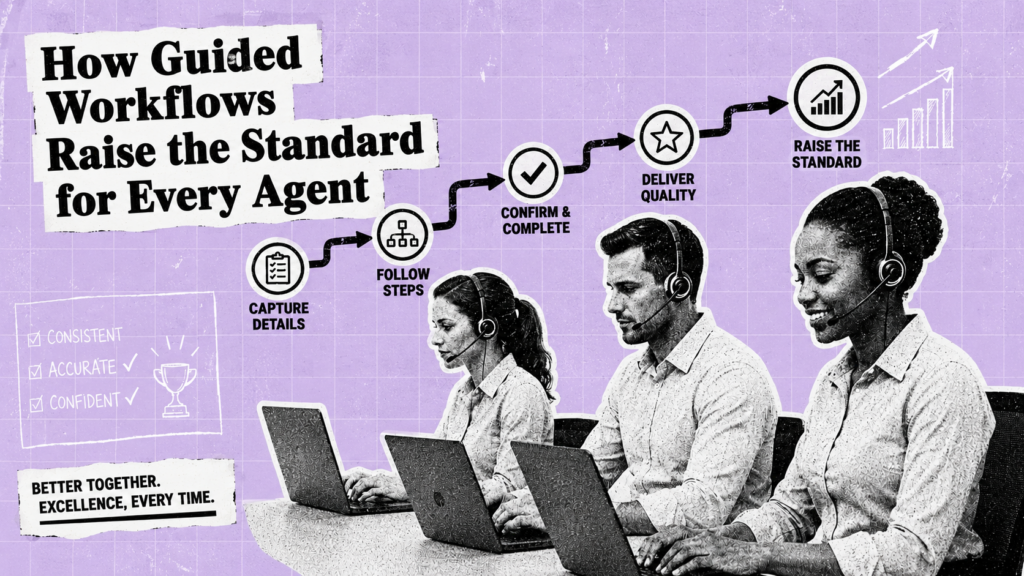
How Guided Workflows Raise the Standard for Every Agent
Guided workflows address the root causes of inconsistent customer service in a call centre directly, not by making agents better at remembering, but by removing the dependency on memory altogether.
They close the knowledge gap between new and experienced agents instantly. The difference between a two-week agent and a two-year agent is primarily experience, which in a call centre context means familiarity with processes, policies, and edge cases. Interactive decision tree software transfers that process knowledge into the workflow itself, so a new agent handling a complex scenario on their second week follows exactly the same steps as a veteran handling the same scenario on their five hundredth call. The quality floor rises to meet the quality ceiling.
They enforce consistent process across every shift and every scenario. When the process is embedded in the workflow rather than recalled from training, the outcome stops depending on who picked up the call. The same scenario produces the same steps, the same checks, and the same resolution pathway regardless of which agent answered, which shift it was, or how busy the floor happened to be. Consistency becomes the output of the system rather than a characteristic of individual agents.
They reduce handling time without cutting corners. A significant portion of call handling time is spent in hesitation: agents pausing to recall the next step, searching a knowledge base in a separate tab, or putting a customer on hold to find an answer. Guided workflows eliminate that friction. The next step is always present. Knowledge articles are surfaced within the workflow itself at the moment they are needed. Agent productivity improves not through pressure or speed targets, but through the removal of the uncertainty that slows agents down.
They embed compliance into every interaction. In regulated industries, the consequences of an agent skipping a required disclosure or missing a mandatory process step can be serious. Guided workflows make compliance automatic. Required steps are built into the workflow and cannot be bypassed. The agent does not decide whether a compliance check is necessary. The system determines it and requires it before the interaction can proceed.
They surface knowledge exactly when it is needed. One of the most common causes of extended handling times and customer frustration is the agent needing to find information they do not have at hand. Guided workflows solve this by surfacing relevant knowledge articles, policy documents, and product information directly within the workflow step, at the precise moment the agent needs them, without switching screens or interrupting the call.
The Measurable Difference
The impact of guided workflows on customer service in a call centre is not abstract. It shows up in the metrics that operations managers and contact centre leaders track every day.
First-call resolution rates improve when agents have the right process and the right information in front of them during every interaction, rather than escalating because they are uncertain. Average handling time decreases when agents are not pausing to search, recall, or deliberate. Escalation rates fall when every agent is equipped to handle the full range of scenarios rather than deferring to more experienced colleagues. Compliance scores improve when required steps are enforced by the system rather than left to individual recall.
Onboarding time shortens meaningfully as well. When new agents are guided through interactions in real time, the ramp from new hire to productive agent is measured in days rather than months. Tracking the right customer service KPIs across these dimensions gives operations leaders a clear, evidence-based picture of where their call centre stands and where the greatest opportunities for improvement lie.
Conclusion
The standard of customer service in a call centre does not rise primarily because agents are told to do better. It rises when the system around agents is built to support consistent, accurate, quality execution on every call, regardless of who is answering, what shift it is, or how long that agent has been in the role.
The agents in your call centre are not the problem. The absence of process infrastructure that makes consistency the default is. Guided workflows are that infrastructure.
Process Shepherd gives call centre teams the decision trees, real-time knowledge support, and guided workflow infrastructure to deliver consistent, high-quality customer service from day one. Learn more at processshepherd.com.