AI Call Center Software: What It Is and Why Businesses Are Adopting It
AI call center software uses technologies like natural language processing, machine learning, and automation to manage customer interactions across voice and digital channels. It handles routine inquiries through chatbots and virtual assistants, while supporting human agents with real-time coaching, call summaries, and intelligent routing. Businesses use AI-powered call centers to improve efficiency, reduce costs, and deliver faster, more personalized customer support—whether teams are in-house or outsourced.
Table of Contents
- How AI Call Center Software Works in Modern Contact Centers
- Key Benefits of AI-Powered Call Centers (For In-House and Outsourced Teams)
- AI Call Center Software vs AI-Enabled Call Center Outsourcing
- Best AI Call Center Software Platforms
- How to Choose the Right AI Call Center Solution (or Outsourcing Partner)
- Real-World Use Cases: How Businesses Use AI in Outsourced Call Centers
- Common Concerns About AI Call Centers (Answered)
- Frequently Asked Questions About AI Call Center Software
- Final Takeaway: When AI-Powered Call Center Outsourcing Makes Sense
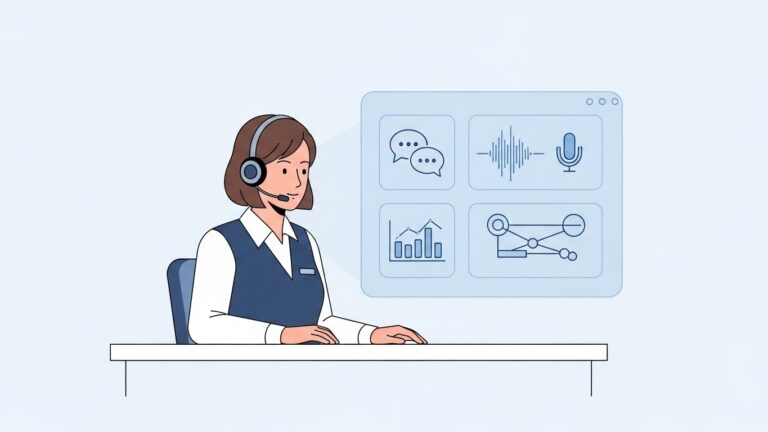
Call centers have always been the front line of customer service, but they’ve also been notoriously challenging to run efficiently. Long wait times, inconsistent service quality, high turnover rates, and rising operational costs have plagued the industry for decades. Now, artificial intelligence is changing the game.
AI call center software uses natural language processing, machine learning, and automation to handle customer interactions across voice and digital channels. It supports agents with real-time coaching, call summaries, and intelligent routing, while chatbots resolve simple inquiries without human involvement. The result is faster service, lower costs, and better experiences for both customers and agents.
Businesses are adopting this technology rapidly for several compelling reasons. Support volumes continue to climb as companies grow and customers expect instant help across more channels than ever. Cost pressure from economic uncertainty and competitive markets drives the search for efficiency. Customer experience expectations keep rising—people want personalized, immediate solutions regardless of when they reach out.
AI call center software addresses all these challenges simultaneously, which explains why adoption has accelerated from experimental to mainstream in just a few years.
How AI Call Center Software Works in Modern Contact Centers
Understanding how AI actually functions in a call center environment helps clarify what’s possible, what’s still developing, and where human agents remain essential. Modern AI call center software operates across five core areas, each addressing specific operational challenges.
Automation: How AI Handles Routine Call Center Tasks
The most visible impact of AI in call centers is automation of repetitive work that doesn’t require human judgment. Chatbots and virtual assistants handle frequently asked questions like business hours, account balances, order status, and basic troubleshooting. These automated systems work 24/7 across multiple channels—phone, chat, email, and messaging apps.
Beyond customer-facing interactions, AI automates significant behind-the-scenes work. It creates and updates tickets automatically based on conversation content, handles data entry that agents previously did manually, completes after-call work like categorization and note-taking, and triggers follow-up actions based on conversation outcomes.
Importantly, automation in modern AI call center software includes smart handoff logic. The system knows when it’s reached the limits of what it can handle and transfers seamlessly to human agents with full context. Customers don’t need to repeat themselves, and agents receive all relevant information upfront.
For businesses using outsourced call center teams, this automation delivers particular value. Outsourced agents can focus entirely on conversations requiring human skills—problem-solving, empathy, complex decision-making—rather than spending time on data entry or routine questions. This improves both efficiency and job satisfaction for outsourced teams, making them more effective despite potentially being in different time zones or locations.
Agent Assistance: How AI Supports Human Call Center Agents
While automation handles tasks without human involvement, agent assistance tools work alongside call center representatives to make them more effective. These AI copilots provide real-time support during customer conversations.
Real-time coaching tools monitor conversations as they happen and prompt agents with helpful suggestions. If a customer mentions a specific product issue, the AI instantly surfaces relevant troubleshooting steps. If sentiment turns negative, it might suggest empathetic language or escalation options. The agent stays in control of the conversation while receiving intelligent backup.
Conversation summaries and context carryover eliminate one of the most frustrating aspects of call center work—constantly asking customers to repeat information. AI maintains complete context across multiple interactions, so when a customer calls back about an ongoing issue, the agent immediately sees the full history without digging through notes.
Context-aware recommendations help agents resolve issues faster by suggesting solutions based on similar past cases, highlighting relevant knowledge base articles, predicting what the customer might need next, and identifying upsell or cross-sell opportunities when appropriate.
These assistance features significantly reduce wrap-up time and handling time per call. Agents spend less time searching for information or documenting conversations because the AI handles much of that work automatically. Tools like Balto provide real-time coaching, while platforms like Zendesk and Intercom offer agent-assist features integrated into their broader support ecosystems.
Intelligent Routing: How AI Decides Where Calls Go
Traditional call center routing relied on simple rules—route based on phone number, time of day, or agent availability. AI-powered intelligent routing is far more sophisticated, using intent detection to understand what customers actually need from their first few words.
The system analyzes incoming calls or messages using natural language processing to determine the customer’s intent, emotion, and urgency. It then applies skills-based routing to match each interaction with the most appropriate agent based on expertise, language, past performance with similar issues, and current availability.
One of the most valuable aspects of intelligent routing is determining when to use bots versus humans. Simple, routine questions go to automated systems. Complex or emotionally charged situations route immediately to human agents. The decision happens instantly, reducing wait times and minimizing transfers.
For businesses operating distributed or offshore call center teams, intelligent routing becomes even more critical. It ensures each interaction reaches the right person regardless of where team members are located. A technical support question might route to a specialist in one country, while a billing inquiry goes to someone else in a different time zone. The customer experiences seamless service without knowing or caring about the underlying complexity.
Intelligent routing reduces transfers and shorter wait times by getting customers to the right resource immediately rather than bouncing them between departments or agents.
Analytics and Insights: How AI Improves Call Center Performance
AI call center software doesn’t just handle individual interactions—it analyzes patterns across thousands or millions of conversations to surface insights that drive continuous improvement.
Pattern detection identifies recurring issues that might indicate product problems, documentation gaps, process inefficiencies, or training needs. Instead of waiting for problems to become obvious, managers can spot emerging trends early and take proactive action.
Call volume forecasting uses historical data and external factors to predict future demand with impressive accuracy. This helps managers schedule staff appropriately, prepare for seasonal spikes, and allocate resources efficiently across different support channels.
Performance insights for agents and teams go beyond simple metrics like calls per hour. AI analyzes what actually drives positive outcomes—which approaches lead to higher customer satisfaction, which behaviors correlate with faster resolution, and where individual agents might need additional coaching or training.
Customer experience optimization happens continuously as the AI identifies what works and what doesn’t, then suggests process improvements, knowledge base updates, or workflow changes based on actual performance data.
Enterprise analytics platforms like NICE CXone, Genesys, and Verint specialize in this kind of comprehensive call center analytics, providing dashboards and insights that help managers make data-driven decisions rather than relying on intuition alone.
Productivity Gains: How AI Improves Efficiency and Output
The cumulative impact of automation, agent assistance, intelligent routing, and analytics is significant productivity improvement across the entire call center operation.
Transcription and call summaries happen automatically, eliminating the need for agents to type detailed notes after each conversation. The AI listens, transcribes, summarizes key points, and files everything appropriately without human intervention.
Reduced manual work means agents spend their time on actual customer interactions rather than administrative tasks. Data entry, ticket creation, follow-up scheduling, and documentation all happen in the background.
Faster handling times result from agents having instant access to information, receiving AI-powered suggestions, and spending less time on wrap-up work. More calls get resolved in less time without sacrificing quality.
Higher first-call resolution rates improve when agents have better tools and information. Customers don’t need to call back repeatedly because the AI helps agents solve problems completely the first time.
For businesses using outsourced call centers, these productivity gains translate directly into lower costs per interaction. You can handle more volume with the same team size, or maintain current volume with a smaller team. Either way, the economics of outsourced support improve significantly when AI augments human capabilities.
Key Benefits of AI-Powered Call Centers (For In-House and Outsourced Teams)
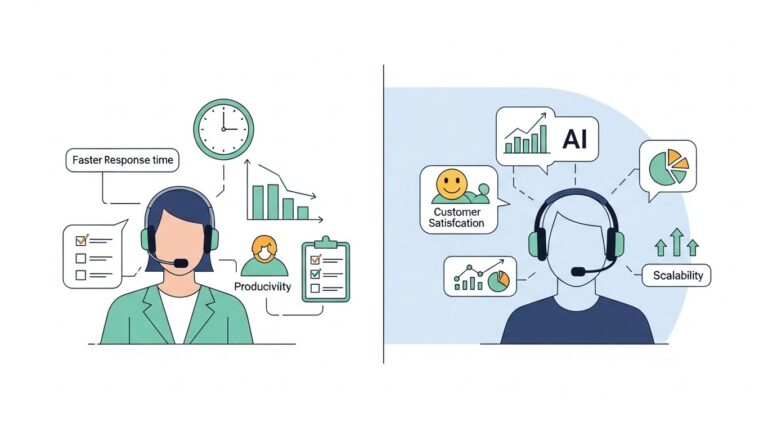
Whether you run your call center in-house or partner with an outsourced provider, AI-powered solutions deliver measurable benefits across multiple dimensions.
Improved efficiency: Automation reduces repetitive work, freeing agents to focus on interactions that genuinely require human skills. Teams accomplish more with the same resources.
Lower operational costs: Fewer agents are needed per unit of volume when AI handles routine interactions and accelerates complex ones. This cost reduction applies whether you’re paying in-house salaries or outsourcing fees.
Faster response times: Intelligent routing and instant AI responses eliminate wait times for simple questions, while getting complex issues to the right human agent immediately.
Personalized customer experiences: Context retention across interactions means customers never feel like they’re starting over. The system remembers previous conversations, preferences, and issues.
Scalable support: Handle volume spikes without emergency hiring pressure. The AI absorbs much of the variable demand, allowing your human team to focus on complex cases regardless of overall volume.
24/7 availability: Combining AI automation with global outsourcing partnerships enables truly round-the-clock support without requiring night shifts or weekend staffing at premium rates.
These benefits work together synergistically. Faster response times improve customer satisfaction, which reduces complaint volume. Lower costs per interaction enable better service at the same budget. Scalability means consistent service quality regardless of demand fluctuations.
AI Call Center Software vs AI-Enabled Call Center Outsourcing
When businesses explore AI for their call centers, they face a strategic choice that many articles avoid discussing: should you buy software and implement it yourself, or partner with an outsourcing provider that brings AI capabilities built-in?
Understanding the Difference
Buying software only means licensing an AI call center platform and integrating it with your existing operation. You maintain full control over implementation, training, and ongoing management. Your team owns the technology stack and can customize it extensively. However, you’re also responsible for implementation complexity, ongoing maintenance and updates, training staff on new tools, and ensuring the AI performs as expected.
Partnering with an AI-enabled outsourcing provider means working with a company that already has AI call center software implemented and optimized. They bring both the technology and the trained agents who know how to use it effectively. The provider handles technology implementation and maintenance, agent training and quality assurance, scaling up or down based on demand, and continuous optimization of AI performance.
Pros and Cons of Each Approach
Software-only approach:
Pros: Complete control over implementation and customization. Data stays within your organization. Can integrate tightly with existing systems. No ongoing outsourcing management needed.
Cons: Requires significant internal technical expertise. Implementation can take months. Training your team takes time and resources. You absorb all scaling challenges and staffing complexity.
Outsourcing with AI approach:
Pros: Faster time to value with proven implementations. Provider expertise in both AI and call center operations. Easier scaling without hiring headaches. Predictable costs and performance.
Cons: Less direct control over the technology stack. Requires trust in the outsourcing partner. May have less customization flexibility. Data security considerations with external partners.
When Outsourcing Plus AI Makes More Sense Than Software Alone
Several scenarios strongly favor the outsourcing approach:
Rapid scaling needs: If you’re growing quickly or experiencing unpredictable volume spikes, an outsourced partner can scale immediately without the delays of hiring and training.
Limited internal resources: Companies without dedicated IT teams or call center management expertise benefit from leveraging a partner’s established capabilities.
Cost-sensitive situations: When budget pressure is intense, outsourcing with AI often delivers better economics than building internal capabilities from scratch.
Global coverage requirements: If you need 24/7 support across multiple languages and time zones, outsourcing partners with international operations provide this more easily than building it yourself.
Focus on core business: Organizations that want to concentrate resources on their primary business rather than building call center expertise often prefer the outsourcing model.
The choice isn’t always binary. Some businesses use AI software for in-house teams handling complex or sensitive issues, while outsourcing routine support to an AI-enabled partner. This hybrid approach balances control with scalability.
Best AI Call Center Software Platforms
Choosing AI call center software requires understanding your specific needs—team size, volume, complexity, budget, and whether you’re running in-house or outsourced operations. Here are five platforms representing different use cases and price points.
When evaluating these options, consider scalability potential, integration capabilities with your existing systems, feature depth for your specific use case, total cost including licensing and implementation, and compatibility with outsourced teams if relevant.
Zendesk — Best for Omnichannel AI and Agent Assist
Zendesk has evolved from a ticketing system into a comprehensive customer service platform with strong AI capabilities. The platform excels at omnichannel support, handling phone, email, chat, social media, and messaging apps in a unified workspace.
Strengths: Sophisticated workflows that can be customized for complex scenarios. Excellent agent assist features including suggested responses and knowledge surfacing. Extensive integration ecosystem connecting to CRMs, payment systems, and other business tools. Strong reporting and analytics capabilities.
Ideal use case: Mid-size to enterprise businesses that need sophisticated omnichannel support with AI augmentation.
Outsourcing compatibility: Zendesk works well with outsourced teams. The platform can be accessed globally, supports multiple languages, and includes permission controls that let you manage outsourced agents alongside in-house staff. Many outsourcing providers are already familiar with Zendesk, reducing training time.
Freshdesk — Best for SMBs and Fast Setup
Freshdesk offers a more approachable entry point into AI call center software, with pricing and complexity scaled for small to medium-sized businesses. Setup is straightforward, often taking days rather than weeks.
Strengths: Intuitive interface that requires minimal training. Automation features that cover common use cases out of the box. Affordable pricing tiers that scale with your business. Solid integration options with popular business tools.
Ideal use case: Small businesses getting started with AI call center capabilities, or companies that value simplicity over extensive customization.
Cost considerations: Freshdesk’s pricing makes it accessible for businesses with tighter budgets, though some advanced AI features require higher-tier plans.
Nextiva — Best All-in-One AI Call Center Solution
Nextiva bundles call center functionality with CRM and unified communications, creating an all-in-one platform. This integrated approach eliminates the need to connect multiple separate systems.
Strengths: Single platform for voice, video, messaging, and CRM. Simplified vendor management with one provider. SMB-friendly positioning with easier implementation than enterprise platforms. Predictable bundled pricing.
Ideal use case: Small to mid-size businesses that want integrated communications and call center capabilities without managing multiple vendors.
Integration advantage: Since Nextiva bundles multiple functions, you avoid integration complexity that comes with stitching together separate systems from different providers.
Talkdesk — Best for Automation-First Teams
Talkdesk built its platform with AI as a core component rather than an add-on. The system emphasizes automation and digital-first customer interactions.
Strengths: Advanced AI-first routing that uses sophisticated intent detection. Strong chatbot capabilities for automated interactions. Designed for digital-first environments where chat and messaging are primary channels. Good scalability for growing businesses.
Ideal use case: Companies with significant digital support volume that want to maximize automation and minimize human handling of routine inquiries.
Digital focus: If your customers primarily interact via chat, messaging, or email rather than phone, Talkdesk’s digital-first design aligns well with that preference.
NICE CXone and Five9 — Best for Enterprise-Scale Operations
NICE CXone and Five9 represent enterprise-grade AI call center platforms designed for large-scale operations with complex requirements.
Strengths: Deep analytics and reporting capabilities that surface sophisticated insights. Comprehensive compliance and security features for regulated industries. Massive scalability supporting thousands of agents. Advanced workforce management and quality assurance tools.
Ideal use case: Large enterprises with high volume, complex compliance requirements, or sophisticated operational needs.
Outsourcing relevance: These platforms are commonly used by large outsourced call center operations. If you’re partnering with a major outsourcing provider, they likely have experience with one or both of these systems.
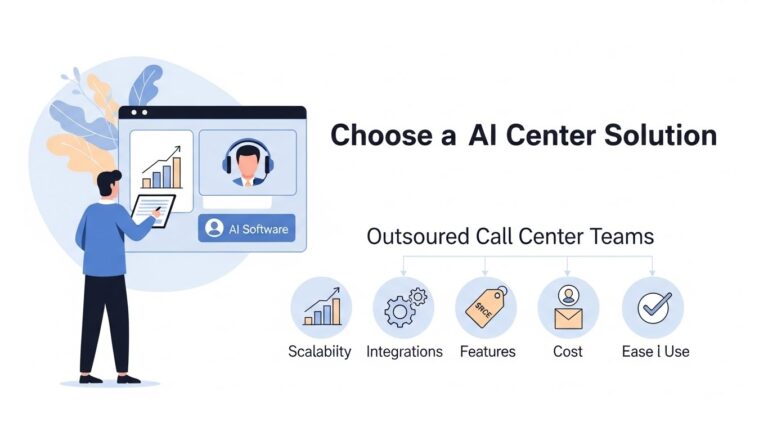
How to Choose the Right AI Call Center Solution (or Outsourcing Partner)
Selecting AI call center software—or an outsourcing partner that uses it—requires evaluating multiple factors beyond just features and price.
Scalability: Can the solution handle your growth trajectory? Consider not just current volume but where you’ll be in two or three years. Some platforms scale smoothly while others hit performance walls at certain volumes.
Integrations: Does it connect with your existing CRM, help desk software, telephony systems, and other business tools? Integration complexity can make or break implementation success.
Features: Which AI capabilities matter most for your situation? Voice bots, agent assist, analytics, and routing intelligence each deliver value in different ways. Prioritize features that address your specific pain points rather than seeking the most comprehensive feature list.
Cost: Look beyond licensing fees to understand total cost of ownership. Implementation services, training, ongoing support, and feature upgrades can significantly impact budget. For outsourcing, understand how AI capabilities affect per-contact pricing.
Ease of use: Complex systems deliver more power but require more training and expertise. Consider your team’s technical capabilities and how much time you can invest in learning new tools.
Outsourcing compatibility: If you work with outsourced teams now or might in the future, ensure the platform supports distributed operations, multi-language capabilities, appropriate security and permissions controls, and monitoring across internal and external agents.
The best choice depends on your specific context. A small business might prioritize ease of use and cost, while an enterprise focuses on scalability and compliance. An outsourcing-first company needs different capabilities than one building internal teams.
Real-World Use Cases: How Businesses Use AI in Outsourced Call Centers
Understanding how AI call center software works in practice helps clarify potential benefits for your situation.
Cost reduction through automation: A mid-size e-commerce company handling 50,000 monthly support contacts implemented AI chatbots for routine questions about order status, returns, and shipping policies. The AI resolved 40% of inquiries without human involvement. This allowed their outsourced support team to shrink from 30 agents to 18 while maintaining the same service level, reducing monthly outsourcing costs by approximately 35%.
Improved customer satisfaction through faster routing: A software company with both technical and billing support needs struggled with customers being transferred between teams multiple times. After implementing AI-powered intelligent routing, the system detected inquiry type from initial customer messages and routed correctly the first time. First-contact resolution improved by 28%, and customer satisfaction scores increased 15 points.
Faster agent onboarding with real-time assistance: A financial services company using an outsourced call center for account support found that new agents typically needed six weeks of training before handling calls independently. By implementing AI agent assist tools that provided real-time prompts and suggestions, new agents became productive after just two weeks. The outsourcing provider reduced training costs while the company received better service faster.
24/7 global support at reasonable cost: A B2B software company with customers worldwide needed 24/7 support but couldn’t justify the cost of overnight in-house staffing. They partnered with an AI-enabled outsourcing provider operating across multiple time zones. AI chatbots handled routine questions around the clock, while human agents in appropriate time zones handled complex issues. The company achieved true 24/7 coverage at roughly 60% of the cost of domestic overnight staffing.
These scenarios represent realistic outcomes that businesses across industries have experienced. Results vary based on implementation quality, existing processes, and specific circumstances, but the patterns are consistent: AI call center software delivers measurable improvements in cost, speed, quality, and scalability.
Common Concerns About AI Call Centers (Answered)
As businesses consider AI call center software, several concerns come up repeatedly. Addressing these questions directly helps set realistic expectations.
Will AI Replace Call Center Agents?
This is the most common concern, and the straightforward answer is no—not in the foreseeable future. AI replaces specific tasks, not entire jobs.
AI excels at handling routine, repetitive interactions that follow predictable patterns. It can answer “What are your business hours?” thousands of times without variation or fatigue. It can route calls based on clear intent signals. It can transcribe conversations and summarize key points.
What AI cannot do well is handle situations requiring genuine empathy, navigate complex problems with ambiguous information, make judgment calls about policy exceptions, build relationships that turn customers into advocates, or understand subtle communication nuances that change meaning.
The realistic outcome is augmentation rather than replacement. AI handles routine work, allowing human agents to focus on interactions that genuinely require human capabilities. Some businesses maintain the same number of agents but handle higher volume. Others reduce headcount through attrition while improving service quality. The specific approach depends on business goals and customer needs.
Job roles may evolve—agents might spend more time on complex problem-solving and less on data entry—but the need for human judgment, creativity, and empathy in customer service remains strong.
Is AI Call Center Software Reliable?
Reliability concerns are legitimate, especially for businesses where customer service directly impacts revenue or reputation.
Modern AI call center software has matured significantly and is generally reliable for tasks within its capabilities. Natural language understanding, intent detection, and response generation work well for common scenarios. Where reliability becomes questionable is at the edges—unusual situations, ambiguous questions, or highly specialized contexts.
The key to reliability is proper implementation with appropriate fallback systems. Quality AI call center software includes human escalation when the AI isn’t confident in its response, quality assurance monitoring to catch errors, continuous learning from corrections, and clear boundaries defining what AI handles versus what requires humans.
Many platforms also include A/B testing and gradual rollout capabilities, letting you verify reliability with limited traffic before full deployment. This phased approach reduces risk and allows for adjustment based on actual performance.
For outsourced call centers, the provider typically manages reliability through their quality assurance processes, monitoring AI performance alongside human agent performance and making adjustments as needed.
How Much Does AI Call Center Software Cost?
Pricing varies dramatically based on platform sophistication, feature set, and scale.
Small business platforms like Freshdesk start around $15-50 per agent per month for basic plans. Advanced AI features may require higher tiers at $50-100+ per agent monthly.
Mid-market solutions like Talkdesk or Nextiva typically range from $75-150 per agent per month depending on feature selection and commitment level.
Enterprise platforms like NICE CXone or Five9 often involve custom pricing based on volume, features, and implementation needs. These can range from $100-300+ per agent per month.
Additional costs to consider include implementation and setup fees (potentially $10,000-100,000+ for enterprise), training and onboarding expenses, integration development for connecting to existing systems, and ongoing support and maintenance.
For AI-enabled outsourcing, pricing structures differ. You typically pay per contact or per hour rather than per-agent licensing. The outsourcing provider absorbs the software costs and includes them in their service pricing. This can simplify budgeting and reduce upfront investment, though the per-contact rates may be higher than software-only costs in some scenarios.
The question shouldn’t be “How much does it cost?” but rather “What does it cost relative to the value delivered?” Many businesses find that AI call center software pays for itself within months through efficiency gains and cost reduction.
Is AI Call Center Technology Secure?
Security and compliance are critical considerations, especially for businesses handling sensitive customer data or operating in regulated industries.
Reputable AI call center software platforms implement comprehensive security measures including data encryption in transit and at rest, compliance with industry standards like SOC 2, HIPAA, PCI DSS, GDPR, regular security audits and penetration testing, role-based access controls and permissions, and audit logs tracking all system access and changes.
For businesses using outsourced call centers, security considerations extend to the outsourcing partner’s practices. Ensure your provider demonstrates clear data handling policies, compliance certifications relevant to your industry, secure facilities and infrastructure if using on-premise agents, background checks and security training for agents, and contractual protections including data processing agreements.
Many businesses in highly regulated industries successfully use AI call center software and outsourcing by carefully vetting providers and implementing appropriate controls. The technology itself isn’t inherently less secure than traditional call center operations—security depends on implementation quality and operational practices.
Frequently Asked Questions About AI Call Center Software
What is AI call center software?
AI call center software is a platform that uses artificial intelligence to automate tasks, assist agents, and improve call center operations. It handles customer interactions through chatbots, routes calls intelligently based on intent and context, provides real-time coaching and suggestions to human agents, and analyzes conversations to surface performance insights. The goal is faster, more efficient, more consistent customer service at lower operational cost.
How does AI improve call center productivity?
AI improves productivity by automating routine tasks that don’t require human judgment, reducing the time agents spend on data entry and after-call work, providing instant access to relevant information and suggested responses, minimizing time wasted on transfers and searching for information, and enabling higher first-call resolution rates through better-informed agents. The cumulative effect is that agents handle more interactions per day while maintaining or improving service quality.
Is AI call center software good for small businesses?
Yes, AI call center software can benefit small businesses, particularly those experiencing growth or handling repetitive support questions. Several platforms offer pricing and features scaled for small teams. Key benefits for small businesses include handling more volume without immediately hiring additional staff, providing faster responses that compete with larger competitors, offering 24/7 basic support even with limited team size, and freeing up time for team members to focus on revenue-generating activities. Small businesses should look for platforms with simple setup, intuitive interfaces, and pricing that scales with growth rather than requiring large upfront commitments.
Can AI be used in outsourced call centers?
Absolutely. In fact, AI and outsourcing often work together effectively. Many outsourcing providers have already implemented AI call center software and bring that expertise to client relationships. AI enhances outsourced operations by helping distributed teams maintain consistency despite geographic separation, enabling efficient scaling without lengthy hiring and training cycles, reducing language barriers through translation and intent detection, and improving monitoring and quality assurance across external teams. Businesses can either implement their own AI software and grant access to outsourced agents, or partner with providers who bring AI capabilities built into their service offering.
Final Takeaway: When AI-Powered Call Center Outsourcing Makes Sense
AI call center software represents a significant advancement in how businesses handle customer support, but the right implementation approach depends on your specific situation.
Who benefits most from AI call center software:
- Businesses handling high volumes of routine inquiries
- Companies experiencing rapid growth or unpredictable demand spikes
- Organizations with cost pressure but rising service expectations
- Teams struggling with high agent turnover or training challenges
- Businesses needing 24/7 support without prohibitive staffing costs
When software alone is enough:
- You have strong internal technical and call center management expertise
- You need deep customization specific to your unique processes
- Data must remain entirely within your organization for regulatory reasons
- You have the resources to manage implementation and ongoing optimization
- Your volume is stable and predictable enough to staff appropriately
When outsourcing with AI delivers better ROI:
- You need to scale quickly without hiring and training delays
- Internal resources are limited for implementation and management
- You require global coverage across multiple time zones and languages
- Cost efficiency is critical and internal operations struggle to compete
- You prefer focusing internal resources on core business rather than building call center capabilities
The most important consideration is alignment between your business needs and the solution approach. Neither AI software nor outsourcing is inherently superior—the best choice depends on your context.
For many businesses, the combination of AI-enabled outsourcing provides the optimal balance: advanced technology without implementation complexity, scalable capacity without staffing headaches, and predictable costs that flex with actual demand.
If you’re exploring options for improving your call center operations, consider both the technology capabilities and the implementation model. The right AI call center solution should make your life simpler, your customers happier, and your operations more sustainable—regardless of whether you build it internally or partner with a provider who brings those capabilities ready to deploy.

Nola Neven
Nola Neven is a content strategist in the CX space, focused on turning complex operational problems into clear, credible content that people actually read, reference, and share.
Her work sits where content and operations meet. She spends her time understanding how contact centers and help desks really function day to day, where workflows break down, where teams rely on workarounds, and where systems quietly slow everything down.