What Exactly Is a BPO Call Center? Pros, Cons, and How it Works

If you’ve ever contacted a company for help — through phone, email, or chat — chances are you’ve interacted with a BPO call center. But what exactly does that mean, and why do so many businesses rely on them today?
- What Is a BPO Call Center?
- How a BPO Call Center Works
- BPO Call Center vs. In-House Call Center
- Why Businesses Choose BPO Call Centers
- Types of BPO Call Centers
- When Should You Outsource to a BPO Call Center?
- Pros and Cons of a BPO Call Center
- Best Practices for Implementing a BPO Call Center
- How Process Documentation Supports BPO Success
- Quick Checklist to Decide and Implement
- How Guided Workflows and Decision Trees Improve BPO Call Centers
- The Role of Technology in Modern BPO Call Centers
- How Process Shepherd Enhances BPO Efficiency
- Common Questions About BPO Call Centers
- Improving Performance With Data and Analytics
- The Future of BPO Call Centers
- Conclusion
Let’s break it down in simple terms.
What Is a BPO Call Center?
A BPO call center (Business Process Outsourcing call center) is a third-party company that manages customer interactions and support on behalf of other businesses. Instead of hiring, training, and managing an in-house support team, companies partner with BPO providers who already have the people, tools, and processes in place.
These call centers handle a wide range of tasks, including:
Customer service and support
Technical assistance
Order management and billing
Sales and lead generation
Feedback collection and surveys
In short, a BPO call center acts as an extension of your business — taking care of your customers while you focus on growth, product development, and strategy.
How a BPO Call Center Works
Here’s how it typically functions:
Client setup: The business and BPO provider align on goals, brand tone, and service requirements.
Agent training: The outsourcing partner trains agents using brand-specific guidelines and communication scripts.
Technology integration: Systems like CRM, ticketing software, and guided workflow tools are synced to ensure seamless operations.
Service delivery: Agents handle calls, chats, and emails on behalf of the brand.
Reporting and optimization: Performance data is tracked to continuously improve customer service outcomes.
BPO Call Center vs. In-House Call Center
Should your company run its own support team or outsource to a BPO provider? Here’s a quick comparison:
| In-House Call Center | BPO Call Center |
|---|---|
| Requires recruitment, training, and infrastructure | Fully managed by outsourcing partner |
| Higher operational cost | Cost-effective and scalable |
| Limited coverage hours | 24/7 global coverage possible |
| Full control over quality and culture | Shared control but guided by service-level agreements (SLAs) |
For many small and medium-sized businesses, outsourcing is a smarter way to scale fast without compromising quality.
Why Businesses Choose BPO Call Centers
There are several reasons why companies — from startups to enterprises — turn to call center outsourcing:
Cost savings: Reduce HR, tech, and management costs.
Scalability: Quickly add or reduce agents as call volumes change.
Expertise: Access trained professionals who specialize in customer communication.
Focus: Free your core team to handle growth and innovation.
Round-the-clock support: Offer 24/7 service across time zones.
In 2025, outsourcing isn’t just a cost-saving move — it’s a strategic growth tool.

Types of BPO Call Centers
Not all BPO call centers operate the same way. Different types specialize in different functions, and choosing the right type depends on your specific business needs.
1. Inbound Call Centers
Inbound BPO call centers handle incoming customer contacts. When customers call with questions, problems, or requests, inbound agents respond. These centers typically handle customer service inquiries, technical support, billing questions, order tracking, and general helpdesk operations.
Inbound call centers work best for businesses that receive high volumes of customer-initiated contacts. If your customers frequently reach out for support, troubleshooting, or information, an inbound BPO call center specializes in managing these interactions efficiently while maintaining service quality.
2. Outbound Call Centers
Outbound BPO call centers focus on agents making outgoing calls rather than receiving them. These centers handle telemarketing, lead generation, customer surveys, appointment reminders, subscription renewals, and collections. Sales teams often use outbound call centers to reach potential customers at scale.
The key difference from inbound centers is the proactive nature of the work. Agents aren’t waiting for customer contact—they’re initiating conversations based on lists, campaigns, or scheduled follow-ups. Outbound BPO call centers require different skills and metrics than inbound operations, focusing on conversion rates, contact rates, and campaign effectiveness.
3. Blended Call Centers
Blended BPO call centers combine both inbound and outbound activities. The same agent pool handles incoming support calls during busy periods and switches to outgoing campaigns during slower times. This flexibility maximizes agent utilization and provides operational efficiency.
Blended centers work well for businesses with variable call volumes or those wanting to combine support and sales functions. For example, agents might handle customer service during peak hours and make renewal calls during quieter periods. This model requires versatile agents comfortable with both reactive support and proactive outreach.
4. Multichannel and Omnichannel Call Centers
Modern BPO call centers increasingly support multiple communication channels beyond phone calls. Multichannel centers handle phone, email, chat, social media, and SMS through separate systems. Omnichannel centers go further by unifying these channels so customer context carries across touchpoints seamlessly.
For example, in an omnichannel BPO call center, if a customer starts a conversation via chat and later calls, the agent sees the complete history without the customer repeating information. This seamless experience has become the standard expectation for modern customer service.
Businesses serving customers who use multiple communication channels benefit most from multichannel or omnichannel BPO call centers. These centers require sophisticated technology platforms but deliver significantly better customer experiences than phone-only operations.
5. Virtual and Remote Call Centers
Virtual BPO call centers employ agents working remotely rather than from a central physical facility. Agents might work from home or distributed locations anywhere in the world. This model enables geographic flexibility, reduces facility costs, and expands the available talent pool.
The shift to remote work has accelerated adoption of virtual BPO call centers. Many businesses discovered that remote agents can deliver service quality equal to or better than traditional on-site teams when properly managed. Virtual centers often combine nearshore, onshore, and offshore agents to provide coverage across time zones and languages.
6. Specialized and Niche Call Centers
Some BPO call centers focus exclusively on specific industries or functions requiring specialized knowledge. Healthcare BPO call centers understand medical terminology and HIPAA compliance. Financial services centers know banking regulations and security requirements. Technical support centers employ agents with specific product or technology expertise.
Specialized BPO call centers charge premium rates but deliver higher quality for complex needs. If your industry requires compliance knowledge, technical expertise, or specialized training, a niche provider often outperforms generalist call centers despite higher costs.
7. Back-Office BPO Services
While not strictly call centers, many BPO providers combine front-office customer interaction with back-office processing. These providers handle customer calls while also managing billing, claims processing, data entry, and administrative tasks. This end-to-end approach streamlines operations by keeping related functions under one provider.
Businesses with interconnected front-office and back-office needs benefit from combined BPO services. For example, a healthcare provider might outsource both patient calls and insurance claims processing to the same BPO call center, ensuring better coordination and fewer handoffs.
How to Choose the Right Type
Match the BPO call center type to your specific business needs. Consider whether you need support or sales functions, what channels your customers prefer, what compliance or language requirements you have, and whether you need specialized industry knowledge. Most businesses start with one type and expand to others as needs evolve.
When Should You Outsource to a BPO Call Center?
Deciding when to partner with a BPO call center requires honest assessment of your current situation and future needs. Several clear signals indicate outsourcing might make sense.
Cost Pressures and Scale Needs
Building an in-house contact center requires significant investment. You need office space, equipment, phone systems, software platforms, and staff. Salaries, benefits, training, and management add ongoing costs. For many businesses, especially smaller ones, these expenses exceed what a BPO call center charges.
Calculate your total cost of ownership for in-house support including all direct and indirect costs. Compare this to realistic BPO call center pricing for equivalent service levels. If outsourcing costs less while delivering comparable or better quality, it’s worth serious consideration.
Scale also matters. If you need to quickly double capacity or support seasonal spikes, hiring and training enough staff in-house takes months. A BPO call center can often scale up or down within weeks, providing flexibility that’s difficult to achieve internally.
Difficulty Meeting 24/7 or Multilingual Coverage
Customer expectations increasingly include round-the-clock availability. Providing true 24/7 support in-house means staffing night shifts, weekends, and holidays. This requires enough volume to justify full-time coverage or accepting that overnight agents sit idle during slow periods.
Similarly, serving customers in multiple languages requires hiring multilingual agents or separate teams for each language. A BPO call center already employing agents across time zones and languages can provide this coverage immediately without you needing to recruit specialized staff.
If customers demand after-hours support or service in languages your team doesn’t speak, a BPO call center with existing capabilities solves this problem faster than building it yourself.
Need for Rapid Scaling
Businesses experiencing rapid growth, seasonal demand fluctuations, or product launches face capacity challenges. Holiday retail spikes, tax season for financial services, or new product releases can temporarily overwhelm in-house teams.
Hiring temporary staff requires recruiting, training, and onboarding time—often taking six to eight weeks. By the time new hires are productive, the peak might be over. BPO call centers maintain bench capacity and can deploy trained agents quickly, sometimes within days for existing clients.
If your support volume varies significantly or you need capacity fast, the flexibility of a BPO call center becomes a strategic advantage.
Lack of Specialized Skills or Technology
Modern contact centers run on sophisticated technology—omnichannel platforms, workforce management systems, quality monitoring tools, and analytics dashboards. Implementing these systems requires capital investment and technical expertise.
BPO call centers already operate mature technology stacks that would take years and significant budget to build internally. They also employ specialists in workforce management, quality assurance, and performance optimization that most companies can’t justify hiring full-time.
If keeping up with contact center technology feels overwhelming or you lack internal expertise, outsourcing provides immediate access to advanced capabilities and experienced professionals.
Focus on Core Competencies
Every business has limited management attention and resources. Customer support, while essential, may not be where your competitive advantage lies. If leadership spends excessive time managing call center operations instead of product development, sales growth, or strategic initiatives, outsourcing might free valuable resources.
Companies often discover that customer service, though important, isn’t their core competency. A BPO call center whose entire business is customer service excellence brings focus and expertise that’s hard to match when support is just one of many company functions.
Poor Performance Despite Investment
Sometimes teams struggle despite training, process improvements, and technology investments. If your key performance indicators—customer satisfaction, first call resolution, average handle time, or service level agreements—consistently miss targets, fresh perspective might help.
An experienced BPO call center brings proven processes, management expertise, and performance benchmarks from serving multiple clients. They’ve likely solved problems similar to yours many times before. When internal improvement efforts plateau, external expertise can break through performance barriers.
When to Be Cautious About Outsourcing
Outsourcing isn’t always the right answer. If customer experience is a core brand differentiator—think luxury services, boutique retailers, or premium products—losing direct control over customer interactions carries significant risk. In these cases, a hybrid model keeping critical interactions in-house while outsourcing routine tasks might work better.
Also consider whether you have the internal capability to manage a BPO relationship effectively. Successful outsourcing requires governance, clear communication, and active partnership management. If you lack resources to oversee the relationship properly, outsourcing may create more problems than it solves.
Pros and Cons of a BPO Call Center
Understanding both advantages and risks helps set realistic expectations and prepare for successful outsourcing.
Advantages of BPO Call Centers
Cost savings and predictable pricing stand out as the primary driver for most outsourcing decisions. BPO call centers eliminate facility costs, reduce hardware expenses, and convert fixed salary costs to variable pricing. Many providers offer per-minute, per-call, or per-agent pricing that scales with your actual usage.
Access to scale and specialized skills expands capabilities quickly. Need multilingual support? BPO call centers employ agents speaking dozens of languages. Need technical specialists? Industry-focused providers maintain teams with specific expertise. Need to handle volume spikes? Providers can rapidly deploy additional agents without lengthy hiring cycles.
Faster access to modern technology removes the burden of building and maintaining contact center systems. Leading BPO call centers run cloud platforms, omnichannel routing, workforce management software, and analytics tools that would require significant capital investment and technical expertise to implement internally.
24/7 coverage and geographic reach become immediately available. Nearshore and offshore BPO call centers provide extended hours and local language support without requiring you to staff night shifts or open international offices.
Focus on core business frees internal resources for strategic priorities. When routine support operations move to a BPO call center, your team can concentrate on product development, sales growth, and competitive differentiation rather than managing call center infrastructure.
Disadvantages and Risks of BPO Call Centers
Loss of control and brand risk concerns many businesses considering outsourcing. External teams may not naturally represent your brand voice or culture. Without careful management, customers might receive inconsistent or off-brand experiences that damage your reputation.
Potential customer experience degradation can occur if the BPO call center is poorly chosen or managed. Quality suffers when vendor selection focuses only on price, onboarding is rushed, or ongoing governance is weak. Customer satisfaction might decline rather than improve if the partnership isn’t managed properly.
Data security and compliance exposure increases when sharing customer information and system access with third parties. BPO call centers handle sensitive personal and financial data, creating security risks and regulatory obligations. GDPR, HIPAA, PCI-DSS, and other compliance requirements must be carefully managed across the relationship.
Hidden or variable costs sometimes surprise businesses after contracts are signed. Transition expenses, management overhead, customization fees, and change orders add up. Always model realistic total cost of ownership including these often-overlooked expenses, not just the per-agent or per-call rates in proposals.
Employee morale and public perception can suffer when outsourcing is announced. Internal staff may feel their jobs are threatened. Customers sometimes react negatively if they perceive outsourcing as the company cutting corners. Careful communication and change management help mitigate these concerns.
Best Practices for Implementing a BPO Call Center
Success with BPO call centers requires thoughtful planning and active management. These best practices help ensure positive outcomes.
1. Define Clear Objectives and Scope Up Front
Document exactly what services you’re outsourcing, performance targets, expected volumes, exception handling procedures, and escalation rules before talking to potential partners. Specify measurable service level agreements—target average handle time, first call resolution rates, customer satisfaction scores, and compliance requirements.
Clear objectives prevent misunderstandings and provide the foundation for evaluating vendor proposals consistently. Vague requirements lead to mismatched expectations and disappointment later.
2. Use a Structured Vendor Selection Process
Evaluate potential BPO call center partners systematically. Assess their capabilities, industry certifications (ISO, SOC2), client references, technology platforms, language coverage, compliance experience, and financial stability. Include operational site visits or virtual audits to see how they actually work.
Don’t select based solely on price. The cheapest provider rarely delivers the best results. Consider total value—quality, reliability, flexibility, and partnership potential—not just hourly rates.
3. Prioritize Integration and Technology Compatibility
Confirm that the BPO call center’s systems integrate with your CRM, ticketing platforms, authentication systems, and workforce management tools. Lack of integration forces agents to work across disconnected systems, slowing them down and creating errors.
Modern cloud-based platforms with strong API capabilities integrate more easily than legacy systems. Prefer vendors using contemporary, flexible technology stacks that will evolve with your needs.
4. Define KPIs, SLAs, and Reporting Cadence
Agree on specific, measurable key performance indicators before launch. Common metrics include customer satisfaction (CSAT), Net Promoter Score (NPS), first call resolution, average handle time, call abandonment rate, and service level agreement compliance.
Establish reporting format and frequency—daily operational dashboards, weekly performance reviews, and monthly business reviews. Regular governance meetings ensure continuous alignment and quick identification of problems.
5. Strong Onboarding and Knowledge Transfer
Create documented standard operating procedures, process playbooks, and product knowledge bases. Train the BPO call center’s agents using your subject matter experts. Use shadowing, joint calls, and detailed run-books for complex scenarios.
Inadequate onboarding is the most common cause of early-stage outsourcing failures. Invest heavily in this phase to set up long-term success.
6. Start With a Pilot or Phased Rollout
Mitigate risk by piloting limited scope—perhaps one product line, geographic region, or channel—before full implementation. Monitor performance closely, identify issues, iterate on processes, then gradually expand.
Pilots catch problems early when they’re easier and cheaper to fix. Full-scale launches without testing risk large-scale failures requiring expensive remediation.
7. Maintain Governance and Continuous Improvement
Establish a vendor governance model with regular business reviews, performance scorecards, escalation procedures, and a joint roadmap for improvement. The BPO call center relationship requires active management, not just setting it up and walking away.
Quarterly business reviews should assess performance against SLAs, identify improvement opportunities, review customer feedback, and discuss technology or process enhancements.
8. Protect Data and Ensure Compliance
Require contractual security controls including encryption, access restrictions, data residency clauses, and regular security audits. Ensure the BPO call center meets all relevant regulatory requirements—GDPR for European customers, HIPAA for healthcare, PCI-DSS for payment processing.
Data breaches or compliance violations create significant financial and reputational damage. Security and compliance must be foundational requirements, not afterthoughts.
9. Align Culture and Brand Voice
Provide call scripts, tone guidelines, and customer experience training so outsourced agents represent your brand authentically. Monitor quality through regular call reviews, quality assurance programs, and customer satisfaction surveys.
The best BPO call centers become extensions of your team, not just vendors. This requires ongoing investment in cultural alignment and brand training.
10. Plan Transition and Change Management
Communicate internally about the outsourcing decision and what it means for existing staff. Prepare for knowledge transfer and potential staff departures. Allocate internal resources for vendor management and escalation handling.
External communication might also be necessary. Some businesses proactively inform customers about support changes; others handle it transparently when customers ask. Either approach works if executed thoughtfully.
How Process Documentation Supports BPO Success
Behind every successful BPO call center partnership lies clear, comprehensive process documentation. BPO providers need to understand exactly how you handle different scenarios, what information to collect, when to escalate, and what authority agents have.
Without documented processes, the BPO call center makes assumptions that may not match your expectations. Different agents interpret verbal instructions differently, creating inconsistent customer experiences. Clear documentation eliminates ambiguity and ensures everyone follows the same proven approaches.
Process Shepherd helps businesses document their support workflows before outsourcing and maintain that documentation as processes evolve. When procedures are clearly captured and easily accessible, BPO call center agents can follow them accurately, reducing errors and improving quality.
Good documentation also makes vendor transitions smoother if you ever need to switch providers. Rather than rebuilding institutional knowledge from scratch, new partners can quickly understand how you operate by reviewing documented processes.
Quick Checklist to Decide and Implement
Before committing to a BPO call center, work through this decision framework:
Complete a cost-benefit analysis comparing total cost of ownership for in-house support versus realistic BPO pricing including transition and governance costs.
Build an ROI model that accounts for hard costs (vendor fees) and soft costs (management time, integration work, training) plus expected benefits (cost savings, quality improvements, freed internal resources).
Run a 30-90 day pilot with limited scope before full migration. Use this period to validate vendor capabilities, refine processes, and ensure integration works properly.
Require dashboards and weekly reporting from day one. Don’t wait for problems to become obvious—monitor performance continuously and address issues immediately.
Insist on contractual SLAs with clear performance targets and financial penalties or credits for breaches. This accountability ensures the BPO call center prioritizes your requirements.
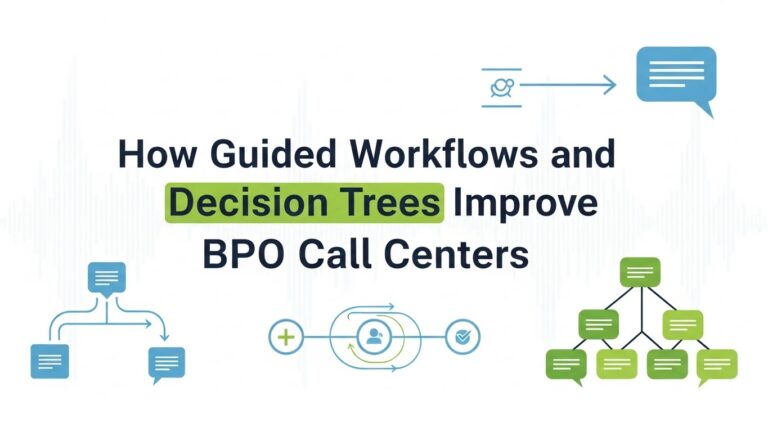
How Guided Workflows and Decision Trees Improve BPO Call Centers
Traditional call centers rely heavily on agent experience. But even the best-trained agents can struggle when faced with complex or unfamiliar scenarios.
That’s where guided workflow systems and decision trees come in.
Platforms like Process Shepherd empower call center agents with interactive, step-by-step guidance during customer interactions. Instead of guessing the next step or searching through manuals, agents follow visual workflows that lead them to the right answer — every time.
Key Benefits of Guided Workflows:
Consistency: Every customer receives accurate, standardized support.
Speed: Agents resolve issues faster, reducing average handle time (AHT).
Confidence: New hires reach full competency quickly, improving morale.
Quality assurance: Supervisors can easily track process adherence.
For example, a telecommunications client using Process Shepherd’s guided workflows saw:
30% faster call resolutions
80% shorter onboarding time for new agents
40% reduction in escalations
That’s the power of pairing call center outsourcing with process automation.
The Role of Technology in Modern BPO Call Centers
Modern BPOs rely on a mix of technology to boost performance and efficiency. Some of the most important tools include:
CRM systems for tracking customer interactions
IVR (Interactive Voice Response) for automated call routing
AI chatbots for handling simple inquiries
Guided workflow and decision tree software for agent assistance
Real-time analytics for monitoring service levels
With these tools, businesses can maintain high service quality while keeping costs under control.
How Process Shepherd Enhances BPO Efficiency
At Process Shepherd, we believe great customer experiences start with empowered agents.
Our platform simplifies complex decision-making through guided workflows that help BPO teams deliver consistent, efficient, and high-quality service — even when dealing with intricate customer issues.
Whether your business handles customer service, tech support, or back-office operations, Process Shepherd helps by:
Reducing average handling time
Improving first-call resolution (FCR) rates
Accelerating agent training and onboarding
Maintaining compliance across all processes
The result? A BPO call center that’s not just reactive — but proactive, efficient, and scalable.

Common Questions About BPO Call Centers
Let’s answer some popular questions people ask online about BPO call centers:
1. What does BPO mean in a call center?
BPO stands for Business Process Outsourcing — when a company hires a third-party service provider to handle certain tasks like customer support, sales, or back-office operations.
2. Are BPO call centers only for customer service?
Not at all. Many handle technical support, billing, lead generation, telemarketing, and data entry in addition to customer service.
3. What are the benefits of outsourcing to a BPO call center?
The main benefits include reduced costs, access to specialized talent, scalability, and 24/7 service availability.
4. How do decision trees help BPO call centers?
Decision trees guide agents step-by-step through each call scenario, ensuring quick, consistent, and accurate responses — even for complex issues.
5. What industries use BPO call centers the most?
BPOs serve industries like e-commerce, healthcare, fintech, telecommunications, logistics, and education — basically any sector with high customer interaction volume.
Improving Performance With Data and Analytics
High-performing BPO call centers rely on data to improve performance. Key metrics include:
-
Service Level (SL): Percentage of calls answered within a target time.
-
Average Handle Time (AHT): How long agents spend per customer.
-
First Call Resolution (FCR): How many issues are resolved in one call.
-
Customer Satisfaction (CSAT): Direct feedback from customers.
-
Net Promoter Score (NPS): Measures customer loyalty and brand advocacy.
By tracking these metrics — and using guided workflow tools like Process Shepherd — BPOs can identify bottlenecks and optimize performance continuously.
The Future of BPO Call Centers
As AI, automation, and self-service tools continue to evolve, the future of BPO call centers looks more intelligent and data-driven than ever.
However, technology alone isn’t enough. The best outsourcing providers balance automation with human empathy — combining digital tools with real people who care about solving problems.
Platforms like Process Shepherd enable that balance by supporting agents with structured workflows that make every interaction smarter and faster.
Conclusion
A BPO call center isn’t just an outsourced department — it’s a strategic extension of your brand. With the right partner, technology, and processes, it can elevate your customer experience and give you a competitive edge.
By using tools like guided workflows and decision trees, you can transform how your support team works — making every interaction efficient, accurate, and human-centered.
If you’re ready to improve your customer service operations and scale confidently, Process Shepherd can help guide your business every step of the way.

Nola Neven
Nola Neven is a content strategist in the CX space, focused on turning complex operational problems into clear, credible content that people actually read, reference, and share.
Her work sits where content and operations meet. She spends her time understanding how contact centers and help desks really function day to day, where workflows break down, where teams rely on workarounds, and where systems quietly slow everything down.