Call center compliance isn’t the most exciting topic — but it’s one of the most consequential. A single TCPA violation can cost $500 to $1,500 per call. A serious GDPR breach can result in fines reaching millions of euros. And a PCI-DSS failure that exposes payment data can shut down operations entirely.
If your team makes outbound calls, handles sensitive customer data, or operates in regulated industries like healthcare or financial services, call center compliance isn’t optional. It’s a core operational function.
The good news is that contact center compliance doesn’t have to be a constant source of anxiety. When you build the right regulatory framework and back it up with the right operational systems, compliance becomes something your team does automatically — not something they have to stress about remembering.
In this guide, we’ll break down the major regulations governing call center compliance, what a modern compliance framework looks like, and — critically — how to build systems that actually enforce compliance at the workflow level, every single day.
What Is Call Center Compliance?
Call center compliance refers to the set of laws, regulations, and internal policies that govern how a contact center operates — particularly around how it communicates with customers, handles personal data, processes payments, and manages its own internal accountability.
At its core, compliance in a call center is about three things: protecting consumers, protecting your organization, and ensuring every agent interaction meets the legal and ethical standards that apply to your business.
This covers a wide range of activities, including:
- Obtaining proper consent before calling, texting, or recording
- Handling personal and payment data securely
- Honoring Do Not Call (DNC) requests promptly and reliably
- Disclosing call recording to customers as required by law
- Training agents on what they can and cannot say or do
- Documenting everything in a way that holds up to audit
When call center compliance breaks down, the consequences are serious. Lawsuits, regulatory fines, reputational damage, and — in extreme cases — operational shutdowns are all on the table. The goal isn’t to check a box. It’s to build a system where compliance is the default, not the exception.
The Core Regulations Governing Call Center Compliance
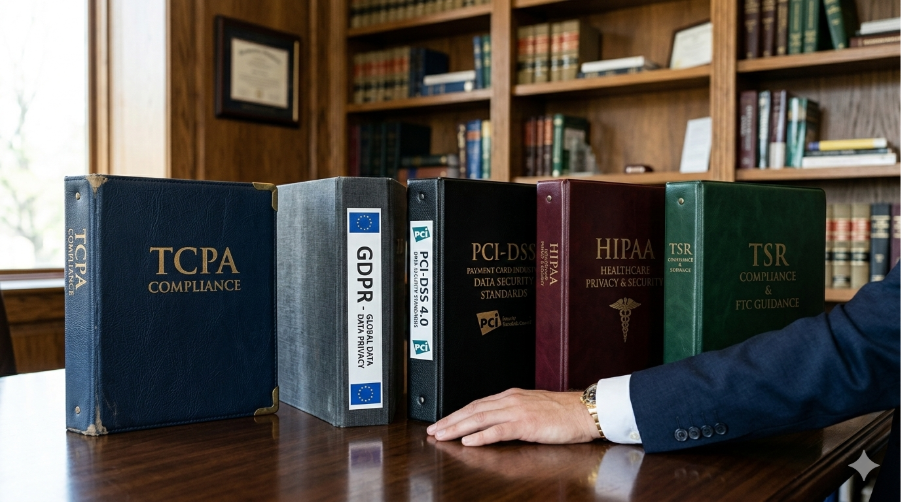
The regulatory landscape for contact centers is broad — and it varies by industry, geography, and the type of outreach you’re conducting. Here are the major frameworks every compliance-aware contact center needs to understand.
TCPA Compliance in Call Centers (Telephone Consumer Protection Act)
The TCPA is the most litigated call center regulation in the United States. It governs how businesses can contact consumers by phone and text, with strict requirements around consent, autodialer use, and Do Not Call (DNC) compliance.
Key requirements include:
- Prior express written consent is required before using an autodialer or sending pre-recorded messages to cell phones
- Compliance with both the National DNC Registry and any company-level DNC lists
- Restrictions on calling times (generally 8am–9pm in the called party’s local time)
- Clear opt-out mechanisms that are honored promptly
The stakes are high. TCPA violations carry statutory damages of $500–$1,500 per call or text, and class action lawsuits in this space are common. DNC compliance call center failures alone have resulted in multi-million dollar settlements.
GDPR and Call Center Data Privacy Compliance
If your contact center handles data belonging to EU residents, GDPR applies — regardless of where your business is located. GDPR call center compliance centers on lawful data processing, transparency, and honoring individual rights.
Core obligations include:
- Establishing a lawful basis for processing customer data (consent, contract, legitimate interest, etc.)
- Informing data subjects about how their information is collected and used
- Enabling data subject rights: access, correction, erasure, portability
- Maintaining data minimization — only collecting what you actually need
- Implementing appropriate security measures and breach notification protocols
GDPR penalties reach up to 4% of global annual revenue or €20 million, whichever is higher. For contact centers with international reach, data protection isn’t a compliance side note — it’s a central operational requirement.
PCI-DSS Requirements for Call Centers Handling Payments
Any call center that takes payment card information over the phone must comply with PCI-DSS (Payment Card Industry Data Security Standard). This is non-negotiable if you’re processing credit or debit cards in any volume.
PCI-DSS call center requirements include:
- Automatic redaction or pausing of call recordings when card data is being verbally provided
- Prohibiting agents from writing down or storing card numbers
- Encrypting cardholder data in transit and at rest
- Restricting access to payment data on a need-to-know basis
- Conducting regular vulnerability assessments and penetration testing
A payment security call center failure doesn’t just mean fines — it means potential card network bans, breach remediation costs, and severe customer trust damage.
HIPAA Compliance in Healthcare Call Centers
Healthcare contact centers — and any business handling Protected Health Information (PHI) on behalf of healthcare providers — must comply with HIPAA. HIPAA call center compliance is about ensuring that sensitive health data is handled with strict confidentiality and access controls.
This means:
- PHI is only accessed by agents who need it to perform their role
- Call recordings containing health information are stored securely with access logging
- Business Associate Agreements (BAAs) are in place with all vendors who touch PHI
- Breach notification protocols are defined and practiced
TSR (Telemarketing Sales Rule) & Ethical Communication Standards
The FTC’s Telemarketing Sales Rule governs outbound telemarketing practices in the US. It prohibits deceptive and abusive tactics, requires specific disclosures at the start of calls, and sets rules around upselling and payment collection. Telemarketing compliance under the TSR also overlaps significantly with TCPA obligations, making it essential to treat the two frameworks together rather than in isolation.
The 5 Pillars of a Modern Call Center Compliance Framework
Understanding the regulations is step one. The harder — and more valuable — work is building a call center compliance framework that enforces those regulations operationally, day after day, regardless of who is on the floor.
Here’s how modern compliance-first contact centers structure their programs:
Pillar 1: Regulatory Adherence (External Laws)
This is the foundation. Your compliance program must map every applicable regulation to your specific operations — factoring in geography, industry, and the nature of your outreach. TCPA, GDPR, PCI-DSS, HIPAA, and TSR don’t all apply to every contact center, but understanding which ones apply to yours — and exactly how — is the starting point for everything else.
Pillar 2: Consent & Communication Governance
Consent management is one of the highest-risk areas in call recording compliance and DNC compliance. This pillar covers:
- Automated recording disclosures triggered at the start of each call
- Script compliance monitoring to ensure agents are following approved language
- DNC list synchronization — ideally updated daily, not weekly
- Opt-out tracking workflows that remove numbers from contact lists instantly
The key word here is workflow. These aren’t things agents should be doing manually from memory. They need to be enforced by the system — which is exactly where tools like Process Shepherd play a critical role, guiding agents through required steps automatically rather than relying on them to remember every compliance requirement on their own.
Pillar 3: Data Security & Access Controls
Data security call center compliance means having clear policies around who can access what, how data is stored, and how long it’s retained. This includes:
- Role-based access controls (agents only see data relevant to their function)
- Defined data retention and deletion schedules aligned to GDPR and HIPAA requirements
- Encryption protocols for data in transit and at rest
- Regular access reviews to ensure former employees or role-changers lose access promptly
Pillar 4: Monitoring, QA & Real-Time Compliance Enforcement
This is the pillar most contact centers underinvest in — and it’s often where compliance actually breaks down. Real-time compliance monitoring means:
- Automated alerts when agent behavior deviates from approved scripts or workflows
- Escalation workflows that route compliance flags to supervisors immediately
- QA scorecards that include compliance checkpoints, not just quality metrics
- Documentation automation that captures compliance evidence without manual effort
The goal is to catch compliance issues before they become violations — not discover them in a post-call audit three weeks later.
Pillar 5: Audit & Continuous Improvement Systems
A compliance program is only as good as its ability to improve over time. This pillar covers:
- Scheduled internal audit cycles with defined scope and ownership
- Risk scoring to prioritize where compliance attention is most needed
- Compliance dashboards that give leadership real-time visibility
- Incident reporting workflows that create a paper trail when things go wrong
- Policy acknowledgment tracking to prove agents have been trained and briefed
When a regulator or auditor comes knocking, this is the pillar that determines whether you walk out confident — or scrambling.
The Cost of Non-Compliance in Call Centers
Let’s be direct about the financial reality. Call center compliance failures are expensive — far more expensive than building the systems to prevent them.
| Regulation | Potential Fine / Penalty | Additional Risk |
| TCPA | $500–$1,500 per call/text (trebled for willful violations) | Class action lawsuits, injunctions |
| GDPR | Up to 4% of global annual revenue or €20M | Data subject claims, operational restrictions |
| PCI-DSS | $5,000–$100,000/month until remediated | Card network bans, breach liability |
| HIPAA | $100–$50,000 per violation (up to $1.9M/year) | Criminal charges for willful neglect |
| TSR (FTC) | Up to $51,744 per violation | Consent decrees, operational restrictions |
Beyond the direct fines, non-compliance carries indirect costs that can be just as damaging: brand damage, customer churn, increased legal costs, and the operational disruption of an investigation or enforcement action.
Here’s a simple way to think about the ROI of compliance investment: a team handling 5,000 outbound calls per month with an undetected TCPA issue — say, calling numbers on the DNC list without proper consent — faces potential exposure of $2.5M to $7.5M per month at statutory rates. The cost of a compliance workflow system is a rounding error by comparison.
How to Build a Compliance-First Call Center (Step-by-Step)
Knowing the regulations is necessary. But building a call center compliance program that actually works in daily operations requires a deliberate, structured approach. Here’s how to do it.
Step 1: Map Your Regulatory Exposure
Start by understanding which regulations actually apply to your operations. Consider:
- Geographic markets — US-focused operations face TCPA and TSR; EU reach triggers GDPR
- Data types handled — payment data means PCI-DSS; health data means HIPAA
- Outbound vs. inbound mix — outbound telemarketing carries significantly higher regulatory risk
- Industry vertical — financial services, healthcare, and debt collection each carry sector-specific rules
Document this mapping. It becomes the foundation of your compliance program and determines where you invest your resources.
Step 2: Define Compliance Ownership
Compliance without clear ownership drifts. Every contact center needs a defined compliance ownership structure:
| Role | Compliance Responsibility |
| Compliance Officer / Manager | Owns regulatory tracking, policy updates, audit coordination |
| QA Manager | Owns monitoring, scorecard design, real-time compliance flagging |
| IT / Security Lead | Owns data security, access controls, encryption, retention systems |
| Operations Manager | Owns workflow design, agent training, process adherence |
| Legal Counsel | Reviews policy changes, manages incidents, assesses exposure |
Without this structure, compliance becomes everyone’s responsibility — which means it becomes no one’s.
Step 3: Design Compliance Workflows
This is the most operationally critical step, and the most commonly skipped one. Compliance workflows are the mechanisms that ensure your team follows the rules automatically — not because they remember to, but because the system guides them through it.
Examples of compliance workflows every regulated contact center should have:
- Recording consent verification — agent is prompted to deliver the required disclosure, and confirmation is logged
- DNC sync automation — numbers are checked against updated lists before any dial is initiated
- Script deviation escalation — when an agent goes off-script in a regulated interaction, a supervisor is alerted
- Audit documentation workflow — compliance evidence is captured and stored without manual agent effort
- Policy acknowledgment automation — agents confirm they’ve reviewed updated compliance procedures
This is where Process Shepherd fits naturally into a compliance-first contact center. Rather than relying on agents to remember every compliance step across every interaction type, Process Shepherd’s dynamic guided workflows walk agents through each required action in sequence — capturing documentation, triggering escalations, and enforcing consistency at scale. It’s the enforcement layer that turns your compliance policies into daily operational reality.
Step 4: Implement Monitoring & Documentation
You can’t manage what you don’t measure. A compliance monitoring setup should include:
- Real-time call monitoring with compliance-specific alert triggers
- Structured incident logging with timestamp, agent ID, and issue type
- Evidence archiving for call recordings, consent records, and opt-out logs
- Audit-ready reporting dashboards that can be pulled at any time — not just during an investigation
Step 5: Run Continuous Training & Certification
Regulations change. Policies evolve. Agent training needs to keep up. A strong call center compliance training program includes:
- Onboarding compliance certification before agents handle live interactions
- Quarterly refresher training tied to regulatory updates or internal incident learnings
- Automated alerts when regulation changes require policy acknowledgment
- Training completion tracking with documented sign-off — critical for demonstrating good-faith compliance efforts
Call Center Compliance Checklist (2026)
Use this as a quick-reference audit tool for your compliance program. It covers the core requirements across the major regulatory frameworks.
Consent & Communication
- ✔ DNC list synchronized daily (National + internal lists)
- ✔ Recording disclosures automated and logged per call
- ✔ Written consent records retained for TCPA-covered outreach
- ✔ Opt-out requests honored within required timeframes
- ✔ Agent scripts reviewed and approved by compliance/legal
Data Security
- ✔ Role-based access controls implemented and reviewed quarterly
- ✔ PCI-DSS redaction in place for all payment-related calls
- ✔ Data retention and deletion schedules defined and enforced
- ✔ Encryption protocols active for data in transit and at rest
- ✔ Breach notification process documented and tested
Monitoring & QA
- ✔ QA scorecards include compliance checkpoints
- ✔ Real-time compliance alerts configured for script deviations
- ✔ Incident escalation workflow mapped and operational
- ✔ Evidence archive accessible for audit at any time
Training & Governance
- ✔ New agent compliance certification completed before live calls
- ✔ Compliance training records maintained per agent
- ✔ Policy acknowledgment tracking system in place
- ✔ Internal audit cycle scheduled and owned
- ✔ Compliance ownership structure documented and communicated
Frequently Asked Questions About Call Center Compliance
What is compliance in a call center? Call center compliance refers to the policies, procedures, and systems that ensure a contact center operates within the legal and regulatory requirements that apply to its business — covering consumer communication laws (like TCPA), data privacy regulations (like GDPR), payment security standards (like PCI-DSS), and healthcare privacy rules (like HIPAA). It also includes internal accountability systems for QA, training, and documentation.
What are the key areas of call center compliance? The five core areas are: (1) regulatory adherence to applicable laws, (2) consent and communication governance, (3) data security and access controls, (4) real-time monitoring and QA enforcement, and (5) audit and continuous improvement systems. Each area requires both clear policies and the operational workflows to enforce them day to day.
What are the steps to building a call center compliance program? Start by mapping your regulatory exposure based on geography, industry, and data types. Then define compliance ownership across your team, design the workflows that enforce compliance at the agent level, implement monitoring and documentation systems, and build ongoing training and certification into your operations. The most common failure point is step three — building the workflows that make compliance automatic rather than reliant on agent memory.
What is customer service compliance? Customer service compliance is the application of call center compliance standards to customer-facing interactions specifically — ensuring that agents communicate within approved scripts, handle data appropriately during service calls, deliver required disclosures, and follow escalation procedures when issues arise. It sits at the intersection of operational quality and regulatory risk.
How do you ensure call recording compliance? Call recording compliance requires automated disclosure delivery at the start of applicable calls, clear logging of which calls were recorded and when, secure storage with access controls, and defined retention periods aligned to legal requirements. The most reliable approach is to embed recording compliance into the call workflow itself — so the disclosure step can’t be skipped — rather than relying on agents to remember to deliver it manually.
Final Thoughts
Call center compliance is one of those operational areas where the cost of getting it wrong dramatically outweighs the cost of getting it right. The regulations are clear. The penalties are real. And the organizations that struggle most aren’t the ones that lack knowledge — they’re the ones that lack systems.
Knowing TCPA, GDPR, PCI-DSS, and HIPAA is the starting point. But a compliance program that lives in a policy document and a training deck isn’t a compliance program — it’s a liability waiting to materialize.
The contact centers that get compliance right design it into their operations. They build workflows that enforce consent management automatically. They implement QA systems that catch deviations in real time. They create audit trails that don’t require anyone to scramble when a regulator calls.
That’s what a compliance-first contact center looks like in practice. And it’s what Process Shepherd is built to support — providing the dynamic, guided workflows that turn your compliance policies into something your agents execute correctly on every call, every day, without having to think twice about it.