Every customer who contacts your support team expects the same thing: a fast, clear, and complete resolution. What they experience instead is often the opposite — long hold times, agents who seem uncertain of the next step, repeated transfers, and answers that vary depending on who picks up the call.
The root cause of most of these failures is not a people problem. It is a structure problem. The customer service call flow — the path an interaction follows from the moment a customer makes contact to the moment their issue is resolved — is either well designed or it is not. When it is not, agents improvise. Improvisation produces inconsistency. Inconsistency produces poor customer experiences and the operational costs that follow.
The most effective call flows today are not simply routing systems that direct customers to the right queue. They are guided workflows that help agents navigate complex interactions step by step, in real time, on every call. This guide covers how to design them, what they should include, where traditional approaches break down, and how modern contact centers are building call flows that actually work at scale.
What Is a Customer Service Call Flow?
A customer service call flow is the structured path a customer interaction follows from initial contact through to resolution. It defines every stage of the interaction — how the call is received and routed, how the agent greets and verifies the customer, how the issue is identified and diagnosed, how resolution is reached, and how the interaction is closed — and it provides the framework within which agents operate throughout.
The term customer service call flow carries two distinct but related meanings in contact center operations. The first is the routing flow: the system-level logic that determines how an incoming call moves through IVR menus, queue prioritization, and agent assignment before a human interaction begins. The second — and operationally more significant — is the agent conversation flow: the structured process the agent follows once the call is connected, guiding the interaction from greeting through to resolution.
Both matter. A well-designed routing flow ensures customers reach the right agent quickly. A well-designed agent conversation flow ensures that agent handles the interaction correctly. Most contact centers invest heavily in the first and underinvest in the second — which is why routing is rarely where customer experience breaks down. It breaks down in the conversation itself, where agents are left to navigate complex, branching processes without adequate structural support.
A call flow process is not the same as a script. Scripts are linear — they assume a predictable conversation that proceeds in a fixed sequence. A call flow, properly designed, accounts for the branching nature of real customer interactions: the multiple possible answers to each question, the different resolution paths required by different scenarios, and the edge cases that arise when a customer’s situation does not fit neatly into the standard procedure. The most effective call center call flow designs today combine the structure of a defined process with the flexibility of a dynamic decision framework — and that distinction is what separates contact centers that consistently resolve issues on the first call from those that do not.
The 7 Stages of a Customer Service Call Flow
Every customer service call flow — regardless of the industry, channel, or complexity of the query — moves through the same fundamental lifecycle. Understanding each stage, and what can go wrong at each one, is the foundation of effective call flow design.
Stage 1: Call Entry. The interaction begins when the customer makes contact. In a voice channel this means the inbound call is received by the IVR system, which presents menu options and begins routing. In a digital channel it means an incoming chat, email, or messaging contact enters the queue. The design of this entry stage — the clarity of IVR menus, the accuracy of routing logic, the speed of queue processing — determines how much effort the customer expends before they ever reach a human agent.
Stage 2: Greeting. The agent answers and introduces themselves. A well-designed greeting is warm, professional, and efficient — it establishes the interaction on a positive tone without consuming unnecessary time. Many contact centers embed greeting language into their call flow process to ensure consistency across the team, but the greeting should feel natural rather than mechanical.
Stage 3: Authentication. The agent verifies the customer’s identity before accessing account information or proceeding with any account-level action. Authentication steps vary by industry and regulatory environment — some require a single account number, others require multi-factor verification. Regardless of complexity, this step must be built clearly into the call flow structure to ensure it is completed consistently and compliantly on every interaction.
Stage 4: Problem Identification. The agent establishes what the customer is contacting about and why. This is where active listening is most critical — the agent needs to understand not just the surface-level query but the underlying issue and the customer’s desired outcome. A well-designed call flow guides agents to ask the right clarifying questions and capture the right information before moving to diagnosis.
Stage 5: Troubleshooting and Diagnosis. This is the most complex and variable stage of any customer service call flow — and the stage where most interactions go wrong. The agent must diagnose the issue, navigate internal processes, locate the correct resolution path, and guide the customer through it, all simultaneously. Without structural support, this stage relies heavily on agent memory, experience, and judgment. The variance that produces inconsistent customer experiences lives almost entirely here. A guided workflow with embedded decision tree logic addresses this directly — presenting the agent with the correct diagnostic questions and resolution steps based on what the customer has said, rather than requiring the agent to recall the entire process under pressure.
Stage 6: Resolution or Escalation. The issue is resolved, or the interaction is escalated to a specialist, supervisor, or alternative channel. The escalation decision — when to escalate, to whom, and how to hand off the context — is one of the most consequential decision points in the call flow. Poorly designed escalation logic generates unnecessary transfers, forces customers to repeat themselves, and is one of the primary drivers of high customer effort scores. A decision tree that builds escalation logic explicitly into the call flow eliminates this inconsistency.
Stage 7: Closing. The agent confirms that the issue has been fully resolved, summarizes any actions taken or commitments made, and closes the interaction professionally. A good closing is also an opportunity to capture feedback — a brief post-call survey that feeds into CSAT and CES measurement. Many contact centers underdesign this stage, and the result is interactions that end abruptly without proper confirmation of resolution — a missed opportunity and a frequent driver of unnecessary repeat contacts.
Customer Service Call Flow Example

The most effective way to understand how a call flow works in practice is to walk through a realistic scenario. Consider a billing dispute — one of the most common and potentially high-effort contact types in any consumer-facing contact center.
A customer notices an unexpected charge on their account and calls to dispute it. The call enters the IVR system, which presents billing as a menu option. The customer selects it and is routed to a billing specialist. The agent greets the customer, verifies their identity using account number and postcode, and then opens the problem identification stage: “I can see you’re calling about a recent charge — can you tell me which transaction you’re querying?”
The customer explains the charge. The agent’s call flow branches based on the charge type: is it a recurring subscription charge, a one-time transaction, a late payment fee, or a billing error? Each branch leads to a different investigation path. For a billing error, the flow guides the agent to access the transaction record, compare it against the account terms, check for any system-generated errors, and confirm whether a credit is applicable.
The investigation confirms an error. The flow presents the resolution step: issue a credit, confirm the amount with the customer, and document the case. The agent confirms the credit will appear within three to five business days, asks whether there is anything else the customer needs, and closes the interaction. The entire call follows a structured path from entry to resolution — with the agent guided through each decision point rather than navigating the process from memory.
This is what a well-designed customer experience flow looks like in practice. The agent is competent and professional throughout — but their competence is supported and structured by a call flow that ensures no step is missed and no decision is left to guesswork.
A call flow script provides the language framework agents use at each stage of the interaction. Unlike a rigid word-for-word script, an effective call flow script provides structured language guidance that agents can deliver naturally while ensuring consistency across the team. Below is an example aligned to the billing dispute scenario above.
Greeting: “Thank you for calling. My name is James in the billing team — how can I help you today?”
Authentication: “Before I access your account, could I take your account number and the postcode associated with the account, please?”
Problem identification: “Thank you. I can see your account — can you tell me a bit more about the charge you’re querying? Which transaction are you concerned about?”
Troubleshooting: “I’m going to pull up that transaction now so I can take a look at what happened. Bear with me for just a moment… I can see the charge here — let me check this against your account terms.”
Resolution: “I can confirm that this charge was applied in error. I’m going to raise a credit of [amount] to your account — this will appear within three to five business days. You’ll also receive a confirmation email.”
Closing: “Is there anything else I can help you with today? Thank you for calling — and I’m sorry for the confusion with that charge. Have a great day.”
The value of embedding this language guidance in a guided workflow — rather than a printed script or a training manual — is that it is available to the agent during the live interaction, not just recalled from memory. Agents who are newer to the role, handling a less familiar query type, or simply managing a high-volume day perform to the same standard as experienced agents because the guidance is in front of them at every stage.
Common Problems
Most contact center call flow problems share a common origin: the call flow exists as a document or a policy rather than as a live operational tool embedded in how agents actually work. The consequences are predictable and consistent across the industry.
Inconsistent agent responses are the most visible symptom. When the call flow lives in a training manual rather than in the agent’s interface, each agent interprets and applies it differently. Over time, the team develops as many variations of the process as there are agents on the team. Customers receive different information, different outcomes, and different levels of service depending on who answers their call. This inconsistency is not a training failure — it is a process infrastructure failure.
Complex troubleshooting without structural support is the most operationally costly problem. The troubleshooting stage is where the greatest cognitive demand is placed on agents — and where call flows most commonly break down. Agents facing a complex billing dispute, a technical fault, or a sensitive complaint while simultaneously navigating a CRM, listening to the customer, and trying to recall the correct procedure are operating at the limit of their cognitive capacity. Without a structured decision framework, mistakes happen, steps are missed, and customers receive incomplete resolutions that generate repeat contacts.
Long average handle times driven by information searching are a direct consequence of poorly structured call flows. When the correct next step is not embedded in the agent’s workflow, they search for it — across knowledge bases, team chats, and escalation to supervisors. Every second of that search is customer time wasted and operational cost generated.
Knowledge gaps compound with team scale. A small team where experienced agents informally share knowledge can function without rigorous call flow documentation. A large team, a team with high turnover, or a team handling a wide range of query types cannot. Knowledge gaps in the call flow process become visible as error rates, escalation rates, and repeat contact rates climb.
Training challenges for new agents are directly tied to call flow design. When the call flow exists only as something to be memorized, new agent ramp time is long, error rates during the ramp period are high, and the quality of customer interactions during that period is unpredictable. A guided workflow that presents the call flow in real time eliminates the dependence on recall — and dramatically reduces the time before new agents are performing at the standard the operation requires.
The Evolution of Call Flows
The call center call flow has evolved significantly over the past three decades — moving from purely technological routing systems toward sophisticated operational frameworks that support agents throughout the entire customer interaction.
The first generation of call flows was entirely system-level: IVR technology that automated call routing, directing customers to the correct department based on keypad input. The customer’s experience improved relative to manual switchboards, but once the call reached an agent, the agent was largely on their own.
The second generation introduced static call scripts — linear documents that provided agents with suggested language and a basic sequence to follow. Scripts improved consistency in greetings and closings but were too rigid to handle the variability of real customer interactions. Agents deviated from scripts the moment a conversation took an unexpected turn, which it almost always did.
The third generation brought knowledge bases and internal wikis — searchable repositories of process documentation and product information that agents could consult during calls. This was an improvement, but it introduced a new problem: agents had to search for the information they needed while the customer waited, and the quality of the outcome depended on the agent’s ability to find, interpret, and apply the right knowledge under time pressure.
The fourth and current generation is guided workflow technology — dynamic, decision-tree-driven call flow systems that present agents with the correct next step in real time based on the specific details of each customer interaction. Rather than a static document to be memorized or a knowledge base to be searched, the guided workflow is an active participant in the interaction — adapting to what the customer says, routing the agent through the correct process, and ensuring every compliance requirement and resolution step is completed in the right sequence. This is where contact center technology is today, and it represents a fundamental shift in how call flows are designed and delivered.
A Better Way to Support Agents
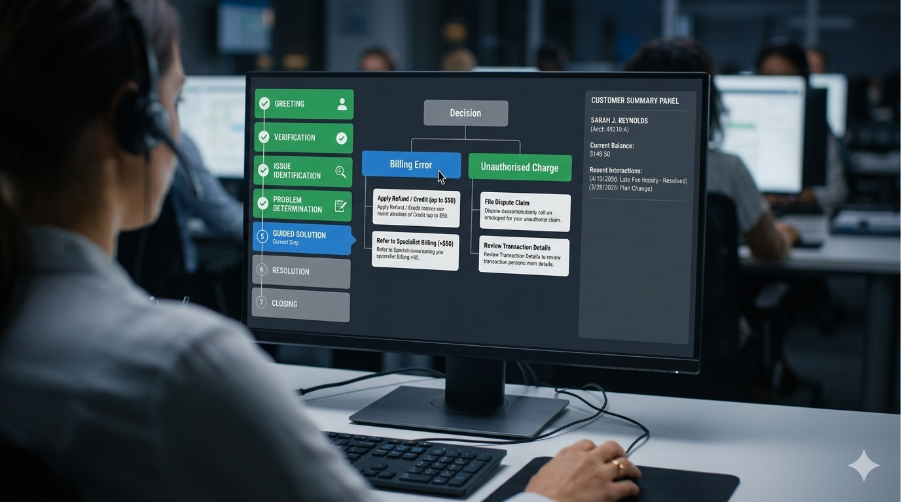
A guided call flow combines the structure of a defined call flow process with the intelligence of a decision tree — producing an agent support tool that is neither a rigid script nor an unstructured knowledge base, but something more powerful than either.
The principle is straightforward. At each stage of the customer interaction, the agent is presented with a small number of clearly defined options based on what the customer has said or selected. Their choice determines the next branch of the flow. The system guides them through diagnosis, troubleshooting, compliance steps, and resolution actions in a logical sequence — without requiring them to hold the entire process in memory or search for the relevant procedure in a separate system.
The operational impact is significant across every dimension that matters. New agents perform at a consistently high standard from day one because the guided workflow provides the structural support that experience would otherwise need to supply. Experienced agents maintain consistency even on less familiar query types because the decision tree catches the edge cases that memory misses. Compliance steps are completed reliably because they are embedded in the flow rather than depending on the agent to remember them under pressure. And average handle time decreases because the time agents previously spent searching for the correct next step is eliminated.
Process Shepherd transforms traditional call flows into interactive decision-tree workflows that guide agents through troubleshooting and resolution in real time. Using a no-code, drag-and-drop editor, operations teams build guided workflows for every contact type — billing queries, complaints, technical troubleshooting, regulated disclosures, escalations, onboarding — without engineering involvement. When a process changes, the workflow is updated once and immediately available to every agent across the operation. Process Shepherd’s native Zendesk integration surfaces the correct guided workflow automatically alongside each incoming ticket, so the agent has both the customer context and the process guidance in a single interface before they have said a word.
The shift from static call flows to guided call flow workflows is not an incremental improvement. It is a structural change in how contact centers support their agents and deliver on their service standards — and it is the clearest single differentiator between contact centers that consistently achieve their KPI targets and those that consistently miss them.
Best Practices for Designing Customer Service Call Flows
A well-designed customer service call flow does not happen by accident. It requires deliberate design choices at every stage — and a clear understanding of where traditional call flow approaches break down and why.
Map the full range of interaction types before designing the flow. The most common failure in call flow design is building for the standard case and ignoring the edge cases. In practice, it is the edge cases — the customer whose situation does not fit neatly into the standard procedure — that generate the most handling time, the most escalations, and the most dissatisfied outcomes. Every contact type handled by your team should be mapped, including the variants and exceptions, before a flow is built around it.
Design multiple resolution paths explicitly. A call flow that assumes a single resolution path for each query type will fail every time a customer’s situation diverges from the assumption. Effective call flow design identifies every decision point in the interaction, documents the possible branches at each one, and designs a specific process path for each. A decision tree structure makes this explicit — every branch is documented, every path has a defined next step, and no agent is left to improvise when the customer’s situation is not the standard one.
Keep routing logic and agent conversation flow separate. IVR routing design and agent conversation flow design are distinct disciplines requiring different expertise. Conflating them produces call flows that are well-optimized for routing but underdesigned for the agent interaction — which is where most of the customer experience is actually created.
Use analytics to identify where the current flow is breaking down. Before redesigning a call flow, analyse where the existing one is failing. High handle times on a specific interaction type indicate the troubleshooting stage is unstructured. High escalation rates indicate the decision framework is unclear. High repeat contact rates on specific query types indicate the resolution process is incomplete. The data tells you exactly where to focus the redesign effort.
Implement guided workflows to make the call flow operational. A call flow that exists only as documentation will degrade over time as agents adapt and diverge from the defined process. Embedding the call flow in a guided workflow system — using a platform like Process Shepherd to make the decision tree logic live in the agent’s interface — ensures the designed process is the actual process. Decision-tree platforms like Process Shepherd make it practical to build flexible call flows that adapt dynamically to different customer scenarios, without requiring the agent to make the adaptation manually.
Key Metrics to Track Performance

A call flow is only as good as the outcomes it produces. Measuring those outcomes requires the right set of contact center metrics — tracked consistently and connected back to specific stages of the call flow process.
First Call Resolution (FCR) is the most direct measure of whether the call flow is producing complete resolutions. A low FCR rate on a specific interaction type is a precise signal that the troubleshooting or resolution stage of the call flow for that type is inadequate — either incomplete, unclear, or not being followed consistently.
Average Handle Time (AHT) reveals where in the call flow agents are spending unnecessary time. When AHT is elevated on specific interaction types, it typically indicates that agents are searching for information during the troubleshooting stage — a problem that guided workflows address directly by surfacing the correct next step without requiring a search.
Customer Satisfaction Score (CSAT) measures how the overall interaction felt to the customer. Post-call CSAT data, when linked to specific call flow stages and interaction types, identifies which parts of the designed flow are producing poor experiences — and provides the evidence base for targeted improvements.
Customer Effort Score (CES) is particularly valuable for call flow assessment because it measures the friction the customer experienced during the interaction — which is a direct reflection of how well the call flow is guiding agents through complex processes. A high effort score on a specific interaction type points directly to a call flow design problem in that interaction’s process path.
Abandonment Rate measures the percentage of contacts where the customer disconnects before reaching resolution. High abandonment during the IVR stage indicates routing design problems. High abandonment after connecting to an agent — less commonly tracked but highly revealing — indicates the agent interaction stage of the call flow is creating rather than resolving customer frustration.
Tools for Managing Customer Service Call Flows
The technology stack that supports an effective customer service call flow spans several distinct tool categories, each addressing a different layer of the call flow process.
IVR and contact center platforms manage the routing layer — the system-level logic that moves calls from entry point to agent. Leading platforms like Genesys, NICE, and Cisco provide robust routing infrastructure with IVR design tools, skills-based routing, and real-time queue management. These platforms define how calls arrive at the agent — but not what happens once they do.
CRM platforms provide the customer data layer — the account history, contact records, and previous interaction data that agents need to handle calls intelligently. Salesforce, Microsoft Dynamics, and HubSpot are among the most widely deployed CRM platforms in contact center environments. The CRM gives the agent context. The call flow gives the agent process.
Knowledge management tools provide the information layer — searchable repositories of product documentation, process guides, and troubleshooting resources that agents can reference during calls. The limitation of traditional knowledge bases is that agents must proactively search them, introducing hold time and the risk of finding the wrong information under pressure.
Decision-tree and guided workflow platforms are the operational layer — the tools that convert call flow documentation into live, interactive guidance embedded in the agent’s interface during the call. This is the category that most directly determines whether the designed call flow is the actual call flow agents follow. Process Shepherd sits in this category, allowing operations teams to build decision-tree-driven guided workflows for every contact type using a no-code editor, integrate them with Zendesk and CRM systems through native connections, and deploy them instantly across the agent team. When a customer contacts support and a ticket opens in Zendesk, the matched Process Shepherd workflow surfaces automatically — giving the agent both the customer’s context and the correct process path before the conversation has begun.
Analytics and quality assurance platforms close the measurement loop — tracking call flow performance across FCR, AHT, CSAT, and CES at the interaction type level, surfacing where the call flow is producing the intended outcomes and where it is breaking down. These platforms are what make call flow improvement evidence-based and continuous rather than periodic and intuitive.

Conclusion
The customer service call flow is the operational backbone of every contact center. It determines whether agents have the structure they need to handle every interaction correctly, whether customers receive consistent resolutions regardless of who answers their call, and whether the operation meets its service, quality, and efficiency targets at scale.
Traditional call flows — designed as routing systems and delivered as static scripts or documentation — have reached the limit of what they can reliably produce. The interactions they were designed for have become more complex. The agent teams they were written for have become larger and more distributed. The customer expectations they need to meet have risen. Static structure is no longer sufficient.
The shift to guided call flows — dynamic, decision-tree-driven workflows that present agents with the correct next step in real time, throughout the live interaction — is what allows modern contact centers to meet these demands without sacrificing consistency or operational efficiency. As customer interactions grow more complex, guided workflows are not a future investment. They are an operational necessity for any contact center serious about delivering consistent, first-time resolution at scale.
Process Shepherd makes this transition practical and immediate — converting your call flow documentation into live guided workflows and decision-tree processes that work inside the agent interaction, on every call, from day one.
Start your free trial at processshepherd.com — no credit card required.