Customer Service BPO: What It Is, How It Works, and Why Businesses Use It

Businesses of all sizes face a common challenge: providing excellent customer service while managing costs and focusing on their core operations. For many, the solution involves partnering with specialized companies that handle customer interactions on their behalf. This arrangement, known as customer service BPO, has become a cornerstone of modern business operations across industries from technology to healthcare to retail.
- What Is a Customer Service BPO?
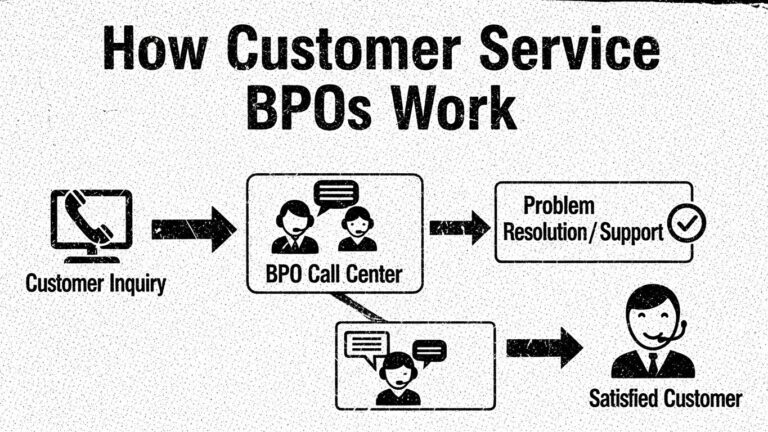
- How Customer Service BPOs Work
- Types of Customer Service BPO Models
- Role of Customer Service Representatives in BPOs
- What Good Customer Service Looks Like in a BPO Environment
- Benefits of Customer Service BPO for Businesses
- Common Challenges in Customer Service BPO Operations
- How Technology Supports Modern Customer Service BPOs
- Choosing the Right Customer Service BPO Partner
- The Future of Customer Service BPO
- Conclusion
Customer service BPO allows companies to deliver professional support without building and managing entire support departments internally. These partnerships provide access to trained agents, established infrastructure, and proven processes that would take years to develop independently. Yet the model also presents unique challenges around maintaining quality, ensuring consistency, and managing complex workflows across distributed teams.
This guide explains what customer service BPO actually means, how these operations work day-to-day, why businesses choose this model, and the evolving strategies that help BPOs deliver consistent, high-quality service at scale. Whether you’re considering outsourcing for the first time or looking to improve existing BPO partnerships, understanding the fundamentals helps you make informed decisions about customer service delivery.
What Is a Customer Service BPO?
Customer Service BPO Definition
A customer service BPO (business process outsourcer) is a third-party company that manages customer support interactions—such as phone calls, emails, live chat, and social media—on behalf of other businesses. These specialized firms provide the people, processes, and technology needed to handle customer communications, allowing client companies to focus resources on their core business activities while maintaining professional support operations.
The BPO (business process outsourcing) model extends beyond just customer service to include various business functions, but customer service represents one of the most commonly outsourced operations due to its specialized requirements and significant resource demands.
What Customer Service BPOs Actually Do
Customer service BPOs handle both inbound and outbound customer communication across multiple channels. Inbound work involves responding to customer-initiated contacts—answering questions, resolving problems, processing orders, and handling complaints. Outbound activities include making proactive calls for surveys, appointment reminders, follow-ups on previous interactions, or customer outreach campaigns.
Critically, BPO agents represent the client’s brand during these interactions. They don’t identify themselves as third-party representatives—to customers, they are the company. This means BPOs must thoroughly understand client products, follow specific brand guidelines for tone and messaging, and execute predefined processes and policies exactly as the client company would internally.
The channels BPOs manage have expanded significantly beyond traditional phone support. Modern customer service BPOs operate across phone systems for voice calls, email platforms for written correspondence, live chat interfaces for real-time text conversations, social media channels including Facebook, Twitter, and Instagram, and helpdesk systems that track issues from initial report through resolution. Managing consistency across these diverse channels presents both operational complexity and strategic importance.
How Customer Service BPOs Work
Understanding the mechanics of BPO operations reveals both the benefits and challenges of this model.
Client–BPO Relationship
The foundation of any BPO engagement is the outsourcing agreement that defines responsibilities, expectations, and performance standards. Service level agreements (SLAs) establish measurable commitments around response times, resolution rates, quality scores, and availability. These contractual obligations create accountability while providing frameworks for evaluating performance.
Brand, tone, and policy alignment ensure BPO agents deliver experiences consistent with the client company’s standards. This requires extensive documentation of how different situations should be handled, what language to use, when exceptions are appropriate, and how to escalate unusual circumstances. The challenge lies in translating the implicit knowledge that internal teams develop over time into explicit instructions that external agents can follow consistently.
Day-to-Day Operations
BPO agents typically log into client systems directly rather than using separate BPO-specific platforms. They access the same CRM tools, ticketing systems, and knowledge bases that internal support teams would use. This integration ensures agents have the information they need while creating seamless experiences for customers who can’t tell whether they’re speaking with internal staff or outsourced support.
Agents rely heavily on scripts, workflows, and knowledge bases that standardize how interactions are handled. Scripts provide consistent greetings, key messages, and closing statements. Workflows define step-by-step approaches to common scenarios. Knowledge bases store product information, troubleshooting guides, and policy details. The quality of these resources directly impacts the quality of support BPO agents can deliver.
Work gets prioritized based on urgency, customer tier, and queue management rules. High-priority tickets from enterprise customers receive immediate attention. Standard requests get handled in order received. Complex issues requiring specialized knowledge route to experienced agents with relevant expertise. This orchestration ensures resources focus where they create the most value.
Omnichannel Support in BPO Environments
Customers increasingly expect to start conversations on one channel and continue them on another without repeating information. Someone might begin troubleshooting via live chat, then call when the issue persists, expecting the phone agent to have full context of the chat conversation.
BPOs must maintain consistency across all touchpoints by ensuring information flows between channels seamlessly, agents can see complete customer histories regardless of which channel was used previously, messaging and service quality remain consistent whether customers use phone, email, or chat, and handoffs between channels don’t require customers to re-explain their situations. Achieving this consistency requires both technological integration and standardized processes that work identically across different communication methods.
Types of Customer Service BPO Models
Customer service BPO encompasses several distinct models that serve different business needs and priorities.
Front-Office vs Back-Office BPO
Front-office BPO handles customer-facing operations where direct interaction occurs. This includes customer service representatives answering questions and resolving issues, sales teams conducting outbound calling campaigns or processing inbound leads, and technical support specialists troubleshooting product problems. These roles directly shape customer perceptions and require strong communication skills alongside product knowledge.
Back-office BPO manages business operations that don’t involve direct customer contact. This includes HR functions like payroll processing and benefits administration, accounting operations such as invoice processing and financial reporting, and data processing tasks like data entry and record maintenance. While both types fall under BPO, customer service represents the front-office category where brand representation matters most.
Offshore, Nearshore, and Onshore BPO
Geographic location significantly impacts both cost and operational characteristics. Offshore BPO places operations in distant countries, typically offering the lowest costs but presenting challenges around time zones, language fluency, and cultural alignment. Common offshore locations include the Philippines, India, and various countries in Eastern Europe and Latin America.
Nearshore BPO uses neighboring countries with geographic proximity, offering moderate cost savings while minimizing time zone differences. For US companies, this often means operations in Mexico, Central America, or the Caribbean. Cultural similarities and compatible business hours create smoother coordination.
Onshore BPO keeps operations within the same country as the client, providing native language fluency, cultural alignment, and identical time zones at higher cost than offshore alternatives. This model works well for complex support requiring nuanced communication or for companies prioritizing domestic employment.
The right choice depends on balancing cost efficiency, quality requirements, language needs, and the complexity of customer interactions being handled.
Industry-Specific Customer Service BPOs
Some BPOs specialize in particular industries, developing deep expertise in sector-specific requirements. Fintech BPOs understand financial regulations, payment processing, and fraud prevention. Healthcare BPOs navigate HIPAA compliance, insurance verification, and medical terminology. E-commerce BPOs excel at order management, returns processing, and high-volume seasonal scaling. Telecommunications BPOs handle technical troubleshooting, plan changes, and network issues.
Industry specialization allows BPOs to provide higher-quality support for complex products and regulated environments while reducing training time since agents already understand industry fundamentals.
Role of Customer Service Representatives in BPOs
Understanding what BPO agents actually do reveals why consistency and process adherence matter so much in this environment.
Core Responsibilities of BPO Customer Service Agents
BPO agents handle customer inquiries spanning questions about products or services, billing concerns, technical problems, and account management. They address complaints and service recovery situations where customers are dissatisfied and relationships need repair. They follow scripts and workflows that define how different scenarios should be handled, ensuring consistency across agents and shifts. They escalate issues correctly when situations exceed their authority or expertise, knowing when to involve supervisors, specialized teams, or client company personnel.
The challenge is that agents must execute these responsibilities for client companies whose products, policies, and procedures they may understand less deeply than internal employees who live and breathe the business daily.
Importance of Scripts, Processes, and Compliance
BPO environments require agents to follow exact steps more rigidly than typical internal support teams. This discipline addresses several critical needs. Consistency across numerous agents working different shifts in potentially different locations ensures customers receive uniform service quality. Regulatory compliance in industries like healthcare, finance, and telecommunications demands specific procedures, disclosures, and documentation. Brand protection requires messaging that aligns with how client companies want to be represented. Quality assurance depends on standardized processes that can be measured and evaluated objectively.
The consequences of inconsistency or non-compliance include regulatory violations and associated penalties, customer complaints stemming from incorrect information or resolution, brand damage when experiences don’t match company standards, and operational inefficiency from mistakes requiring rework and escalation.
Training and Ramp-Up in BPO Environments
BPO operations often face higher agent turnover than internal support teams due to the nature of outsourced work, leading to continuous onboarding of new agents. Training must transform people with no knowledge of client products into competent representatives quickly to minimize the period where they’re being paid but not yet productive.
This creates pressure for repeatable processes that new agents can learn and follow reliably. The faster agents can reach acceptable performance levels, the more economically viable the BPO model becomes. Yet rushing training risks quality problems, so BPOs constantly balance speed and thoroughness.
What Good Customer Service Looks Like in a BPO Environment
Measuring success in BPO operations requires clear performance standards and consistent evaluation.
Key Performance Metrics
BPO partnerships typically track several core metrics. First Call Resolution (FCR) measures the percentage of issues resolved during initial contact without requiring follow-up calls or escalations. Higher FCR indicates effective problem-solving and reduces overall support costs. Average Handle Time (AHT) tracks how long interactions take from start to finish, balancing efficiency needs with quality requirements. Customer Satisfaction (CSAT) scores capture customer perceptions of service quality through post-interaction surveys. Quality assurance scores evaluate whether agents follow proper procedures, provide accurate information, and deliver professional service. Compliance rates track adherence to required processes, particularly important in regulated industries.
These metrics provide quantitative assessment of BPO performance, forming the basis for SLA compliance evaluation and continuous improvement initiatives.
Consistency at Scale
The unique challenge of BPO operations is maintaining quality across potentially hundreds or thousands of agents who may work different shifts, speak different languages as first languages, and support multiple client companies simultaneously. This scale creates higher risk of errors, inconsistencies, and quality variation than small internal teams face.
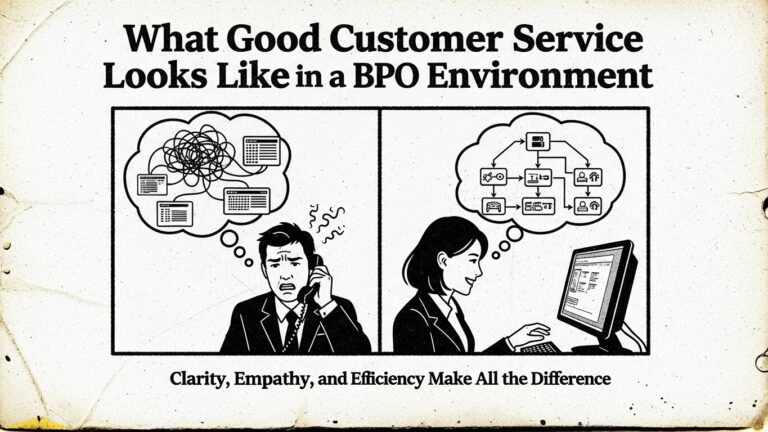
Standardized processes protect quality by ensuring every agent follows identical approaches to common scenarios. When procedures are clear, well-documented, and actively enforced, BPOs can deliver consistent experiences despite the complexity of large, distributed operations. When processes exist only as general guidance open to interpretation, consistency suffers and quality becomes unpredictable.
Benefits of Customer Service BPO for Businesses
Companies choose the BPO model for several compelling reasons that impact both economics and operational capability.
Cost Efficiency
The primary driver for many BPO decisions is reduced operational costs compared to building equivalent internal capabilities. BPOs achieve economies of scale by serving multiple clients, spreading infrastructure costs across larger operations. Labor costs in offshore and nearshore locations typically run significantly lower than domestic hiring. Reduced hiring expenses come from the BPO handling recruitment rather than the client company investing in sourcing, screening, and onboarding. Infrastructure savings emerge because companies don’t need to build call center facilities, purchase equipment, or implement support technology themselves.
These savings allow companies to provide better service than they could afford with internal teams alone, or to allocate budget toward other strategic priorities.
Scalability and 24/7 Coverage
BPOs provide flexibility that internal teams struggle to match. Seasonal demand fluctuations that characterize retail, tax services, or subscription businesses can be accommodated by scaling BPO capacity up during peak periods and down during slower times. Global customer bases spanning multiple time zones receive coverage without requiring internal staff to work nights and weekends. Rapid growth scenarios where support needs double or triple over months can be handled through BPO capacity rather than the time-intensive process of building internal teams.
This scalability eliminates the painful choice between understaffing that damages service quality and overstaffing that wastes resources during normal periods.
Access to Trained Talent and Technology
Established BPOs bring experienced agents who already understand customer service fundamentals, reducing the training burden to product-specific knowledge rather than teaching basic support skills from scratch. They provide established support systems including CRM platforms, call center technology, quality assurance tools, and workforce management capabilities that would require significant investment to build independently. They offer process expertise developed across years of operations and multiple clients, bringing best practices that companies might take years to discover through trial and error.
This expertise accelerates time-to-value, allowing companies to launch or expand support operations faster than internal buildout would permit.
Common Challenges in Customer Service BPO Operations
Despite significant benefits, the BPO model faces operational challenges that impact service quality and consistency.
Process Inconsistency Across Agents
Even with scripts and documented procedures, different agents often handle similar issues differently based on personal interpretation, experience level, or individual judgment. Knowledge gaps lead to mistakes when agents lack complete understanding of products, policies, or proper procedures. The challenge intensifies in BPO environments where agents may support multiple clients simultaneously, increasing the risk of confusion about which client’s procedures apply in each situation.
This inconsistency creates customer frustration when calling back yields different answers, operational inefficiency from mistakes requiring escalation or rework, and quality scores that vary significantly depending on which agent handles each interaction.
Training Time and Knowledge Retention
Long onboarding periods where new agents require weeks or months to reach acceptable performance levels increase costs and reduce flexibility. Even after completing training, agents forget steps under the pressure of live customer interactions, particularly for complex procedures or infrequently encountered scenarios. The continuous learning required as products change and procedures update creates ongoing training demands that never truly end.
These challenges make it difficult to maintain consistent quality, especially in high-turnover BPO environments where a significant percentage of agents are always relatively new.
Compliance and Quality Risks
Missed steps during procedures create compliance violations when required verifications, disclosures, or documentation don’t occur. Incorrect resolutions happen when agents misapply policies or misunderstand situations, leading to customer dissatisfaction and potential rework. Escalation failures occur when agents either escalate prematurely, wasting specialized resources, or delay escalation too long, frustrating customers who could have been helped sooner.
For client companies, these risks translate to regulatory exposure, customer churn, and damaged brand reputation despite the cost savings BPOs provide.
How Technology Supports Modern Customer Service BPOs
Progressive BPOs leverage technology not just for infrastructure but to address the consistency and quality challenges inherent in large-scale operations.
Process Guidance and Workflow Tools
A category of technology focuses specifically on guiding agents through processes step-by-step during actual customer interactions. These tools use interactive decision trees that present agents with questions and automatically determine next steps based on responses. Real-time process support provides guidance exactly when needed rather than expecting agents to remember or search for information while customers wait.
This approach differs from static documentation or knowledge bases that contain information but require agents to find, interpret, and apply it correctly under pressure. Guided workflows actively direct agents through each step, adapting to specific situations and preventing the inconsistency that emerges when everyone interprets procedures individually.
Ensuring Consistency and Accuracy at Scale
Process guidance technology addresses BPO-specific challenges directly. It reduces human error by enforcing correct procedures and preventing common mistakes like skipped steps or incorrect sequencing. It supports both new and experienced agents by providing expertise on-demand, compensating for knowledge gaps without requiring months of experience. It enables faster onboarding because agents can handle complex scenarios with guidance from their first week rather than needing to memorize everything before taking customer calls.
For BPOs managing hundreds or thousands of agents across multiple clients, these capabilities transform how consistency is maintained. Rather than hoping training sticks and agents remember everything, technology ensures execution matches standards regardless of individual agent experience or memory.
Using Process Shepherd to Guide BPO Agents
Process Shepherd represents this category of process-guidance platforms designed specifically for operational environments like BPOs. The platform creates interactive workflows that guide agents through customer interactions step-by-step, ensuring they follow client-specific procedures correctly every time.
For BPO operations, this addresses several critical needs. It maintains consistency across large teams by ensuring everyone follows identical processes regardless of shift, location, or experience level. It ensures compliance by embedding required steps into workflows that can’t be skipped or forgotten. It accelerates training by allowing new agents to contribute productively earlier with guided support rather than extended memorization periods. It supports multi-client operations by organizing workflows by client so agents always follow the correct procedures for whichever account they’re servicing.
The outcome is BPO operations that deliver the consistency and quality that make outsourcing viable while avoiding the errors and inconsistency that undermine client satisfaction with the model.
Choosing the Right Customer Service BPO Partner
Selecting a BPO partner requires evaluating capabilities that determine whether the relationship will succeed.
Key Factors to Consider
Relevant experience in your industry or with similar products indicates the BPO understands specialized requirements and can ramp up faster. Industry knowledge particularly matters in regulated sectors where compliance complexity demands specific expertise. Process maturity reveals whether the BPO operates with sophisticated, well-documented procedures or relies more on individual agent judgment. Technology stack determines what systems the BPO can integrate with and what capabilities they bring for quality, consistency, and efficiency.
Additionally, consider geographic and linguistic alignment based on your customer base, scalability to accommodate growth or seasonal fluctuations, and cultural fit regarding how the BPO approaches quality, compliance, and client relationships.
Questions to Ask Before Outsourcing
Productive due diligence includes asking: How do you ensure agents follow processes consistently across all interactions? What technology do you use to guide agents and prevent errors? How is quality monitored and what percentage of interactions get reviewed? How is training structured and how long until new agents reach full productivity? How do you handle situations where clients have different or conflicting procedures? What visibility will we have into performance, quality issues, and operational metrics?
The answers reveal whether the BPO has sophisticated approaches to the consistency and quality challenges inherent in the model or relies primarily on hiring and hoping for the best.
The Future of Customer Service BPO
The BPO industry continues evolving in response to changing customer expectations and available technology.
Automation increasingly supports agents rather than replacing them, handling routine tasks and information lookup while humans focus on problem-solving and relationship building. Process standardization becomes more sophisticated as tools like interactive workflows make it practical to standardize even complex procedures that previously relied on individual agent expertise. AI-assisted agent guidance provides real-time suggestions, relevant knowledge base articles, and next-best-action recommendations that help agents deliver better service faster.
The trajectory points toward BPOs as high-tech operations leveraging advanced tools to deliver consistent quality at scale, moving away from the traditional perception of BPOs as simply low-cost labor pools. Companies choosing BPO partners increasingly evaluate technological sophistication alongside cost, recognizing that the right technology investments enable both quality and efficiency rather than forcing trade-offs between them.
Conclusion
Customer service BPO provides businesses with access to professional support operations without the investment and complexity of building internal teams. The model offers compelling benefits including cost efficiency, operational scalability, and access to established expertise. Yet delivering consistent, high-quality service through BPO partnerships requires addressing inherent challenges around process consistency, training effectiveness, and quality maintenance across distributed teams.
Success increasingly depends on combining skilled agents with technology that guides execution rather than merely hoping training and documentation ensure compliance. Interactive workflows, decision support tools, and process guidance platforms transform how BPOs operate by enforcing consistency, reducing errors, and enabling faster onboarding. As the industry matures, the BPOs thriving are those investing in both people and the systems that help those people perform reliably at scale.
For companies considering or currently using customer service BPO, the key insight is that strong processes backed by technology that actively guides execution create the foundation for successful outsourcing relationships. When agents have clear guidance for every situation, consistency becomes achievable even across large, geographically distributed operations. That combination—skilled people plus structured support—defines the future of customer service BPO.