If you’re here, you’re learning about customer service duties probably because you are writing a job description, updating your resume, training a new team, or trying to understand what customer service really involves. You’ve likely seen dozens of generic lists that say things like “answer phones” and “be friendly.”
This guide is different. We’re going beyond the bullet points to show you what customer service duties actually look like in real business operations—and how modern teams execute them consistently, even when things get complicated.
What Are Customer Service Duties?

Customer service duties are the specific responsibilities and actions that customer service employees perform to help customers, solve problems, and maintain relationships. These duties go beyond just “being helpful”—they’re the concrete tasks that keep your business running smoothly and your customers satisfied.
Customer Service Duties, Explained
Customer service duties are the day-to-day responsibilities that service representatives perform to support customers. These include responding to inquiries, resolving complaints, processing orders, updating records, documenting interactions, and providing information. When executed well, these duties lead to higher customer satisfaction, better retention rates, and consistent service quality across your entire team.
Why Customer Service Duties Matter in Real Business Operations
Here’s something most articles won’t tell you: customer service duties aren’t just tasks to check off a list. They’re activities that directly shape your customer’s experience with your company.
When customer support responsibilities are performed consistently, customers stay loyal. When they’re done poorly or inconsistently, people leave—and they tell others about it.
Customer care responsibilities also expose gaps in your operations. If your agents struggle with the same duties repeatedly, that’s not a people problem. It’s usually a process problem. Maybe the steps aren’t clear. Maybe the training didn’t stick. Or maybe your team is being asked to remember too much while juggling live conversations.
Understanding your customer care duties isn’t just about knowing what needs to be done. It’s about building systems that help your team do those duties well, every single time.
Core Customer Service Duties (Grouped by Function)
Let’s break down the main customer service duties by what they actually accomplish. This isn’t a top-10 list—it’s a functional look at how customer service work is really organized.
Communication and Engagement Duties
These are the duties that involve direct interaction with customers:
- Responding to customer inquiries across phone, email, chat, and social media
- Managing conversations while maintaining appropriate tone and professionalism
- Setting clear expectations about resolution timelines
- Providing status updates on ongoing issues
- Communicating policy changes or product updates
In a contact center, this means guiding agents through the correct responses while maintaining tone and accuracy, even under pressure. The challenge isn’t just what to say—it’s saying the right thing at the right time, consistently, across hundreds of interactions per day.
This is where many teams struggle. Agents know they should communicate well, but when they’re handling back-to-back calls with different scenarios, consistency becomes hard without the right support.
Problem-Solving and Resolution Duties
These duties focus on actually fixing customer issues:
- Diagnosing what’s wrong based on customer descriptions
- Asking the right follow-up questions to understand the full situation
- Applying the correct resolution path for each type of issue
- Escalating complex cases to the appropriate department or supervisor
- Following up to ensure the problem was fully resolved
Here’s a real-world example: In telecom or utilities, one wrong step can escalate complaints or cause compliance issues. An agent might accidentally promise something the company can’t deliver, or miss a critical troubleshooting step that would have solved the problem.
The best customer service teams don’t rely on agents to memorize every possible scenario. They use decision trees and step-by-step resolution paths that reduce reliance on memory and ensure the right outcome every time.
Order, Account, and Record Management Duties
These are the administrative customer care duties that keep operations running:
- Processing customer orders and returns
- Updating customer account information
- Managing billing inquiries and payment processing
- Ensuring all customer data is accurate and current
- Maintaining detailed records of all interactions
Errors in this area often don’t come from lack of effort. They come from unclear processes. An agent might update the wrong field, skip a step they didn’t realize was critical, or enter information in an inconsistent format.
When these duties go wrong, the consequences cascade. A small data entry mistake can lead to billing errors, shipping delays, or compliance violations.
Feedback, Documentation, and Improvement Duties
Modern customer service isn’t just reactive—it’s also about continuous improvement:
- Logging all customer interactions with appropriate detail
- Collecting and recording customer feedback
- Flagging recurring issues or common pain points
- Contributing to knowledge base articles
- Reporting process gaps or training needs
This is where operational visibility becomes critical. When you can see where agents consistently struggle, you can improve the process. When you track which issues come up most often, you can prevent them proactively.
Teams using guided workflows get built-in visibility into where agents pause, where they ask for help, and which steps cause the most confusion. That data becomes fuel for better processes.
Proactive Customer Service Duties
The best customer service teams don’t just react—they prevent:
- Following up with customers after purchases or resolutions
- Reaching out proactively when issues are detected
- Checking in with at-risk accounts
- Educating customers about features they’re not using
- Preventing problems before they escalate into complaints
This is what separates modern customer service from basic reactive support. It requires agents to have the bandwidth and clarity to look ahead—which is impossible when they’re drowning in procedures they’re trying to remember.
Real-World Examples of Customer Service Duties in Action
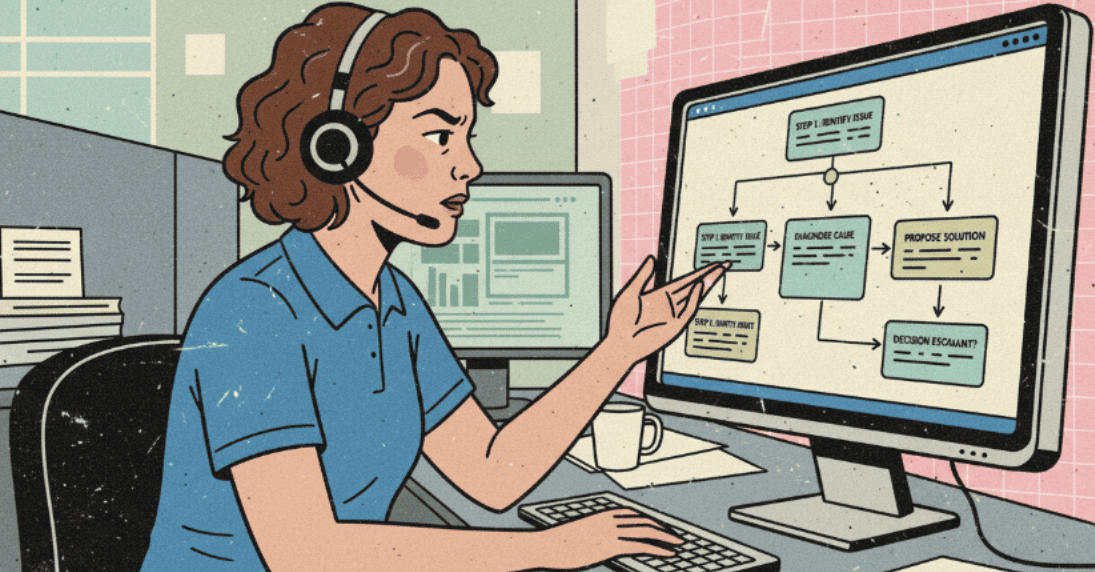
Let’s look at how these duties play out in real business scenarios.
Example: Customer Service Duties in a Call Center
A customer calls in frustrated because they were charged twice for the same order.
Here’s what happens in a well-run operation:
- The agent greets the customer and asks guided questions to understand the issue
- The system walks the agent through verification steps to confirm the customer’s identity
- The agent follows the correct resolution path: checking the order history, confirming the duplicate charge, and initiating a refund
- The interaction is documented automatically with all relevant details
- A follow-up is scheduled to ensure the refund posts correctly
Notice what didn’t happen: The agent didn’t have to remember 47 different billing scenarios. They didn’t have to dig through a manual. They didn’t have to guess which form to fill out. The process guided them to the right outcome.
Example: Customer Service Duties in a Regulated Industry
In banking, insurance, or healthcare administration, customer service duties carry extra weight. Compliance isn’t optional, and errors can have serious consequences.
Consider a customer calling their health insurance provider about a denied claim. The customer service representative needs to:
- Verify identity according to HIPAA requirements
- Access the claim within compliance boundaries
- Explain the denial reason using specific, accurate language
- Follow the exact escalation path if the customer disputes the decision
- Document everything in a way that meets regulatory standards
There’s zero tolerance for mistakes here. Agents can’t afford to miss a compliance step or use the wrong phrasing. This is why many regulated industries are moving toward guided processes that enforce the right steps while still allowing agents to communicate naturally with customers.
Customer Service Duties vs Customer Service Skills
A lot of people confuse these two, so let’s clear it up.
Duties Define What Is Done. Skills Define How It’s Done.
Customer service duties are the responsibilities and actions you’re expected to perform: answer questions, resolve complaints, process returns, update records.
Customer service skills are the abilities that make you good at those duties: communication, empathy, patience, problem-solving, active listening.
Here’s why this matters: You can hire someone with excellent skills—friendly, empathetic, quick learner—and they can still struggle with their duties if the processes aren’t clear.
Many businesses invest heavily in skills training (communication workshops, empathy exercises, conflict resolution) but don’t give their teams clear processes for actually executing their duties. The result? Skilled people who are inconsistent because they’re working from memory, not guidance.
The best approach supports duties with clear processes and then trains skills on top of that foundation.
How Customer Service Duties Differ by Role and Industry

Not all customer service looks the same. The duties vary significantly based on your industry and business model.
Call Centers and Support Teams
These environments are characterized by:
- High volume of interactions
- Need for speed without sacrificing quality
- Scripted workflows that still require flexibility
- Strong emphasis on consistency across large teams
The challenge here is scale. When you have 50 or 500 agents, even small inconsistencies multiply into major customer experience gaps.
Banks, Financial Services, and Utilities
Customer service duties in these industries include:
- Compliance-driven interactions with strict requirements
- Complex escalation paths that must be followed exactly
- Zero tolerance for errors that could lead to regulatory issues
- High-stakes conversations where one mistake can cost the company significantly
These teams need more than good training—they need real-time guidance that prevents errors before they happen.
Retail, Tech, and SaaS Companies
These businesses focus on:
- Relationship-building and personalization
- Omnichannel support across multiple platforms
- Product education and feature adoption
- Turning support interactions into growth opportunities
Customer care duties here are less about strict compliance and more about creating positive experiences that lead to retention and upsells.
Customer Service Duties in African and Emerging-Market Businesses
This is an angle most competitors miss. In markets across Africa and other emerging economies, customer service teams face unique challenges:
- Infrastructure constraints that require creative solutions
- High customer sensitivity to service quality
- Rapid scaling that outpaces traditional training methods
- Need for clarity and consistency despite resource limitations
Teams in these markets can’t afford lengthy onboarding or inconsistent service. They need systems that bring new agents up to speed quickly and keep experienced agents consistent—even when operations are growing fast.
Modern Customer Service Duties in 2026 and Beyond

Customer service has evolved significantly, and so have the duties that come with it.
Omnichannel Communication Duties
Customer service duties now span multiple platforms:
- Traditional phone support
- Email correspondence
- Live chat on websites
- Messaging apps (WhatsApp, Telegram, Facebook Messenger)
- Social media interactions
- SMS support
Agents are expected to deliver the same quality across all these channels while managing context switching and different response time expectations.
CRM Usage and KPI Tracking
Modern customer support responsibilities include:
- Updating CRM systems in real-time
- Tracking key metrics like first response time and resolution time
- Monitoring customer satisfaction scores
- Contributing to team performance goals
This administrative layer adds to the cognitive load—another reason why clear, guided processes matter.
Automation, AI, and Guided Workflows
The most forward-thinking teams are reimagining customer care duties as:
- Supported by automation for repetitive tasks
- Augmented by AI for faster information retrieval
- Executed through guided processes that ensure consistency
This isn’t about replacing people. It’s about giving them the support they need to perform their duties exceptionally well.
How Process Shepherd Helps Teams Perform Customer Service Duties Better
This is where everything comes together.
Turning Customer Service Duties into Guided Workflows
Process Shepherd takes the duties we’ve discussed—communication, problem-solving, documentation, resolution—and breaks them into executable, step-by-step workflows.
Here’s what that means in practice:
- Agents don’t have to memorize complex procedures
- Every interaction follows the correct path
- New team members can handle complex cases from day one
- Training time drops by up to 80%
Instead of relying on memory or hunting through knowledge bases during live calls, agents are guided through each duty in real time.
Supporting Consistency Without Scripting People
Here’s a critical distinction: Process Shepherd provides structure without turning your team into robots.
The platform guides agents through:
- The right questions to ask
- The correct steps to follow
- The appropriate escalation paths
- Proper documentation requirements
But it doesn’t script their exact words. Agents still communicate naturally—they just have confidence that they’re following the right process.
This means:
- New agents perform like experienced ones
- Experienced agents don’t burn out from decision fatigue
- Everyone delivers consistent outcomes without sounding scripted
See how guided workflows support customer service teams in real time. [Process Shepherd offers a free trial with no credit card required.]
When Businesses Should Rethink How Customer Service Duties Are Performed
Here are the warning signs that your current approach isn’t working:
Long onboarding times: If it takes months for new agents to feel confident, your processes aren’t clear enough.
High error rates: If mistakes keep happening despite training, the issue is structural, not individual.
Inconsistent service quality: If outcomes vary wildly between agents, they’re working from different mental models.
Heavy reliance on tribal knowledge: If only certain people know how to handle specific situations, that knowledge needs to be systematized.
Agent stress and burnout: If your team is constantly anxious about making mistakes, they’re carrying too much cognitive load.
These aren’t people problems. They’re process problems. And process problems can be solved with the right tools.
Customer Service Duties Are About Execution, Not Just Job Descriptions
Customer service duties aren’t just bullet points on a job posting. They’re the real work that determines whether customers stay or leave, whether your team thrives or struggles, and whether your business scales smoothly or chaotically.
The traditional approach—hire good people, train them once, and hope for consistency—doesn’t work at scale. Real performance depends on supporting your team during execution, not just during onboarding.
Modern customer service requires real-time guidance that helps agents perform their duties with clarity and confidence. It requires systems that bridge the gap between training and execution, between knowing what to do and actually doing it consistently.
Process Shepherd was built to be that bridge. It turns customer service duties from overwhelming checklists into guided, executable workflows that help your team deliver exceptional service—every single time.
Explore how Process Shepherd helps teams execute customer service duties with clarity and confidence. Start your free trial today at processshepherd.com.