Training for Call Center Agents: A Complete Guide for Modern Support Teams

Training for Call Center Agents Explained
Call center agent training is a structured process that teaches agents how to communicate clearly, use support tools, and resolve customer issues efficiently. It combines product knowledge, call etiquette, and hands-on practice with systems like CRM and ticketing software to help agents deliver consistent, high-quality customer service.
Table of Contents
- Training for Call Center Agents Explained
- What Is Training for Call Center Agents?
- Why Call Center Agent Training Is Critical for Customer Experience
- Core Components of Effective Call Center Agent Training
- How to Build a Call Center Agent Training Program
- Must-Have Call Center Training Materials
- Proven Training Methods for Call Center Agents
- The 5 Stages of Call Center Agent Training
- What Are the Most Important Skills Every Call Center Agent Needs?
- Challenges of Traditional Call Center Training
- How Process Shepherd Improves Training for Call Center Agents
- Measuring the Success of Call Center Agent Training
- Frequently Asked Questions About Call Center Agent Training
Customer expectations have never been higher. In 2026, customers expect fast, accurate, and empathetic support across every interaction. They don’t tolerate long hold times, scripted responses, or being transferred multiple times. Meanwhile, call center agents face increasingly complex issues as simple questions migrate to self-service channels, leaving human agents to handle the challenging cases that require judgment, empathy, and deep product knowledge.
Training for call center agents directly impacts every metric that matters: customer satisfaction, first-call resolution, efficiency, and retention. When agents are well-trained, they resolve issues faster, create positive brand impressions, and stay with your organization longer. When training falls short, customers notice immediately through longer resolution times, inconsistent service quality, and the frustration of explaining their problems multiple times.
Structured call center training is no longer optional—it’s a strategic necessity. This comprehensive guide covers everything you need to build, deliver, and continuously improve training programs that prepare agents for the realities of modern customer support.
What Is Training for Call Center Agents?
Training for call center agents is the structured process of equipping support representatives with the knowledge, skills, tools proficiency, and process understanding they need to deliver effective customer service. This encompasses product and service knowledge so agents understand what they’re supporting, communication and empathy skills for connecting with customers, technical proficiency with CRM systems and call center software, and standardized processes for call handling and escalation. Effective training includes both initial onboarding that prepares new hires for their first customer interactions and ongoing development that keeps experienced agents sharp as products, policies, and customer expectations evolve.
Why Call Center Agent Training Is Critical for Customer Experience
Call center agents represent the human face of your brand. For many customers, a support call is their only direct interaction with a real person from your company. That conversation shapes their entire perception of your brand, influencing whether they remain loyal customers or begin exploring alternatives. The quality of that interaction depends almost entirely on how well you’ve trained your agents.
Improve Customer Satisfaction and Loyalty
Well-trained agents resolve issues faster by knowing where to find information, understanding common problems, and applying proven troubleshooting techniques. They reduce repeat calls by addressing root causes rather than symptoms and by confirming resolution before ending conversations. They create positive brand impressions through professionalism, empathy, and confidence that reassures customers they’re in capable hands. Research consistently shows that customer satisfaction correlates more strongly with agent competence and empathy than with speed alone.
Increase Agent Efficiency and Confidence
Training reduces hesitation during calls by giving agents clear frameworks for handling different scenarios. Agents who know the process don’t waste time figuring out next steps or searching for information while customers wait. Improved decision-making comes from understanding when to troubleshoot further, when to escalate, and when to offer alternatives. Lower average handling time results naturally when agents work confidently rather than second-guessing themselves or asking supervisors for guidance on routine issues.
Reduce Agent Turnover and Burnout
Poor training creates stress by throwing agents into customer conversations before they’re ready. Low confidence from inadequate preparation leads to emotional exhaustion as agents struggle through every interaction. High attrition follows as agents quit rather than endure the daily anxiety of feeling unprepared. Conversely, comprehensive training improves morale by giving agents the competence and confidence to succeed, which translates directly to better retention rates and lower recruitment costs.
Ensure Compliance and Consistent Service Delivery
Consistent training ensures all agents follow the same procedures for data protection, understand call recording disclosure requirements, and know how to handle sensitive customer information. This consistency protects your organization from regulatory violations while ensuring customers receive the same quality of service regardless of which agent answers their call or which shift handles their inquiry. Standardized processes also make quality assurance easier and more meaningful.
Core Components of Effective Call Center Agent Training
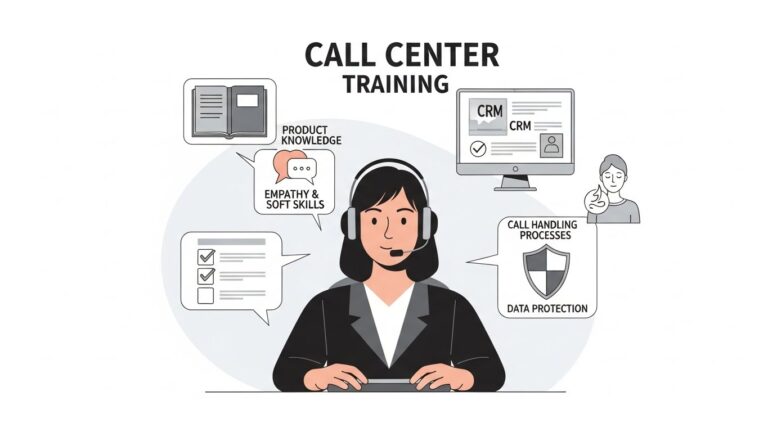
Effective call center agent training rests on several foundational pillars that work together to create competent, confident representatives. Each component addresses a critical aspect of agent performance that directly impacts customer experience and operational efficiency.
Product and Service Knowledge
Agents must thoroughly understand the products and services they support, including features, common use cases, and typical problems customers encounter. They need comprehensive knowledge of policies and service level agreements so they can set accurate expectations and know what they can offer customers. Keeping agents updated on product changes, new features, and policy revisions prevents the common problem where customers know more about recent updates than the agents helping them. Outdated knowledge hurts resolution quality and damages credibility when customers must correct their support agents.
Soft Skills and Emotional Intelligence
Technical knowledge alone doesn’t create great customer service. Agents need empathy to understand customer frustration and respond with genuine concern rather than scripted sympathy. Active listening skills help agents identify the real problem beneath what customers initially describe. Managing frustrated or angry customers requires emotional intelligence to de-escalate tensions while still driving toward resolution. High-pressure calls demand the ability to remain calm, patient, and professional even when customers are upset or hostile.
Technical Skills and Call Center Tools
Modern call center agents work with multiple systems simultaneously during customer interactions. They must master CRM platforms that store customer history and account details, ticketing systems that track issues from report to resolution, telephony software with features like hold, transfer, and conference calling, and increasingly, AI-assisted features that provide suggested responses or relevant knowledge base articles. Technical fluency with these tools directly impacts efficiency—agents who struggle with software can’t focus fully on helping customers.
Call Handling and Escalation Techniques
Consistent call handling starts with professional greetings that set a positive tone. Agents need training on documenting interactions accurately and completely so future agents have context. Escalation procedures must be clear so agents know when issues exceed their authority or expertise and how to transfer customers smoothly without making them repeat information. These standardized techniques ensure professionalism across all customer interactions regardless of individual agent style.
Compliance, Security, and Data Protection
Agents handle sensitive customer information during every call, from payment details to personal identification numbers. Training must cover call recording disclosures required by law, proper handling of payment card information to maintain PCI compliance, and data protection practices that prevent accidental exposure of customer information. Compliance failures create regulatory risk and damage customer trust, making this training component non-negotiable.
Stress Management and Agent Resilience
Call center work involves emotional fatigue from handling multiple challenging conversations daily, high call volumes during peak periods that create pressure to resolve issues quickly, and the occasional abusive customer who tests patience and professionalism. Training that addresses stress management and builds resilience prepares agents for the psychological demands of the role, helping them maintain performance and wellbeing through difficult shifts.
How to Build a Call Center Agent Training Program
Building an effective training program requires structure, clear ownership, and careful planning. The following framework provides a systematic approach to creating training that actually prepares agents for success.
Define Roles and Responsibilities
Successful training programs have clear ownership and accountability. Identify who owns training program development, delivery, and maintenance—typically training managers or learning and development teams. Determine how quality assurance teams contribute by identifying knowledge gaps and training opportunities from call reviews. Clarify how supervisors support ongoing coaching and reinforcement of training concepts. Using a RACI framework (Responsible, Accountable, Consulted, Informed) prevents the common problem where everyone assumes someone else is handling training updates or addressing performance gaps.
Create and Maintain Training Materials
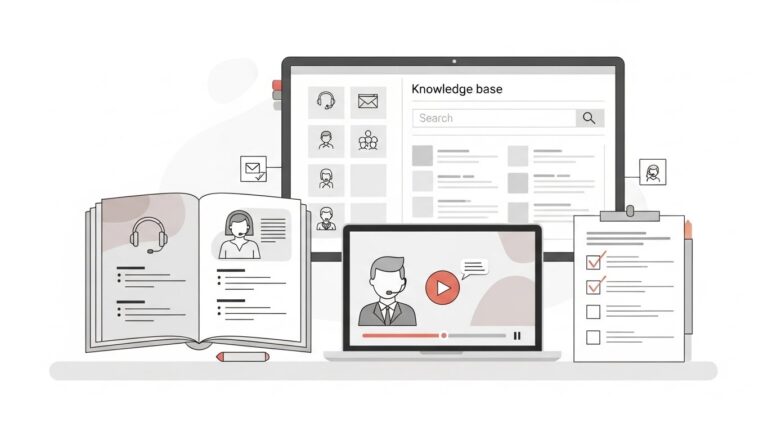
Comprehensive training materials include written documentation for policies, procedures, and reference information agents can review at their own pace. Video content works well for demonstrating call handling techniques, software navigation, and complex processes that benefit from visual explanation. Knowledge bases provide searchable resources agents can access during calls when they need quick answers. The critical challenge is maintaining these materials—products change, policies evolve, and software gets updated. Establish clear processes for regular content reviews and updates so training materials stay current rather than becoming outdated liabilities.
Choose the Right Training and Workforce Tools
Technology supports training through quality assurance platforms that identify coaching opportunities by analyzing call recordings and evaluating agent performance. Workforce engagement management tools help schedule training sessions without disrupting coverage requirements. Performance tracking systems measure how training impacts key metrics over time. The goal is selecting tools that integrate with existing systems and genuinely support training objectives rather than adding complexity.
Must-Have Call Center Training Materials
Effective training requires diverse materials that accommodate different learning styles and use cases. The following resources form the foundation of most successful training programs.
Call Center Training Templates
Templates accelerate training program development by providing standardized structures for common training scenarios. They ensure consistency across training sessions and trainers by establishing a common framework everyone follows. Templates also make it easier to scale training as you grow, allowing you to onboard multiple cohorts simultaneously while maintaining quality standards.
Call Center Training Courses
Training courses can be self-paced, allowing agents to learn at their own speed and revisit difficult concepts, or instructor-led for topics that benefit from discussion and real-time feedback. Internal courses cover company-specific processes and systems, while external courses from industry organizations provide broader customer service skills and certifications. The right mix depends on your specific training needs and agent learning preferences.
Call Center Training Videos
Videos excel at demonstrating visual processes like navigating software interfaces or demonstrating proper call handling techniques. Scenario-based examples show agents how to handle specific situations, from processing returns to de-escalating angry customers. Videos also accommodate visual learners who struggle with text-heavy training materials and can be paused and replayed as needed for complex topics.
Internal Knowledge Bases and Help Centers
Searchable internal knowledge bases give agents instant access to information during live calls without putting customers on hold. Well-organized help centers reduce the cognitive load of memorizing every policy detail by making information easy to find when needed. The best knowledge bases integrate directly into agent workflows so finding answers doesn’t require switching between multiple systems.
Proven Training Methods for Call Center Agents
How you deliver training matters as much as what you teach. Different methods serve different purposes throughout an agent’s development journey.
Onboarding and Foundational Training
The first week focuses on orientation to company culture, basic product knowledge, and system access. The first month builds on this foundation with deeper product training, introduction to common call scenarios, and increasing complexity in mock exercises. Frontloading critical information while avoiding overwhelming new hires requires careful pacing and regular knowledge checks to ensure retention.
Role-Playing, Mock Calls, and Simulations
Practice builds confidence before agents face real customers. Role-playing exercises with trainers or peers allow agents to rehearse call handling techniques in a safe environment. Mock calls using realistic scenarios prepare agents for the variety of situations they’ll encounter. Simulations of difficult customer interactions—angry callers, complex technical issues, or unusual requests—help agents develop problem-solving skills without the pressure of a live customer waiting for answers.
Shadowing, Nesting, and Mentorship
Learning by observation accelerates skill development. New agents shadow experienced performers to see how experts handle calls, manage systems, and navigate challenges. Nesting periods where new agents take calls with mentors listening and providing immediate feedback bridge the gap between training and independence. Ongoing mentorship relationships give newer agents someone to turn to for advice beyond their immediate supervisor.
Feedback, QA Reviews, and Coaching
Continuous improvement requires regular feedback on actual performance. Quality assurance reviews identify specific areas where agents need development. Coaching sessions turn these insights into actionable improvement plans with practice, discussion, and follow-up. The most effective feedback is specific, timely, and focused on behaviors agents can control and improve.
Continuous Learning and Upskilling
Training doesn’t end after onboarding. Ongoing skill development addresses new products, changed policies, and emerging customer expectations. Regular refresher training prevents knowledge decay and reinforces critical concepts. Advanced training pathways give high-performing agents opportunities to develop specialized skills or move into new roles.
Asynchronous and Remote Training
Remote and distributed teams require training approaches that don’t depend on everyone being in the same place at the same time. Asynchronous training materials allow agents across time zones to learn when it fits their schedule. Virtual instructor-led sessions using video conferencing provide real-time interaction without travel requirements. Recording training sessions lets agents who miss live sessions catch up and allows everyone to review complex topics.
The 5 Stages of Call Center Agent Training
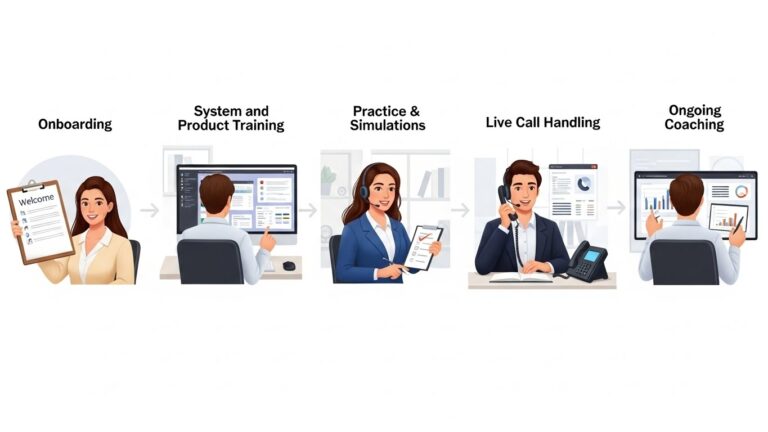
Call center agent training typically progresses through five distinct stages:
- Pre-boarding: Initial paperwork, system provisioning, and welcome materials before the first day
- Initial Training: Intensive classroom or virtual instruction covering products, systems, and processes
- Practice and Simulation: Role-playing, mock calls, and scenario-based exercises in controlled environments
- Nesting: Taking live calls with immediate supervisor support and real-time coaching
- Ongoing Development: Continuous coaching, refresher training, and skill advancement throughout tenure
What Are the Most Important Skills Every Call Center Agent Needs?
Seven skills separate effective call center agents from those who struggle:
Active Listening: Understanding not just what customers say but what they mean, including unspoken concerns and underlying issues.
Communication Clarity: Explaining solutions in language customers understand without jargon or technical complexity that creates confusion.
Empathy: Genuinely connecting with customer frustration and responding with authentic concern rather than scripted sympathy.
Problem-Solving: Thinking critically to diagnose issues, identify root causes, and develop solutions even for scenarios not covered in training.
Technical Proficiency: Navigating multiple systems efficiently while maintaining conversation flow with customers.
Patience: Remaining calm and professional through difficult conversations without rushing customers or showing frustration.
Adaptability: Adjusting communication style and approach based on individual customer needs and personality types.
Challenges of Traditional Call Center Training
Despite significant investments in training, many organizations struggle with common challenges that undermine effectiveness.
Long onboarding periods that extend eight weeks or more delay time-to-productivity and increase costs. Information overload from cramming too much content into initial training leads to poor retention—agents simply can’t remember everything taught in their first few weeks. Knowledge decay occurs naturally as time passes between training and actually needing specific information on calls. Inconsistent execution happens when agents interpret training differently or when trainers deliver content with varying emphasis and quality. Training materials become outdated as products change but documentation lags behind, leaving agents to learn about updates informally from colleagues rather than through structured training.
These challenges create a gap between training completion and actual competence. Agents finish programs feeling overwhelmed rather than confident, and real learning happens through trial and error on live customer calls rather than in structured training environments.
How Process Shepherd Improves Training for Call Center Agents
Modern approaches to call center agent training address traditional challenges by embedding training directly into daily work rather than treating it as a separate phase that ends before agents start taking calls. Process Shepherd represents this evolution by functioning as a training enabler and support system that guides agents through complex processes in real-time.
Guided Workflows as Embedded Training
Rather than expecting agents to remember everything from training, Process Shepherd provides step-by-step guidance during actual customer interactions. Interactive decision trees walk agents through complex processes, presenting relevant information exactly when needed. This approach transforms training from something that happens before work into something embedded within work itself. Agents learn by doing with support, which research shows creates better retention than classroom instruction alone.
Real-Time Decision Support During Live Calls
When agents encounter unfamiliar scenarios, they need answers immediately—customers won’t wait while agents search knowledge bases or ask supervisors. Process Shepherd provides contextual help at each decision point, showing agents their options and the implications of different choices. This real-time support helps agents act correctly in the moment while simultaneously reinforcing their learning for future similar situations.
Reduced Onboarding and Ramp-Up Time
Guided workflows allow new agents to handle complex calls earlier in their tenure because they have step-by-step support rather than relying purely on memory. This dramatically reduces time-to-productivity, allowing agents to contribute meaningful work while still learning. Organizations using this approach report onboarding reductions from 8-12 weeks to 3-4 weeks for equivalent competency levels.
Consistent Process Execution Across Teams
When processes exist in guided workflow form, every agent follows the same steps regardless of when they were trained, which trainer they had, or which shift they work. This consistency ensures customers receive the same quality of service whether they call at 9 AM or 9 PM, whether they reach a new agent or a veteran. It also simplifies quality assurance since evaluators can verify that agents followed the established process.
Training That Scales With Complexity
Some processes—compliance-heavy workflows, edge cases, infrequently encountered scenarios—are difficult to train because they’re too complex to remember or too rare to practice. Guided workflows handle these situations by providing detailed guidance when needed without requiring agents to memorize procedures they might use once a month. This allows organizations to standardize and train on processes that previously relied on supervisor involvement or tribal knowledge from experienced agents.
Measuring the Success of Call Center Agent Training
Training investments must demonstrate impact on business outcomes. The following metrics connect training effectiveness to results that matter.
Key Performance Indicators (KPIs)
Quality Assurance Scores measure whether agents follow processes correctly and deliver the service level your organization defines. Rising QA scores after training indicate agents are applying what they learned.
Average Handle Time (AHT) decreases when agents work more efficiently through better product knowledge and tool proficiency.
First Call Resolution (FCR) improves when agents can solve problems completely without callbacks or escalations.
Repeat Calls decline as agents address root causes rather than symptoms.
Customer Satisfaction (CSAT) scores reflect the customer perspective on whether training translated to better experiences.
Using Insights to Continuously Improve Training
Training should improve based on results, not remain static. Analyze which topics correlate with lower performance scores to identify where training needs strengthening. Review calls from recent graduates to understand what they struggle with despite completing training. Gather feedback from agents about what training prepared them well and where they felt underprepared. Use this information to iterate on training content, adjust delivery methods, and update materials. The best training programs operate as continuous improvement systems rather than fixed curricula.
Frequently Asked Questions About Call Center Agent Training
How long should call center agent training take?
Training duration depends on industry complexity and role scope, but most programs run 3-8 weeks. Simple retail support might need only 2-3 weeks, while technical or regulated industries like healthcare or financial services often require 8-12 weeks. The key is balancing thoroughness with speed—agents need enough preparation to succeed, but extended training delays productivity and increases costs.
What’s the difference between call center training and ongoing coaching?
Training focuses on building foundational knowledge and skills before or shortly after agents start taking calls. Coaching is continuous performance improvement through feedback, targeted skill development, and addressing individual performance gaps. Training prepares agents for the job; coaching makes good agents great.
How often should call center agents receive refresher training?
Quarterly refresher training on critical topics helps combat knowledge decay, with additional sessions when products, policies, or systems change significantly. High-turnover topics like new features or compliance updates need more frequent reinforcement, while stable fundamentals may only need annual review.
Can you train call center agents remotely?
Yes, remote training is now standard practice using video conferencing for live instruction, recorded training videos for asynchronous learning, virtual simulation tools for practice, and screen sharing for system training. The main challenge is creating engagement and connection without in-person interaction, which requires more interactive approaches than simply broadcasting lectures.
What’s the biggest mistake companies make with call center training?
The most common mistake is treating training as a one-time event that ends when agents start taking calls. Effective training is continuous, combining initial onboarding with ongoing coaching, regular refreshers, and embedded support during actual work. Companies that invest heavily in initial training but neglect ongoing development see rapid skill decay and performance degradation.

Nola Neven
Nola Neven is a content strategist in the CX space, focused on turning complex operational problems into clear, credible content that people actually read, reference, and share.
Her work sits where content and operations meet. She spends her time understanding how contact centers and help desks really function day to day, where workflows break down, where teams rely on workarounds, and where systems quietly slow everything down.